


AI-Generated Journalism Software Advancements and Who Controls News
Written with AI assistance under our editorial guidelines
AI-generated journalism software now rapidly produces news content through natural language generation and large language models, fundamentally reshaping newsrooms and editorial workflows. The critical question centers on who controls these systems and whose interests they serve, as algorithms increasingly synthesize information faster than human reporters while raising concerns about misinformation, bias, and the concentration of journalistic power in the hands of technology companies.
In 2025, something uncanny pulses just below the surface of the world’s news cycle. Where seasoned reporters once pounded keys in smoke-filled rooms, algorithms now scan, analyze, and synthesize at a velocity that would leave any old pressman reeling. AI-generated journalism software advancements aren’t just a technical footnote—they’re the story itself, rewriting what it means to report, curate, and trust news. The debate isn’t whether these tools are coming for the newsroom—they’re already here. The real question is: whose interests do they serve, and at what cost? From viral misinformation scares to the quiet efficiency gains behind the scenes, the narrative is as tangled as the code powering it. This definitive guide cracks open the black box, revealing the truths, risks, and power shifts that are reshaping journalism as we know it. If you’re after unvarnished insight—not just hype—strap in: this is your backstage pass to the revolution running your newsfeed.
The new newsroom: How AI crashed the gates of journalism
From telex to transformers: A brief history of automation in news
Scan any newsroom floor in the last century and you’ll see a relentless march from analog mechanics to digital dominance. The 1920s telex revolutionized wire coverage. By the 1970s, newswires and electronic typesetting cut human hands from the printing process. The leap to the internet brought the first content management systems, automating headline queues and distribution. Now, in the 2020s, natural language generation (NLG) and large language models (LLMs) like GPT-4 and BloombergGPT are rewriting not just stories, but entire editorial workflows.
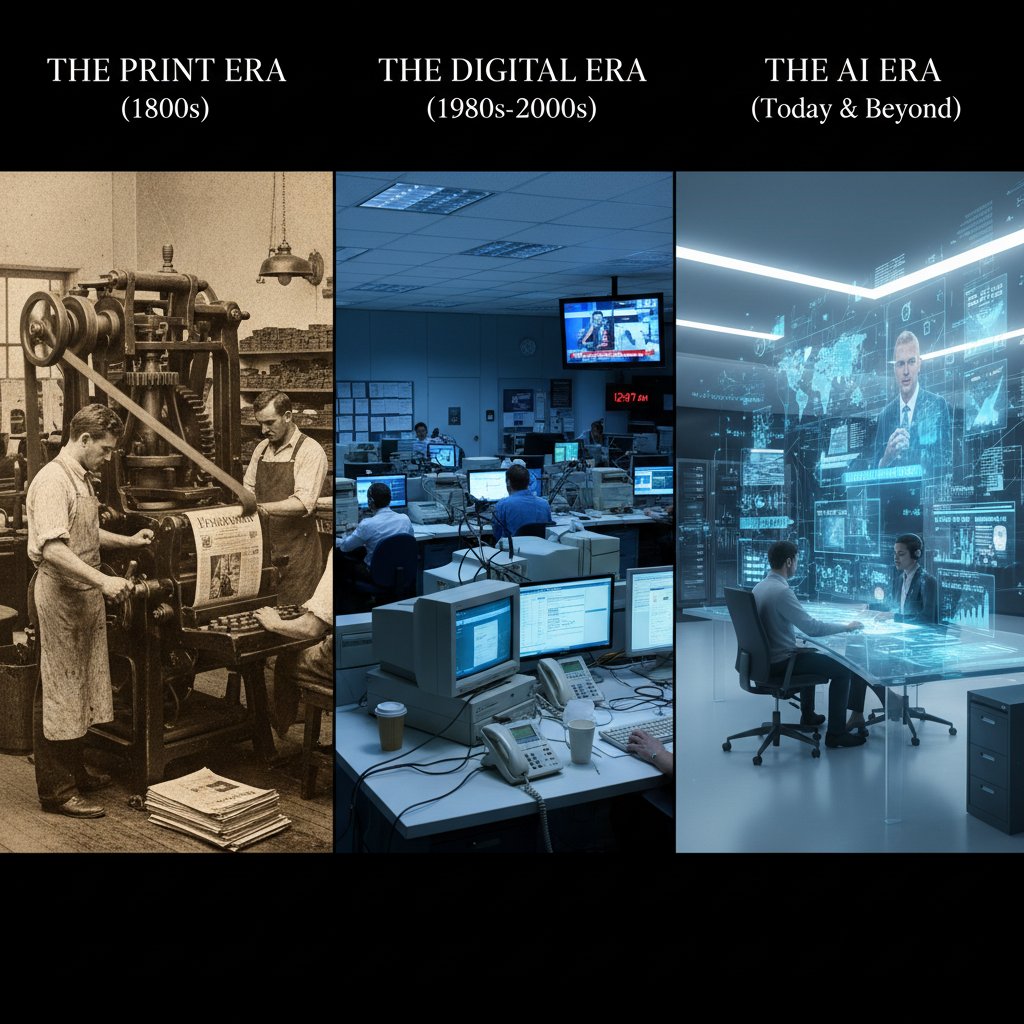
The upshot? Each wave of automation shrank the gap between event and audience. AI-generated journalism software advancements are just the latest—and arguably the most radical—chapter. Forget waiting for the morning edition; news now breaks in real time, with machines capable of churning out summaries, translations, and even nuanced reports in seconds.
| Year | Technology | Impact on Newsrooms |
|---|---|---|
| 1920s | Telex wire service | Near-instant event reporting across continents |
| 1970s | Electronic typesetting | Faster, less labor-intensive page layouts |
| 1990s | Web publishing systems | 24/7 news cycles, global distribution |
| 2010s | Early NLG (e.g., sports recaps) | Automated routine reporting, cost savings |
| 2020s | LLMs, AI newsgathering | Real-time analysis, multi-language reach, editorial curation shifts |
Table 1: Timeline of journalism automation and its tangible newsroom impacts. Source: Original analysis based on Statista, 2024, Reuters Institute, 2024
What does AI-generated journalism software actually do?
At its core, AI-generated journalism software is the newsroom’s Swiss Army knife. These platforms ingest raw data—think press releases, financial reports, live feeds, and social media streams—and autonomously transform the chaos into structured, readable news. Real-time article creation is just the start. Modern LLMs also handle rapid-fire summarization, data analysis, personalized content delivery, and even translation across dozens of languages.
Definition list:
Platforms or tools using artificial intelligence to automate reporting, content creation, and editorial workflows, often powered by LLMs.
AI systems trained on massive text corpora to generate, summarize, and analyze language with a nuance approaching human writing.
A system where incoming data is instantly processed, analyzed, and published with minimal human intervention.
For instance, BloombergGPT specializes in extracting trends and anomalies from dense financial filings, producing alerts and insights faster than any analyst could. But persistent myths muddy the waters. Contrary to popular belief, AI-generated journalism is not about pressing a button and unleashing perfect prose. Bias, hallucination, and context loss remain live concerns, and total automation is a pipe dream (or nightmare) most serious publishers aren’t buying. As of late 2023, 56% of news leaders were focused on using AI to automate back-end processes, not replace journalists outright (Statista, 2024).
Meet the new boss: Who’s really in charge of your newsfeed?
Here’s the twist that should keep you up at night: editorial control is quietly shifting from human hands to the cold, methodical logic of algorithms. When you scroll through a news app or social feed, chances are the stories you see were picked—if not written—by an AI. The rise of the hybrid “human-in-the-loop” newsroom means that while journalists still oversee the process, much of the initial filtering, ranking, and even tone-setting now happens at the algorithmic level.
"It's not about replacing journalists—it's about amplifying what we can do." — Maya, editorial technologist
This handover is both threat and opportunity. On one side, AI can surge past human bottlenecks, surfacing stories that might otherwise be buried. On the other, the very definition of editorial judgment is being recoded, with all the risk of bias, error, or manipulation that entails. The result is a media ecosystem where access to information is both more democratized and more opaque than ever, challenging the power structures that have defined news for generations.
Breaking news at the speed of light: Real-world applications and case studies
When AI beat the wires: The 2024 earthquake coverage
The night the ground shook in southern Turkey, legacy newsrooms scrambled for confirmation, but AI-driven systems were already at work. Aggregating seismic sensor data, eyewitness social media posts, and official feeds in real time, several AI platforms published accurate updates minutes before the wires caught up. According to the Reuters Institute, 2024, these tools not only informed global audiences faster but also provided multi-language summaries, ensuring the story’s reach on platforms like YouTube and TikTok.

This was no isolated event: AI-powered news generators have since handled everything from election results to market crashes, often outpacing human reporters in both speed and initial accuracy. However, the human touch remains critical—especially for contextual analysis, follow-ups, and on-the-ground stories.
| Coverage Model | Speed to Publish | Initial Accuracy | Audience Engagement |
|---|---|---|---|
| AI-only | Seconds–minutes | High for factual updates | Broad, high on digital channels |
| Human-only | Minutes–hours | Highest with context | Loyal, but often slower reach |
| Hybrid | Minutes | Best of both | Most balanced, high retention |
Table 2: Comparing AI, human, and hybrid breaking news coverage. Source: Original analysis based on Reuters Institute, 2024
Not just breaking: Lifestyle, sports, and investigative journalism
AI-generated journalism software advancements aren’t just for breaking news. They’re now driving lifestyle content—curating food, fashion, and travel stories tailored to niche audiences. In sports, AI generates instant recaps and personalized highlights, freeing human reporters to focus on in-depth features. The real stunner? Investigative journalists are deploying LLMs to sift through millions of documents—think financial leaks, court records, or government contracts—unearthing patterns and anomalies that would have taken teams months to spot.
Among the more unconventional uses for AI journalism tools:
- Hyperlocal reporting: AI scans and aggregates community updates, elevating stories that might never reach big publishers.
- Personalized news feeds: Algorithms tailor content based on user preferences, reading habits, and even sentiment.
- Data-driven features: AI identifies emerging trends—like sudden spikes in public health data—enabling proactive coverage.
These capabilities illustrate both the promise and the pitfalls: efficiency and reach have never been higher, but so too is the risk of missing nuance, or amplifying noise and bias.
newsnest.ai and the new breed of AI-powered news generators
Platforms like newsnest.ai embody this vanguard. As a leading AI-powered news generator, newsnest.ai demonstrates how LLM-driven content creation can scale coverage across topics, languages, and formats—without the traditional bottlenecks of human labor. These platforms don’t just automate; they reshape editorial strategies, enabling outlets to pivot quickly to emerging topics, diversify their content portfolios, and maintain a relentless publishing cadence that keeps them relevant.
Globally, this shift is causing a strategic rethink. As Julian, a media strategist, puts it:
"The only thing more disruptive than AI in news is ignoring it."
As AI-powered news generators become standard, the challenge isn’t integrating the technology—it’s figuring out how to wield it responsibly, ethically, and creatively, so that journalism serves the public, not just the bottom line.
Inside the algorithm: How large language models write the news
Under the hood: Anatomy of a news-generating LLM
Demystifying the tech: Large language models (LLMs) like GPT-4, BloombergGPT, or other domain-specific variants process vast amounts of training data—literally billions of sentences from news, books, and the open web. When fed a prompt (like “Write a 200-word update on today’s inflation data”), the LLM breaks down the request, analyzes context, and predicts word-by-word what the story should be, cross-referencing its internal representations of style, fact, and narrative flow.

Key terms in this media context include:
The process of breaking text into small units (tokens), allowing the model to analyze and generate language efficiently.
Crafting the input to the LLM to steer its output towards the desired topic, tone, or factual accuracy.
Additional training of an LLM on curated datasets (e.g., verified news stories) to improve performance on specific tasks.
An LLM’s power lies in its ability to generalize patterns from training data, but its biggest weakness is context: if the prompt is unclear or the model lacks relevant, up-to-date information, hallucination or error can slip in.
Quality control: Fact-checking and bias mitigation
No serious newsroom runs AI-generated copy without robust safeguards. Automated fact-checking systems cross-reference model output against trusted databases, public records, and real-time feeds. Many platforms continuously monitor for bias, flagging deviations from established norms or overtly partisan language.
Step-by-step guide to AI news validation:
- Data ingestion: AI pulls from verified sources, press releases, or news wires.
- Initial draft: LLM generates draft copy based on prompts.
- Automated fact-check: Content is compared with external databases or fact-checking APIs.
- Human review: Editors verify facts, tone, and context; tweak as necessary.
- Publication: Only after passing checks does the story go live.
Common failures—like misattributed quotes or outdated data—occur, but hybrid workflows allow human editors to catch and correct these before they spiral. According to the Brookings Institution, 2024, the most robust AI newsroom pipelines combine machine speed with human judgment, minimizing both error and bias.
The art of the prompt: How humans guide AI news creation
Don’t be fooled: the job of “prompt engineer” is now as crucial as any editor. Crafting the right prompt ensures the LLM produces news that’s not just accurate, but relevant and compelling. For example, asking “Summarize the latest central bank rate hike” yields a basic report, while “Analyze the social impact of the latest central bank rate hike on low-income households in Chicago” generates a more nuanced story.
Prompt variations can make or break a story’s quality. In practice, editorial teams experiment relentlessly, refining prompts, feeding in key facts, and sometimes even adjusting model parameters to get the right voice or focus.
"Getting the AI to ask the right questions is half the battle." — Priya, prompt engineer
In short: humans set the stage, AI brings the speed and scale, and together they’re redefining what “journalistic judgment” means in a digital age.
The ethics minefield: Trust, transparency, and the future of news
The transparency paradox: When audiences know, do they trust more?
Research consistently shows that audience trust in AI-generated news is a moving target. According to the Reuters Institute, 2024, public attitudes are mixed: while many value speed and breadth, there’s strong opposition to AI-generated realistic images or video, and skepticism spikes when disclosure is unclear. The paradox? Transparency about AI authorship sometimes boosts trust—but can also trigger suspicion if audiences fear “robot news.”

Survey data from six countries paints a nuanced picture:
| Story Type | Human-written | Hybrid (AI + human) | AI-only |
|---|---|---|---|
| Trust Level (%) | 68 | 54 | 39 |
Table 3: Survey results—audience trust by authorship type. Source: Reuters Institute, 2024
For publishers, the takeaway is clear: transparency and disclosure are necessary but not sufficient. Genuine audience engagement and editorial integrity are what ultimately tip the scales.
Debunking the myths: What AI journalism is—and isn’t
It’s time to cut through the noise. Myth one: “AI news is always fake.” False—AI systems, when fed high-quality data and supervised by humans, can outperform even diligent reporters in accuracy and speed for structured information. Myth two: “AI can’t be ethical.” Also false—hybrid models with robust oversight and transparent processes are already raising the bar for accountability, not lowering it.
Hidden benefits rarely discussed by experts:
- Scalable coverage: AI allows outlets to cover more beats, including overlooked topics.
- Inclusion: With proper design, AI can help surface voices from underrepresented regions or communities.
- Speedy corrections: Automated systems can instantly update or retract stories as new data arrives.
Hybrid models—where humans and AI collaborate—are fast becoming the new gold standard. Editorial teams leveraging AI for first drafts, data crunching, or translation are consistently producing more accurate and inclusive journalism, according to Brookings, 2024.
Who owns the news? Copyright, authorship, and legal gray zones
AI-generated journalism software advancements have thrown copyright law into chaos. If an LLM writes your article, who owns it? The publisher? The AI vendor? The data source? Legal frameworks vary widely. The EU AI Act (2023) and Brazil’s recent legislation (see Innovating News, 2024) mandate transparency and accountability, but enforcement is patchy, and landmark court cases are just starting to set precedent.
Newsrooms need a priority checklist:
- Audit training data: Ensure AI partners use legally sourced corpora.
- Disclose authorship: Clearly state when content is AI-assisted or AI-generated.
- Track edits: Maintain a log of human and machine contributions.
- Review licensing: Check agreements for AI-generated content ownership.
- Monitor compliance: Stay current on regional AI media laws and best practices.
Failing to cover these bases not only courts legal trouble—it undermines public trust, the industry’s most precious (and fragile) commodity.
The economics of automation: Winners, losers, and new business models
Do AI newsrooms save money—or just shift the cost?
On paper, automation slashes headcount and overhead. According to Statista, 2024, over half of news industry leaders prioritized AI-driven efficiency gains in 2024. Outlets deploying AI-powered news generators like newsnest.ai have reported content production cost reductions between 30-60%. But the ledger isn’t all black ink: licensing quality data, maintaining proprietary models, and integrating AI with legacy systems all introduce new expenses.
| Expense/Benefit | Human-only Newsroom | AI-powered Newsroom | Difference |
|---|---|---|---|
| Reporter salaries | High | Lower | -40% |
| Data licensing | Low | High | +25% |
| Tech investment | Moderate | High initial | +30% |
| Speed/productivity | Moderate | Very high | +80% |
Table 4: Newsroom cost-benefit analysis, 2024 figures. Source: Original analysis based on Statista, 2024
Different business models are emerging: subscription-based, ad-driven, and bespoke content generation for corporate clients. The common denominator? Outlets that fail to adapt are rapidly losing ground.
Jobpocalypse or job evolution? The changing roles in media
Is AI killing journalism jobs? Not exactly. While layoffs have hit some sectors—especially routine reporting—new roles are proliferating: data scientists, prompt engineers, AI ethicists, and audience analysts. The real change is qualitative: journalists are moving up the value chain, focusing on oversight, investigation, and engagement.
Red flags for AI adoption:
- Overreliance on unverified data streams
- Lack of transparency in editorial processes
- Skewed or homogeneous training datasets
- Insufficient human review
- Ignoring regulatory compliance
Journalists who adapt—learning data literacy, prompt engineering, or audience analytics—are not just surviving, but thriving in this new media ecosystem.
New revenue streams: Monetizing AI-generated content
Innovation is the name of the game. Some outlets sell AI-generated content via subscription models, others produce branded news for corporate partners, while a handful have tried (and sometimes failed) to monetize real-time alerts or analytics dashboards. Success stories share a pattern: value-driven, high-integrity content that audiences actually trust.
"If you’re not experimenting with AI, you’re already behind." — Sam, digital publisher
The lesson? Chasing speed or novelty alone is a dead end. Sustainable revenue comes from credibility, transparency, and relentless reader focus.
AI, culture, and society: Who gets a voice in the next-gen news ecosystem?
Democratizing or centralizing? The paradox of AI in local and minority news
AI-generated journalism software advancements can be a force for inclusion—or the opposite. On one hand, hyperlocal and minority-run outlets are using AI to amplify stories that mainstream media miss. For instance, community news sites in Brazil and sub-Saharan Africa leverage AI-driven content generation to cover local events in native languages, breaking the mold of big-city, majority-centric narratives. On the flip side, under-resourced newsrooms may lack the data or infrastructure to benefit, further centralizing power in the hands of well-funded publishers (Brookings, 2024).

Strategies to ensure inclusivity include active bias auditing, diverse training datasets, and collaborative design processes with community stakeholders.
Cultural impact: New narratives, new norms
AI isn’t just changing how news is made—it’s changing what stories get told and who tells them. With automation freeing up human reporters from rote coverage, more space opens for investigative work and features on topics once deemed too niche. Audiences, for their part, are demanding more transparency, more diversity, and more dialogue.
Newsroom cultures are shifting fast. Editorial hierarchies flatten as tech and editorial merge. Audience expectations turn on a dime: real-time updates are the baseline, not the exception.
Unconventional uses for AI-generated journalism software advancements include:
- Arts reporting: AI curates and contextualizes cultural events, exhibitions, or new music releases.
- Entertainment: Automated recaps of reality shows, sports, or live events.
- Activism: AI surfaces underreported social movements, giving activists new ways to reach the public.
The dark side: Misinformation, manipulation, and the fightback
With great power comes serious risk. Deepfakes, algorithmically amplified misinformation, and coordinated manipulation campaigns are now weapons in the information wars. AI can generate convincingly fake news stories, social posts, or even video, muddying the waters at critical moments.
The fightback is multi-pronged: algorithmic detection tools, human fact-checkers, and public education campaigns all play a role. But vigilance is non-negotiable.
Step-by-step guide to identifying AI-generated misinformation:
- Check for source attribution and author credentials.
- Verify factual claims via trusted outlets (newsnest.ai/fact-checking).
- Analyze writing style for consistency and coherence.
- Cross-reference key quotes and data.
- Use browser tools to check for image or video manipulation.
If it seems too slick, too fast, or too perfectly tailored—it probably is.
How to harness AI-generated journalism software advancements: Playbook for newsrooms
Assess your newsroom: Are you ready for the AI leap?
Before diving in, newsrooms must take a cold, hard look at capabilities and gaps. Do you have the tech infrastructure? Are editorial teams open to change, or stuck in their ways? Can you support the training and oversight needed, or will the tech run amok?

Checklist for newsroom AI readiness:
- Inventory current tech stack—identify integration points.
- Assess data quality and access.
- Map editorial workflows—locate automation opportunities.
- Evaluate staff skills—plan training needs.
- Identify risks—privacy, bias, regulatory exposure.
- Set goals—speed, coverage, diversity, engagement.
Honest answers to these questions are the difference between success and expensive failure.
Implementation: From pilot project to full-scale integration
Rolling out AI-generated journalism software advancements isn’t just plug-and-play. Start small—run a pilot on a low-risk beat (e.g., sports summaries). Monitor outcomes obsessively. Document every failure and tweak the process. Scale only when you can prove clear value.
Common mistakes include underestimating change management, skipping human oversight, and failing to communicate transparently with readers.
Typical timeline for AI newsroom evolution:
- Pilot launch: 1–3 months—single use case, close monitoring.
- Evaluation & adjustment: 2–4 months—refine workflows, train teams.
- Scaled deployment: 6–12 months—expand to multiple beats, regions.
- Optimization: Ongoing—integrate feedback, update models, maintain compliance.
Surprises will happen—prepare to adapt.
Optimization: Getting the most from your AI-powered newsroom
To extract maximum value, workflows must blend human and machine strengths. Editorial oversight is critical—not just at publication, but throughout ideation, prompt engineering, and revision.
Alternative approaches depend on newsroom size. Large outlets can build custom LLM pipelines; smaller ones may rely on third-party platforms like newsnest.ai. The key? Never treat AI as “set it and forget it.” Regular audits, iterative training, and relentless staff development are non-negotiable.
Tips for ongoing success:
- Run regular training sessions on AI tools and ethics.
- Celebrate successful integrations—build culture around innovation.
- Rotate staff through tech and editorial roles for cross-pollination.
- Maintain an open feedback channel—AI is only as good as the input it gets.
The hidden costs of speed: Environmental and ethical considerations
Data centers and carbon footprints: The unseen price of AI news
AI is energy-hungry. Training and running LLMs requires vast server farms, with significant carbon emissions. According to research from Reuters Institute, 2024, the environmental impact of AI-powered newsrooms can dwarf that of traditional newsrooms—unless providers invest in green energy and efficient models.

| Newsroom Type | Energy Use (kWh/year) | CO2 Emissions (tons/year) |
|---|---|---|
| Traditional | 100,000 | 60 |
| AI-powered | 350,000 | 180 |
Table 5: Comparative environmental costs of newsrooms. Source: Original analysis based on Reuters Institute, 2024
Publishers must factor these “invisible expenses” into their sustainability calculations.
Ethical dilemmas beyond the byline
It’s not just about carbon. AI in journalism raises hard questions about data privacy, surveillance, and algorithmic accountability. Who gets to see the raw data? Are newsrooms inadvertently training AI on sensitive or private information? The regulatory terrain is evolving—fast. The EU AI Act sets new standards for transparency and redress, and similar laws are brewing worldwide (Innovating News, 2024).
Newsrooms should ask:
- Are we respecting user privacy in data collection?
- How transparent are our editorial algorithms?
- What’s our plan for algorithmic bias or failure?
- How do we audit and explain AI decisions to the public?
- Are we prepared for regulatory audits or legal challenges?
- Do we have a clear process for error correction?
Ignoring these questions is an ethical failure—one that will not go unnoticed by audiences or regulators.
The road ahead: What’s next for AI-powered news generators?
Forecasting the future: Trends to watch in 2025 and beyond
While speculation is off-limits, current trends are undeniable. According to the latest roadmaps and expert panels (Reuters Institute, 2024), the following forces are shaping AI-generated journalism software advancements right now:

- Increased integration of LLMs for specialized beats (finance, legal, science).
- Shift from social media dependency to direct audience channels.
- Growth in AI-powered personalization and niche content delivery.
- Rising importance of transparency and explainability in editorial AI.
- Acceleration of hybrid (human + AI) newsroom models.
The only certainty? Standing still means falling behind.
Hybrid newsrooms: The human-AI collaboration model
The cutting edge is collaboration, not replacement. Hybrid teams—where humans and AI share reporting, editing, and curation—are outpacing both AI-only and human-only competitors in speed, reach, and trust. Models vary: some outlets put AI in the driver’s seat with humans as safety nets, others use AI for grunt work and let humans lead on analysis and narrative.
Outcomes? When the balance is right, coverage is richer, more responsive, and more inclusive.
"The future of news isn’t human or AI. It’s both—at their sharpest." — Alex, newsroom lead
The new newsroom ethos: Adapt, experiment, and never stop questioning the algorithms shaping our headlines.
Action steps: How to stay ahead of the curve
There’s no finish line, only the next iteration. For journalists, publishers, and readers, thriving in the age of AI-generated news means embracing change, honing critical skills, and demanding transparency at every turn.
Key takeaways and next steps:
- Audit your content workflows for automation opportunities.
- Train teams in AI literacy and prompt engineering.
- Develop transparent editorial guidelines around AI use.
- Regularly review output for bias, error, and inclusivity.
- Engage audiences in the editorial process—invite feedback and scrutiny.
- Stay current on regulatory changes and ethical best practices.
- Prioritize environmental sustainability in tech choices.
- Never forget: skepticism and curiosity are your sharpest tools.
Conclusion
AI-generated journalism software advancements are no longer an industry sideshow—they’re the main act, reshaping who gets heard, how fast the world learns, and what journalism even means in 2025. The path forward is fraught with risk, but it’s also brimming with possibility. With critical engagement, robust oversight, and relentless innovation, newsrooms can harness AI to serve the public good, not just the bottom line. The real revolution isn’t in the technology itself, but in how boldly (and wisely) we wield it. Unfiltered, uncompromising, and undeniably urgent—the evolution of news is here, and it won’t wait.
Sources
References cited in this article
- Statista newsroom AI use 2024(statista.com)
- Reuters Institute Journalism Trends 2024(reutersinstitute.politics.ox.ac.uk)
- Brookings: Journalism needs better representation to counter AI(brookings.edu)
- Innovating News: AI in Journalism(innovating.news)
- Reuters: Public attitudes towards AI in journalism(reutersinstitute.politics.ox.ac.uk)
- The Verge(theverge.com)
- AI in the Newsroom: ONA Case Studies(journalists.org)
- AP survey on AI’s impact(ap.org)
- MDPI systematic review(mdpi.com)
- JournalismAI Case Studies(journalismai.info)
- IBM: AI in Journalism(ibm.com)
- Quintype: AI Newsroom Trends 2024(blog.quintype.com)
- JournalismAI Festival 2024(journalismai.info)
- Top 9 Large Language Models 2024(multimodal.dev)
- MIT: In-context learning in LLMs(news.mit.edu)
- Vamsi Talks Tech: 2024-2025 LLM Review(vamsitalkstech.com)
- Dataiku: 2024 in review(blog.dataiku.com)
- Grand View LLM Market Report(grandviewresearch.com)
- arXiv: Generative AI and LLMs(arxiv.org)
- Full Fact AI(fullfact.ai)
- Reuters Institute: AI and Fact-checking(reutersinstitute.politics.ox.ac.uk)
- IBM: Avoiding Bias(ibm.com)
- Paris Charter on AI in Journalism(rsf.org)
- Forbes: Newsrooms and AI Ethics(forbes.com)
- BuiltIn: AI Copyright(builtin.com)
- Perkins Coie: Human Authorship Requirement(perkinscoie.com)
- SAGE: Copyright in AI News(journals.sagepub.com)
- Reuters Institute Trends(ringpublishing.com)
- Columbia Journalism Review: AI in the News(cjr.org)
- Bill Hartzer: 2024 AI Power Rankings(billhartzer.com)
- PwC AI Jobs Barometer(pwc.com)
- World Economic Forum: AI and Jobs(weforum.org)
- Statista: AI in Media & Entertainment(statista.com)
- Tech Xplore: AI in the News Ecosystem(techxplore.com)
- McKinsey: State of AI 2024(mckinsey.com)
- Capgemini: Generative AI in Organizations(capgemini.com)
- AP Local News AI Case Studies(ap.org)
- Forbes: AI Democratization(forbes.com)
- Northwestern Local News Initiative(localnewsinitiative.northwestern.edu)
- JournalismAI Generating Change Report(journalismai.info)
- Reuters: AI and Journalism(reutersinstitute.politics.ox.ac.uk)
- Open Society Foundations: AI in Journalism Futures(opensocietyfoundations.org)
- AJP Product & AI Studio(theajp.org)
Instantly Generate Breaking News
NewsNest.ai delivers a revolutionary AI-driven news platform, empowering businesses and individuals by automatically generating timely, credible, and engaging news articles. With real-time coverage, deep accuracy, and customizability, you can effortlessly stay informed and ahead of the competition. Eliminate costly journalistic resources and gain instant access to quality content tailored specifically to your preferences and industry focus.
Get startedReady to revolutionize your news production?
Join leading publishers who trust NewsNest.ai for instant, quality news content
Frequently Asked Questions
What AI technologies are currently being used in journalism?
Natural language generation (NLG) and large language models (LLMs) like GPT-4 and BloombergGPT are being used to rewrite stories and automate editorial workflows. These tools can generate summaries, translations, and reports in seconds.
How has automation in journalism evolved over time?
Journalism automation has progressed from the 1920s telex for wire coverage, through 1970s electronic typesetting, 1990s web publishing systems, and 2010s early NLG for sports recaps, to the current 2020s era of LLMs and AI newsgathering that enable real-time analysis.
What is the main concern raised about AI-generated journalism?
The article raises the question of whose interests AI-generated journalism serves and at what cost, noting concerns ranging from viral misinformation scares to power shifts in who controls the news narrative.
How has AI changed the speed of news delivery?
AI has accelerated the gap between event and audience, enabling news to break in real time with machines capable of producing content in seconds, moving beyond waiting for morning editions to 24/7 news cycles.
Keep Reading
See more from AI-powered news generator

AI-Generated Journalism Software Companies Reshape Newsroom Control

How AI Is Rewriting Journalism and Newsroom Control

How AI-Generated Journalism Innovations Are Rewiring Modern Newsrooms

AI-Generated Journalism Software: Capabilities Versus Marketing Claims

How AI-Generated Journalism Software Is Reshaping Newsrooms


