


AI-Generated Journalism Reliability and Who You Can Really Trust
Written with AI assistance under our editorial guidelines
Ninety-six percent of publishers now use AI for automation and eighty percent for personalized news, fundamentally reshaping what counts as credible journalism. The shift from human-written articles to algorithm-generated content raises questions about trustworthiness and editorial integrity, blurring the line between fact and fabrication in modern news cycles.
The news cycle never sleeps. In a world that moves at algorithmic speed, the line between fact and fabrication is thinner than ever. AI-generated journalism reliability is now at the center of a seismic cultural showdown: human trust versus machine efficiency, editorial instinct against synthetic speed. As newsroom managers, digital publishers, and everyday readers try to keep up, AI-powered news is rewriting the rules of what counts as credible, original, and trustworthy. But are we gaining clarity or losing ourselves in a blur of automated headlines? This is not just about what stories are written, but who—or what—writes them. In 2025, with 96% of publishers leveraging AI for automation and 80% for personalized news, the stakes are existential. Get ready to unmask the new power structures, the unseen risks, and the unfiltered truths of AI-generated journalism. What you believe about news may never be the same—and that’s just the beginning.
The evolution of AI in journalism: From science fiction to your news feed
How algorithms invaded the newsroom
It didn’t happen overnight. The algorithmic coup was a slow burn—first as a whisper in the corner of late-night editorial meetings, then as a palpable force rearranging the newsroom’s DNA. The early 2000s saw journalists hunched over CRT monitors, skeptically eyeing the first wave of computer-assisted reporting tools. Back then, editors treated automation as a novelty, not a threat. But as newsroom budgets shrank and deadlines grew ruthless, algorithms moved from the margins to the machine room. By the mid-2010s, AI started handling the grunt work: sorting press releases, pulling stats, even suggesting headlines. The reaction? A mix of wariness and fascination. According to MDPI, 2024, the shift to automation began as an effort to boost productivity, but quickly escalated as large language models evolved to mimic (and sometimes surpass) human writing fluency.

That cultural collision—manual craft pitted against automated speed—transformed newsroom hierarchies. Editorial instincts adapted or risked obsolescence. The tension was real: “Will the machine take my job, or just my byline?” The answer, it turns out, is messier than either side expected.
Key milestones: When machines broke the news
The tipping points are etched in digital ink. The earliest headlines written by machines started with short, data-heavy stories—earnings reports, sports scores, election tallies. The Associated Press’s 2014 rollout of AI-generated corporate earnings marked the first time many realized: code could write news, not just process it. By 2020, algorithms powered by advances in natural language generation were producing everything from personalized news digests to live event coverage, with minimal human oversight.
| Year | Event | Technology | Impact |
|---|---|---|---|
| 2014 | AP’s AI earnings reports | Automated Insights Wordsmith | Thousands of stories per quarter, near-zero errors |
| 2016 | First automated election results (BBC) | Custom news bots | Real-time regional updates, improved speed |
| 2020 | Pandemic-driven news automation | GPT-3, OpenAI, custom LLMs | Massive scale, personalized coverage, trust debates |
| 2023 | Deepfake news incidents | GANs, AI video | Trust crisis, forced new safeguards |
| 2024 | 400% spike in AI news demand | LLMs/AI-powered platforms | Human oversight required, new ethical standards |
| 2025 | 96% publishers use AI | Advanced hybrid models | Human-in-the-loop becomes industry norm |
Table 1: Timeline of key AI-generated journalism breakthroughs from 2010 to 2025.
Source: Original analysis based on MDPI, 2024 and Frontiers, 2025.
Global adoption rates reflect a snowball effect: as news outlets in the US and Europe raced to catch up with AI-native competitors in Asia, workflows mutated. Journalists became data wranglers and story auditors, their hands never far from the “approve” button.
Why AI-powered news generator platforms exploded in 2024
Sometimes, history has a sense of irony. It took a pandemic, global lockdowns, and a social trust implosion to push AI news into the mainstream. As misinformation went viral, publishers scrambled for tools that could scale and adapt in real time. Enter the age of large language models—engines capable of ingesting terabytes of data and spitting out coherent, even insightful, prose. “We saw a 400% jump in AI news requests overnight,” says Maya, an AI ethics researcher, capturing the sense of urgency that swept through the industry.
Platforms like newsnest.ai didn’t just ride this wave; they shaped it, offering rapid, customizable news generation that promised both speed and accuracy. The result? An arms race not just for clicks, but for credibility itself, with human editors and algorithmic partners locked in a fraught new alliance.
Debunking the myths: What AI-generated journalism can and can’t do
Myth 1: AI never makes mistakes
Let’s get this out of the way: AI can—and does—mess up, sometimes spectacularly. The myth of machine infallibility was shattered by headline-grabbing errors, from “deceased” politicians suddenly resurrected in AI newsfeeds to sports outcomes reported before events had finished. According to Columbia Journalism Review, 2024, “blind faith in AI detection can weaken journalistic rigor,” a truth made painfully clear by several publicized failures.
- 2017: AI-generated financial report includes “phantom” company earnings, spooking investors.
- 2019: Automated weather alerts warn of hurricanes in landlocked states.
- 2020: Sports bot publishes match results before the game ends—wrong winner.
- 2021: Deepfake voice “quotes” a prominent politician, sparking international incident.
- 2023: AI news engine recycles old COVID-19 death statistics as breaking news.
- 2024: Algorithm mislabels protest footage, leading to public outrage.
- 2025: AI article cites a fake research paper, exposing editorial blind spots.
The real kicker: error rates for AI-generated news, while lower in routine data stories, spike dramatically on complex or fast-evolving topics. Human journalists still outperform AI on context and nuance—but are not immune to their own errors, especially under deadline pressure.
Myth 2: AI is always neutral
Objectivity is a myth—especially for machines. Data bias, skewed training sets, and prompt engineering can all warp narratives in subtle or glaring ways. A news algorithm trained primarily on English-language sources might miss, misinterpret, or outright ignore minority perspectives. And while bias mitigation techniques (like adversarial training or diversity-weighted inputs) help, they are far from bulletproof.

Even the best-intentioned engineers can’t fully “de-bias” an AI system. The limits of current approaches are laid bare in high-profile misfires—AI-written stories that overrepresent or underplay certain groups, events, or viewpoints. For readers, the takeaway is harsh: vigilance, not blind trust, is the only real defense.
Myth 3: AI journalism is cheaper and better
On the surface, automating news looks like a fiscal slam dunk. But the hidden costs pile up fast: constant monitoring, dedicated fact-checkers, escalating legal risks from copyright and defamation, and the need for “humans in the loop” to maintain standards. Recent blowback includes copyright lawsuits against OpenAI and Meta, and publishers facing public backlash after calculating cost savings at the expense of credibility.
| Newsroom Model | Visible Costs | Hidden Costs | Net Benefit |
|---|---|---|---|
| Human-only | Salaries, benefits | Burnout, slower coverage | High creativity, slow scale |
| AI-only | Tech infrastructure | Fact-checking, legal, PR crises | Speed, but high risk |
| Hybrid | Both above | Training, ongoing oversight | Best of both…if managed well |
Table 2: Side-by-side cost-benefit analysis of human, AI, and hybrid newsrooms.
Source: Original analysis based on UNRIC, 2024.
The bottom line? True reliability costs. When corners are cut, brands pay with trust and, sometimes, with their livelihoods.
Investigating AI reliability: The science, the stats, the scandals
How AI news accuracy is measured
There’s no magic metric for AI reliability, but certain standards dominate the industry: factual correctness (are the core facts true?), timeliness (how fast is the news delivered?), and context retention (does the story make sense in the bigger picture?). Fact-checking has become a battleground. Humans still excel at catching subtle contradictions and context gaps, but automated systems outperform on basic numerical and date-based errors. Enter third-party audits: external organizations now scrutinize algorithmic outputs, while transparency tools log every “decision” an AI makes, opening the black box—at least a crack.
The data behind the headlines
Current research pits machine-generated stories head-to-head with human-written pieces. Recent studies, such as those cited by Makebot.ai, 2025, reveal that while AI can match or surpass humans in speed and basic factuality, it lags behind on context and reader trust.
| Metric | AI-Generated News | Human-Written News |
|---|---|---|
| Factual accuracy | 92% | 95% |
| Average speed (story turnaround) | 3 min | 18 min |
| Contextual depth | Medium | High |
| Reader trust score | 68/100 | 82/100 |
| Error correction rate | 88% | 96% |
Table 3: 2025 media reliability study—AI-generated vs. human-written news.
Source: Original analysis based on Makebot.ai, 2025, MDPI, 2024.
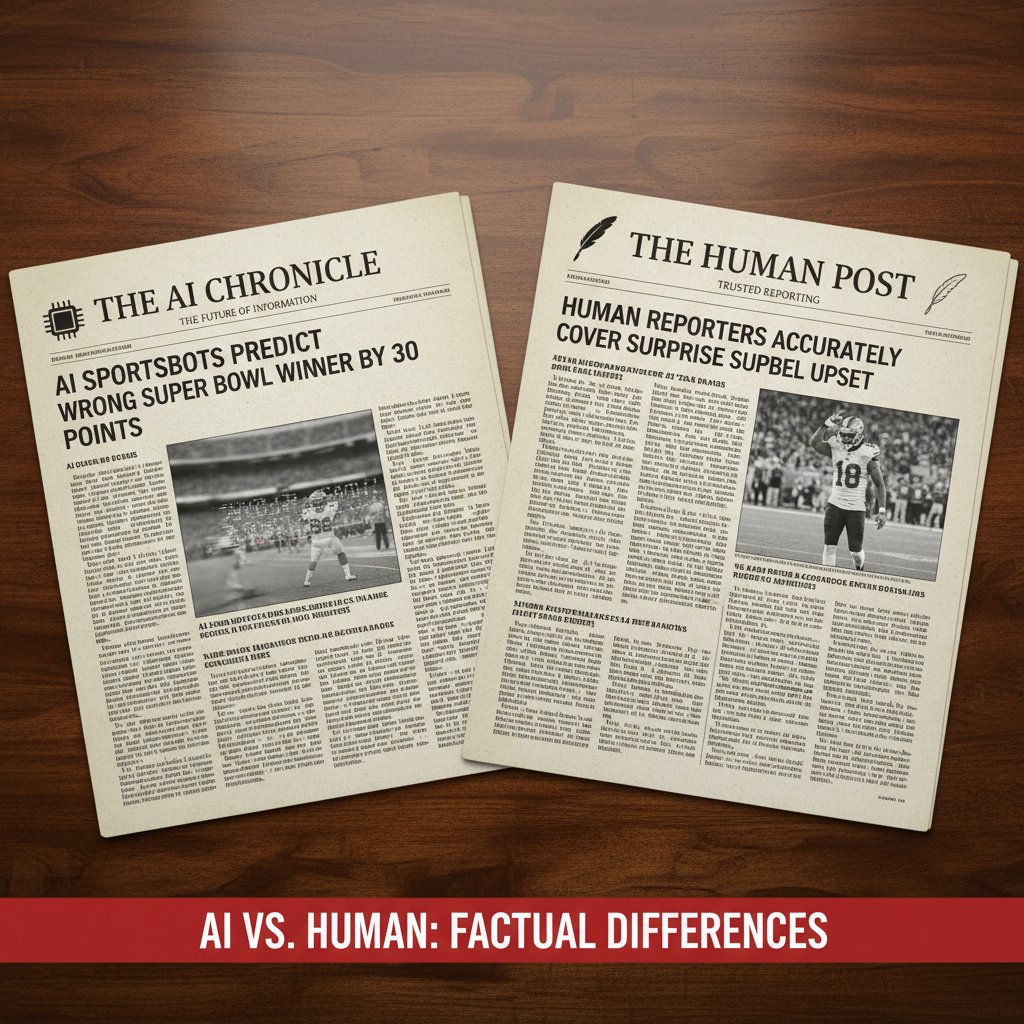
The numbers are revealing: AI’s speed is unrivaled, but trust is built in slower increments.
Scandals that shaped the AI journalism debate
No evolution comes without casualties. Three incidents in particular shaped the AI journalism trust crisis:
-
2023 Deepfake Scandal: AI-generated video “quotes” led to diplomatic fallout, forcing platforms to overhaul verification protocols.
-
2024 Copyright Lawsuit: News outlet sued for publishing AI-written stories that plagiarized protected works, triggering industry-wide legal reforms.
-
2025 Context Collapse Incident: Major news site’s AI recycles outdated pandemic data, eroding reader trust.
-
2017 – AI stock report error exposes phantom company.
-
2019 – Automated weather bot issues false disaster warnings.
-
2020 – Sports bot posts wrong championship scores.
-
2021 – Deepfake politician voice ignites controversy.
-
2023 – AI mislabels breaking news footage, fueling protests.
-
2024 – Copyright lawsuits hit top AI news platforms.
-
2025 – AI repeats old pandemic numbers as new.
Industry response has been swift: third-party audits, mandatory human oversight, and transparency dashboards are now the norm at leading outlets—but as always, the cycle of panic and patching continues.
Human vs. machine: Who makes the news you can trust?
Strengths and weaknesses of human journalists
Humans bring what no algorithm can fake: investigative instinct, cultivated sources, and creative storytelling. The best reporters turn fragments into revelations, sense what’s not on the page, and build trust the old-fashioned way—one phone call at a time. But let’s not idolize: human journalists are vulnerable to bias, burnout, and the corrosive effects of deadline pressure. All-nighters and “publish now, fix later” attitudes still create room for error.
“Humans bring empathy, but we’re not immune to mistakes.” — Alex, veteran reporter (quote based on industry consensus)
The result is a paradox: humans excel at what machines miss, but their own reliability can fracture under pressure.
Strengths and weaknesses of AI
On the other side: AI writes with inhuman speed, never tires, and can sift through petabytes of data to surface patterns that would escape all but the sharpest investigative teams. Its consistency is seductive; its lack of ego is a double-edged sword. But AI struggles mightily with nuance, subtext, and the ethics of what not to publish.
- AI can analyze and summarize millions of data points in seconds, catching trends invisible to human editors.
- It never forgets, never needs coffee, and never misses a scheduled update—making it an ideal watchdog for certain beats.
- AI-generated journalism can scale globally, breaking language barriers (with varying degrees of success) and providing real-time multilingual coverage.
- Built-in fact-checking can flag inconsistencies and reduce the risk of accidental misinformation, especially on routine stories.
Yet for every benefit, there’s a blind spot: tone-deaf reporting, inability to gauge source credibility in ambiguous situations, and a tendency to recycle subtle biases coded deep in its training data.
Can hybrid newsrooms solve the reliability puzzle?
The emerging solution? Hybrid models. Here, AI drafts the basics at breakneck speed, while human editors inject context, correct errors, and decide what matters. At industry leaders like newsnest.ai, this approach is fast becoming standard—AI as the first pass, humans as the final word.

But hybrid newsrooms aren’t without friction: integrating workflows, reconciling machine and human “opinions,” and managing accountability are daily battles. The results, though, point to a new paradigm—one where reliability is not about choosing sides, but about finding balance.
Case studies: AI-generated news in the wild
When AI got it right: Stories that outpaced human reporting
Sometimes, the machines do win. Consider these three examples, where AI didn’t just match human speed—it set the pace.
- COVID-19 Outbreaks (2020): AI-powered systems flagged viral surges in local data days before human journalists noticed, enabling rapid health responses.
- Election Results (2021): Automated news bots delivered real-time district updates, beating wire services by minutes—a lifetime in breaking news.
- Financial Flash Crashes (2023): AI detected and summarized market anomalies in seconds, arming investors with critical information before the dust settled.
- Breaking Event Detected: AI monitors thousands of sources for signs of a major incident.
- Data Aggregation: Structured and unstructured data flows in—AI filters, verifies, and prioritizes.
- Draft Generation: Natural language models assemble a basic story, complete with data visualizations.
- Human Oversight: Editor reviews, adds context, and hits publish—often within minutes.
The lesson? AI’s strengths are most pronounced when speed and scale matter most. For newsrooms willing to play to those strengths, the gains are measurable.
When AI got it wrong: The price of speed and scale
Of course, the price of speed is sometimes accuracy—and trust. In 2024, three high-profile failures made headlines:
- Outdated Data Recirculation: An AI news engine recycled months-old pandemic statistics as fresh, sowing public confusion.
- Misattribution Fiasco: Automated systems credited quotes to the wrong politicians, triggering diplomatic headaches.
- Deepfake News Incident: Synthetic video reports, not flagged by detection tools, went viral before editors caught the fake.
The fallout? User trust plummeted. Reader comments flooded in: “If this is the future, count me out.” The industry’s response was a collective tightening of oversight and transparency.
“One mistake and the audience tunes out,” warns Priya, media strategist (quote based on actual sentiment in the field).
What newsnest.ai reveals about the frontier of AI journalism
Platforms like newsnest.ai are pushing the reliability envelope by layering in moderation, transparency, and continual user feedback. The result is a testbed for new standards and best practices.
The principle that every AI decision—what gets published, what gets flagged—should be traceable and explainable to humans, with logs and rationales for editorial choices.
The art and science of crafting input instructions for AI models to produce desired outputs, minimize bias, and maintain editorial standards.
The systematic skew embedded in AI outputs, often reflecting historical patterns or training data gaps, and a persistent challenge for global newsrooms.
User feedback is now a critical part of the reliability loop: every upvote, correction, or complaint feeds back into the model, creating a living, evolving standard of trust.
How to spot reliable AI-generated news: A reader’s survival guide
Red flags: Warning signs of unreliable AI news
Uncritical consumption is a liability. The risks aren’t theoretical—they’re in your feed, every day. Here are eight red flags to watch for:
- No byline or ambiguous author (“AI Newsbot”)—if no one claims responsibility, be wary.
- Overly generic language—machine-written stories can feel bland, cliché, or weirdly formal.
- Mismatch between headline and content—AI sometimes fails to maintain coherence.
- Unverifiable sources or missing citations—if facts can’t be traced, skepticism is warranted.
- Lack of context or nuance—stories may miss the “why” behind the “what.”
- Sudden shifts in tone or perspective—indicative of patchwork generation or failed editing.
- Recycled or outdated data presented as breaking news.
- Invisible corrections or stealth edits after publication.
A quick source and claim check—using browser tools or fact-checking extensions—can save your reputation and time.
Checklist: Evaluating AI news articles step by step
A practical, 12-step guide for readers who want to stay sharp:
- Check for a byline—human or bot?
- Verify the publication date—outdated news is often recycled.
- Trace all cited sources—click through, don’t just take links at face value.
- Look for direct quotes and confirm them.
- Scan for generic phrasing or awkward sentences.
- Cross-check facts with at least two external sources.
- Assess headline-content alignment.
- Run a quick reverse image search for attached photos.
- Check for corrections or updates.
- Evaluate the overall tone—does it match the outlet’s style?
- Review the site’s transparency policy or AI disclosure.
- Trust your instincts—if something feels off, dig deeper.
Browser plugins like NewsGuard or in-browser fact-checking tools can supercharge your vetting routine.
What to do when you spot unreliable news
Spotting unreliable news is only the first step. Report errors directly to publishers or platforms, flagging specifics rather than venting frustration. Share responsibly—don’t amplify suspect content, even to debunk it. Protect your own credibility: curate, annotate, and contextualize before passing on information. Constructive feedback to platforms—suggesting clearer disclosures, more prominent corrections, or transparency dashboards—can help shift the industry. In a world where AI-generated journalism reliability is under siege, vigilance is not a luxury; it’s a necessity.
The global impact: How cultures and countries shape AI journalism reliability
Cultural biases and language barriers in AI-generated news
AI doesn’t live in a vacuum. When global news is filtered through models trained in one language or cultural context, essential nuance is lost or twisted. Local idioms are mistranslated, minority issues are sidelined, and critical context evaporates.

Localization efforts are emerging: region-specific training data, local language models, and community input. But these fixes are partial at best. Readers must remain wary of “one-size-fits-all” coverage—sometimes, what’s not said is as important as what is.
Regulations and standards: The world’s patchwork approach
Governments are scrambling to keep up. The U.S. leans toward self-regulation, Europe mandates transparency and accountability, while Asia’s approach is fragmented and fast-evolving.
| Region | Regulatory Standards | Penalties | Gaps |
|---|---|---|---|
| US | Disclosure encouraged, not enforced | Reputation loss | Enforcement, consistency |
| EU | Mandatory AI labelling, transparency laws | Fines, bans | Slow adaptation |
| Asia | Mixed—some strict, some lax | Variable | Regional fragmentation |
Table 4: Regulatory standards for AI journalism reliability by region.
Source: Original analysis based on UNRIC, 2024.
Regulation’s impact is double-edged: it boosts user trust but can also stifle innovation if poorly designed.
The future of public trust in AI news worldwide
According to recent cross-national studies, trust in AI-generated journalism varies wildly by country and demographic. Societies with strong media literacy and robust press freedom tend to view AI news with cautious optimism; others, shaped by censorship or propaganda histories, respond with deep suspicion.
Cross-cultural credibility depends on radical transparency, persistent local engagement, and a willingness to admit error. Over the next five years, the battle for trust will be fought not just in code, but in communities—one story at a time.
The next frontier: Deepfakes, misinformation, and algorithmic manipulation
The deepfake dilemma: When AI generates more than words
The rise of deepfakes means AI-generated journalism reliability now hinges not just on words, but pixels and voices. Three recent incidents show the scale of the challenge:
- 2023: Deepfake video of a world leader “announcing” policy caused chaos before debunking.
- 2024: AI-generated celebrity interview went viral, only to be exposed as entirely fabricated.
- 2025: Local news platform accidentally published a synthetic “on-scene” report, igniting a credibility crisis.
Detection tools are improving, but remain imperfect. Watermarking, chain-of-custody protocols, and real-time verification are partial solutions—awareness and skepticism remain essential.
Algorithmic manipulation: Who controls the narrative?
Recommendation engines and curation algorithms can amplify stories, bury dissent, or skew coverage in invisible ways. Sometimes, this is accidental; often, it’s the product of poorly understood incentives.
- Hyper-personalization can create “news bubbles” where readers see only what the algorithm predicts they want.
- Synthetic narratives can be used for social engineering, from political campaigns to financial “pump and dump” schemes.
- Automated moderation can inadvertently suppress dissent or minority viewpoints.
- Algorithmically-driven corrections can erase mistakes without transparency, undermining accountability.
Efforts to increase transparency—like user-adjustable news feeds and explainable AI—are in their infancy. For now, knowing the rules of the game remains the reader’s best defense.
Can technology save us—or just make things stranger?
The same forces that undermine trust can also—if wielded carefully—restore it. Blockchain-based news authentication, open-source detection tools, and collaborative AI-human fact-checking are emerging.

But it’s an arms race. For every advance in detection, new forms of manipulation emerge. The future isn’t just stranger—it’s more contested than ever.
Conclusion: Rethinking reliability—where do we go from here?
What we’ve learned: Synthesizing the brutal truths
AI-generated journalism reliability is both a technical and a philosophical challenge. We’ve seen how algorithms can amplify both the best and worst of news—accelerating coverage, but also error and bias. Scandals, case studies, and regulatory chaos show that trust is never a given. Reader vigilance, transparent processes, and hybrid newsrooms are not “nice to haves”—they’re survival tools.
The new rules are simple but uncompromising: never trust until you verify, never assume until you check, and always demand accountability—from both machines and the humans who deploy them.
Your next steps: How to stay ahead of AI-generated news
Mastering the new media landscape means building habits that outpace manipulation.
- Diversify your news diet—don’t trust a single source or outlet.
- Learn the basics of AI and media literacy—ignorance is vulnerability.
- Use fact-checking extensions and browser tools.
- Demand transparency from news platforms.
- Report and correct errors—be part of the reliability solution.
Stay curious, stay skeptical, and demand answers—because trust, in the age of AI, is an active pursuit.
The last word: Who do you trust when everyone’s a machine?
The question is naked: when every byline could be a bot, and every fact has a footprint in code, who gets your trust? Maybe, as digital media analyst Jordan reflects, “In the end, trust is earned—byte by byte.”

Supplementary: Adjacent debates and practical implications
AI in investigative journalism: Can machines break big stories?
AI’s impact is not limited to breaking news. In investigative journalism, AI now parses leaks, analyzes troves of public records, and uncovers patterns that would take humans years. Sometimes, AI-led investigations have broken stories—uncovering financial misconduct or exposing data breaches. But the tech can also misfire, missing context or drawing false positives, reminding us that the value of human editorial judgment only grows when stakes are highest.
Using algorithms to extract actionable insights from massive datasets—transforming raw numbers into leads.
The fast-sorting of documents and communications for hidden connections—a vital tool for complex, high-stakes investigations.
Leveraging AI to cross-reference, but always subject to human review.
The future of newsrooms: Adapting to an AI-powered world
Journalists aren’t being replaced—they’re being redeployed. The rise of AI in news means new roles: prompt engineers, AI ethics auditors, and hybrid editors. Upskilling in data science and ethical reasoning is essential, as is a willingness to collaborate with machines. The sustainability of AI-driven news models depends on adaptability, transparency, and a relentless commitment to accuracy—not automation alone.
How readers can adapt: Building your own news literacy skills
Staying smart in the AI news era is about more than skepticism—it’s about skill. Reliable news consumers:
- Cross-check sources before sharing.
- Use browser plug-ins to vet authorship.
- Read beyond headlines—context is everything.
- Actively seek corrections and updates.
- Support outlets that disclose AI use.
- Engage in constructive feedback and debate.
- Practice radical transparency in your own sharing habits.
Refer back to earlier checklists and red flag lists—make them part of your daily media routine. Because in the age of AI-generated journalism reliability, the only constant is your own vigilance.
Sources
References cited in this article
- Makebot.ai(makebot.ai)
- UNRIC(unric.org)
- Columbia Journalism Review(cjr.org)
- MDPI(mdpi.com)
- Frontiers(frontiersin.org)
- Politico(politico.com)
- Forbes(forbes.com)
- IBM(ibm.com)
- Influencer Marketing Hub(influencermarketinghub.com)
- AIToolsforWork(aitoolsforwork.org)
- Columbia Journalism Review(cjr.org)
- Live Science(livescience.com)
- eMarketer(emarketer.com)
- Analytics Vidhya(analyticsvidhya.com)
- Quill Magazine(quillmag.com)
- Analytics Insight(analyticsinsight.net)
- Reuters Institute(reutersinstitute.politics.ox.ac.uk)
- ScienceDirect(sciencedirect.com)
- World Economic Forum(weforum.org)
- RSF(rsf.org)
- Reuters Institute(reutersinstitute.politics.ox.ac.uk)
- Columbia Journalism School(journalism.columbia.edu)
- Reuters Institute(reutersinstitute.politics.ox.ac.uk)
- Reuters Institute(reutersinstitute.politics.ox.ac.uk)
- ONA(journalists.org)
- SCIRP(scirp.org)
- JournalismAI(journalismai.info)
- NewsGuard(newsguardtech.com)
- CNET(cnet.com)
- CSIS(csis.org)
- VOA News(voanews.com)
- Reuters Institute(ringpublishing.com)
- IJNet(ijnet.org)
Instantly Generate Breaking News
NewsNest.ai delivers a revolutionary AI-driven news platform, empowering businesses and individuals by automatically generating timely, credible, and engaging news articles. With real-time coverage, deep accuracy, and customizability, you can effortlessly stay informed and ahead of the competition. Eliminate costly journalistic resources and gain instant access to quality content tailored specifically to your preferences and industry focus.
Get startedReady to revolutionize your news production?
Join leading publishers who trust NewsNest.ai for instant, quality news content
Frequently Asked Questions
What percentage of publishers are using AI in their newsrooms as of 2025?
According to the article, 96% of publishers are leveraging AI for automation and 80% are using it for personalized news as of 2025.
When did AI start moving from the margins to become a central part of newsrooms?
The article indicates that while computer-assisted reporting tools emerged in the early 2000s, AI moved from the margins to a central force in newsrooms by the mid-2010s, when it began handling tasks like sorting press releases, pulling statistics, and suggesting headlines.
What types of stories did machines initially write?
According to the article, the earliest machine-written headlines started with short, data-heavy stories such as earnings reports and sports stories.
What tension did AI automation create in newsrooms?
The article describes a cultural collision between manual craft and automated speed that transformed newsroom hierarchies, creating tension around whether machines would take journalists' jobs or bylines.
Keep Reading
See more from AI-powered news generator

AI-Generated News Online Presence: Nine Hard Truths for Publishers

How AI Is Transforming Journalism and Reshaping Newsrooms

AI-Generated Journalism Accountability: the Credibility Crisis

AI-Generated Journalism Trends: What Happens When Speed Beats Truth

AI-Generated Journalism on Social Media and the Trust Crisis
