


AI-Generated News Editing and the Quiet Takeover of Truth
Written with AI assistance under our editorial guidelines
AI-generated news editing has transformed from a theoretical concept to widespread newsroom practice, with over half of news organizations now using algorithms for editing tasks. These systems can process nuance and context far beyond earlier automation, handling summarization, translation, and article generation. However, this shift raises critical questions about editorial integrity, accuracy, and whether algorithmic editing ultimately strengthens or undermines journalistic truth.
Step inside the newsroom of 2024 and you’ll hear more than just the tap of keys or the low murmur of editorial debate. There’s a new presence—quietly tireless, unapologetically efficient, and devoid of coffee breaks—rewriting the rules of journalism one keystroke at a time. AI-generated news editing is no longer a tech demo; it’s the razor’s edge of a newsroom revolution. But beneath the smooth interface and bold claims, what’s really happening to the news you trust? Are automated editors the saviors of journalism, or the architects of its undoing? In this deep dive, we unravel the seven shocking truths shaping AI-powered news generator platforms and expose the hidden shifts, risks, and opportunities that come with letting algorithms take the red pen. If you thought journalism was immune to disruption, buckle up—this is the story the headlines aren’t telling.
When algorithms take the red pen: The birth of AI-generated news editing
How we got here: A brief timeline
The saga of AI in news editing didn’t begin with flashy chatbots or viral headlines. Its roots trace back to the 1950s and ‘60s, when Alan Turing asked if machines could think and early computer scientists dreamed up rule-based expert systems. These first forays were clunky and limited, but they planted the seeds for more ambitious experiments. Fast forward to the early 2010s, and the news world witnessed a surge of “robot journalists” as news agencies like the Associated Press and Reuters began automating earnings reports and sports recaps with simple natural language generation scripts.
But the real inflection point came with the rise of large language models (LLMs) and deep neural networks. Suddenly, AI editors could process nuance, context, and style—not just numbers. According to Statista, by the end of 2023, over half of news industry leaders viewed back-end AI automation as the most important newsroom tech shift for 2024. Today, newsrooms are experimenting not only with AI-powered summarization, tagging, and translation, but with end-to-end article generation and editing.
| Year | Major Advance or Milestone | Impact on News Editing |
|---|---|---|
| 2010 | Automated earnings/news stories (AP, Reuters) | Routine data-driven content |
| 2016 | Adoption of neural networks for text summarization | Contextual, faster editing |
| 2018 | OpenAI and Google release advanced LLMs | Human-like language processing |
| 2020 | Generative Pre-trained Transformers (GPT-3) | Coherent, creative article drafts |
| 2023 | LLMs integrated into mainstream newsrooms | Large-scale AI editing pipelines |
| 2024 | Over 56% of news orgs use AI for editing tasks | Widespread hybrid workflows |
Table 1: Timeline of AI-generated news editing advances. Source: Original analysis based on Statista, 2023, Reuters Institute, 2024

With each leap in neural networks, the pace and scope of AI editing changed. Editors went from delegating menial copyediting to running entire content pipelines through algorithmic checks, stylistic rewrites, and real-time updates. The result: news stories that can be conceived, written, and published in minutes across languages and platforms. But with scale comes a new set of questions—about control, authenticity, and accountability.
The promise and the pitch: What AI-powered news generator platforms offer
The sales pitch for AI-generated news editing is magnetic, especially for organizations chasing speed, reach, and cost-effectiveness. Platforms like newsnest.ai promise “instant articles” and “zero overhead,” letting content teams automate everything from breaking news coverage to SEO optimization. The narrative is one of liberation: freeing journalists from drudgery, allowing small publishers to scale overnight, and delivering more personalized, real-time news experiences to readers.
Yet behind the slick demos, the true value of AI editing is layered—and often under-communicated.
Hidden benefits of AI-generated news editing (rarely on the box):
- Invisible consistency: Unbiased style and voice across thousands of articles, regardless of individual author quirks.
- Lightning-fast corrections: Real-time detection and revision of factual errors or outdated information.
- Audience analytics integration: Editing that adjusts tone and structure based on live reader engagement metrics.
- 24/7 global coverage: No sleep, no holidays—AI editors can handle continuous news cycles across time zones.
- Automatic content enrichment: Embedded links, multimedia assets, and metadata instantly added for SEO and reader value.
But the gap between the pitch and the lived newsroom experience is real. Many AI-powered news generator platforms still struggle with context, subtlety, and nuance—especially in high-stakes or culturally sensitive stories. According to a 2024 Reuters Institute survey, 70% of senior editors worry that too much AI may actually erode public trust in news, not rebuild it. The technology, for all its promise, is not a panacea. It’s a powerful tool—one that must be wielded with caution, skepticism, and a keen editorial eye.
What the tech can and can’t do (yet)
Modern AI news editors are dazzling, but they’re not omnipotent. They excel at pattern recognition, statistical summarization, and rule-based text manipulation. At their best, they spot repetitive errors, enforce house style, and streamline multi-lingual publication. But when it comes to deep fact-checking, investigative context, or emotional resonance, the machine’s edge blunts considerably.
What happens when a news story passes through an AI editing pipeline:
- Ingestion: The article is parsed and pre-processed; key metadata is identified.
- Analysis: The AI scans for grammar, style, and factual consistency using its language model and external databases.
- Enhancement: Suggestions (or automatic edits) are made for structure, clarity, and SEO optimization.
- Fact-checking: External sources are cross-referenced—within the limits of the model’s access.
- Output: The final version is formatted, tagged, and prepped for publication.
- Human review: (Best practice) An editor reviews flagged changes and approves or tweaks the result.
Innovations like real-time topic modeling, multi-modal editing (text, image, audio), and adaptive learning are pushing these boundaries further. But as of 2024, there’s no “set it and forget it.” Human oversight remains essential, especially for nuanced reporting, ethical judgment, and crisis news.
The newsroom power shift: Who wins and loses with AI editing?
From editors to engineers: Changing newsroom roles
The newsroom hierarchy used to be a clear ladder: reporter to section editor to managing editor. Now? It’s more like a circuit diagram, with engineers, data scientists, and AI wranglers crossing editorial lines. Traditional editors find themselves collaborating (or competing) with machine learning specialists to shape news flows.
| Role | Pre-AI Responsibilities | Post-AI (2024) Responsibilities |
|---|---|---|
| Section Editor | Story assignment, line editing, fact-checking | Oversight of AI pipelines, prompt crafting, model fine-tuning |
| Copyeditor | Proofreading, style checks | Supervising AI suggestions, final human pass |
| Data Journalist | Data analysis, visualization | Training AI on custom datasets, QA of algorithmic outputs |
| Product Manager | Workflow optimization | AI tool integration, editorial analytics |
Table 2: How newsroom roles have evolved. Source: Original analysis based on WAN-IFRA, 2024, [Columbia Journalism School, 2024]
"It’s not about replacing editors, it’s about redefining what an editor does." — Elena, Senior Editor, Frontiers in Communication, 2024
The most adaptive newsrooms treat AI as a force multiplier, not a pink slip. Editors are asked to develop new skills: interpreting algorithmic outputs, tuning models, and managing hybrid workflows where the line between human and machine is a moving target.
Job loss or liberation? The real impact on human editors
For some, AI-generated news editing triggers existential anxiety. What happens to years of hard-won editorial instinct when an algorithm makes the calls? But for others, it’s a liberation—an end to rote grammar checks and a ticket to more creative, high-impact work.
Case studies from the Reuters Institute and WAN-IFRA reveal a nuanced reality: job losses are real in some organizations, but most see a shift toward “hybrid professionals.” Editors who adapt to supervising AI, curating datasets, or fine-tuning prompts carve out new, often more influential, roles. However, the cultural and emotional challenges—loss of status, uncertainty over decision-making power—are not easily solved.

The freelance gold rush: New roles created by AI-generated news editing
AI’s newsroom takeover is fueling an unexpected boom in editorial freelancing. As news organizations seek flexible, on-demand expertise, a new breed of hybrid roles is emerging.
Unconventional freelance opportunities in AI news editing:
- AI prompt engineer: Crafts the nuanced instructions that guide LLMs to desired editorial outcomes.
- Editorial data analyst: Designs and maintains the datasets AI editors use to learn context and voice.
- Model QA specialist: Audits AI outputs for bias, error, or narrative drift, often working across teams.
- Newsroom automation consultant: Advises on workflow integration, tool selection, and risk mitigation.
Journalists willing to pivot—combining editorial savvy with technical curiosity—are finding these gigs lucrative and future-proof (for now). The definition of “editorial talent” is expanding, and the boundaries of journalism as a craft are being redrawn in real time.
Bias, speed, and the myth of machine objectivity
Algorithmic bias: Invisible and exponential
AI-generated news editing is often sold as an antidote to human error and bias. But the reality is more insidious: algorithms don’t erase prejudice—they encode, amplify, and often disguise it. According to the London School of Economics' POLIS survey, 25% of newsroom AI challenges are ethical, with cultural and political bias topping the list.
Red flags when evaluating AI-edited news stories:
- Unexplained pattern shifts: Sudden changes in tone or topic emphasis, often reflecting model training biases.
- Omitted perspectives: Minority or unpopular viewpoints systematically underrepresented.
- Algorithmic euphemism: Sensitive topics sanitized or reframed without editorial transparency.
- Repetitive phrasing: Overuse of “safe” language as models avoid controversy.
- Echo chamber effect: AI optimizes for engagement, unintentionally fueling polarization.
"Bias doesn’t disappear—it mutates." — Jordan, AI Ethics Researcher, Reuters Institute, 2024
The danger isn’t just in what’s published—it’s in what’s silently omitted. AI makes choices based on its training data, and those decisions can be as subjective and fraught as any human’s.
Faster news, deeper risks: The trade-off nobody talks about
Speed is the killer app of AI-generated news editing. News stories can be polished and pushed live in seconds—a feat impossible for even the most caffeinated human team. But that velocity comes with a cost: shortcuts in context, nuance, and depth.
| Error Type | Human-Edited (%) | AI-Edited (%) | Notable Risks |
|---|---|---|---|
| Factual inaccuracies | 2.1 | 3.7 | Data hallucination |
| Misleading headlines | 1.5 | 4.2 | Algorithmic over-optimization |
| Cultural insensitivity | 0.8 | 2.3 | Lack of context awareness |
| Typographical errors | 3.9 | 0.5 | Spelling/grammar perfection, but shallow review |
Table 3: Error rates in news editing. Source: Original analysis based on Ring Publishing, 2024, Reuters Institute, 2024
Recent examples abound: AI-edited headlines that go viral for the wrong reasons, or articles that misrepresent events due to overzealous summarization. The drive for speed and scale often overrides the slow, careful work of checking sources or contextualizing facts.
Debunking the myth: Are AI-edited stories really more trustworthy?
The sales pitch around “algorithmic objectivity” is seductive—AI doesn’t get tired, emotional, or vengeful. But research shows it’s a mirage. AI models are only as trustworthy as their training data, editorial logic, and oversight mechanisms.
The human-in-the-loop principle remains critical: the best newsrooms use AI as a first-pass or co-pilot, not as a final arbiter of truth. According to Columbia Journalism School, hybrid workflows—where humans review, override, or contextualize AI edits—produce measurably better and more trustworthy content.
Key terms explained:
The hidden prejudices encoded in AI models, usually reflecting the biases of their training data or creators. Can manifest as skewed coverage, language, or framing.
Editorial workflows where human judgment is an essential checkpoint at every major AI editing stage, ensuring context and accountability.
Synthetic or manipulated news content generated by AI, often indistinguishable from authentic reporting and dangerous for public discourse.
Case studies: AI editing triumphs, disasters, and surprises
When AI got it right: Unexpected wins
In January 2024, a major earthquake struck a densely populated region in Southeast Asia. While traditional newsrooms scrambled to verify sources and assemble updates, an AI-assisted newswire deployed by a leading global agency processed geodata, social media, and satellite imagery, generating a comprehensive, multi-lingual breaking news package within minutes. The result: faster emergency response, accurate casualty reporting, and highly localized updates.
Here’s how AI editing made the difference:
- Real-time data ingestion: AI cross-referenced official reports, user-generated content, and historical data.
- Automated translation and distribution: Stories posted in 8 languages, reaching affected readers before aid workers arrived.
- Continuous updates: As new information emerged, the AI revised and flagged content for human editors to approve.

In scenarios like these, human editors would have struggled to match the AI’s speed and reach. The machine wasn’t just faster—it enabled a new genre of real-time, situationally aware reporting.
When AI failed: Lessons from real-world stumbles
But the record isn’t spotless. In late 2023, an AI-powered editing pipeline at a major European daily misinterpreted a satirical press release as legitimate news. The story, covering a fake “government UFO task force,” was published and widely syndicated before human editors caught the error. The fallout was swift: public retractions, disciplinary action, and a public trust crisis.
Manual interventions included:
- Immediate article takedown: The piece was scrubbed from all platforms.
- Root cause audit: Forensic analysis identified a lack of robust satire-detection protocols in the training data.
- Editorial retraining: Emphasis on cross-referencing AI outputs with trusted human sources.
Top mistakes made by AI news editors:
- Failing to recognize satire or parody
- Over-reliance on engagement metrics at the expense of accuracy
- Inadequate fact-checking of viral content
- Blind spots in culturally nuanced language or idioms
- Automated rewrites that distort original meaning
The gray zone: Human-AI collaboration at its messiest
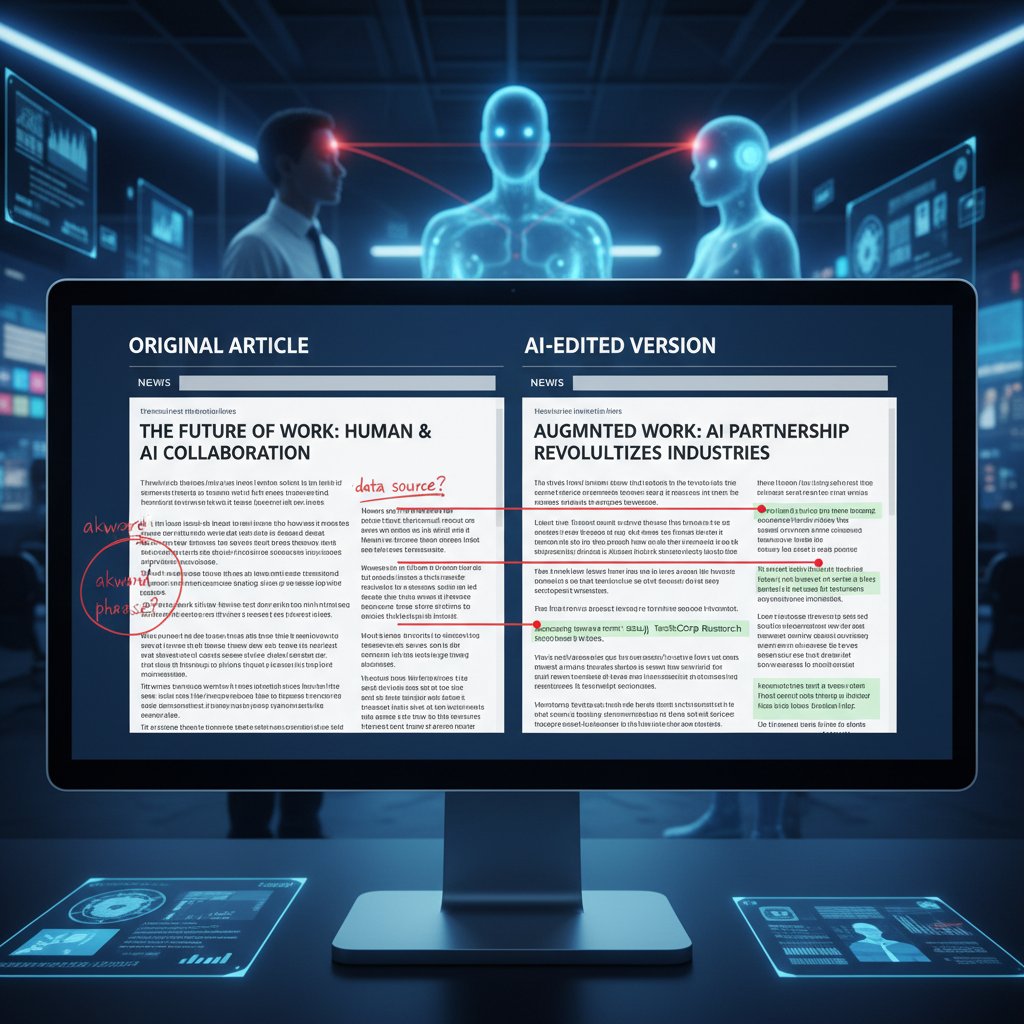
Not every outcome is binary. In many newsrooms, the collaborative process is a blurry dance—where it’s impossible to tell where human decision ends and AI suggestion begins. In one case, an investigative piece about local government corruption was edited by a hybrid team: the AI flagged inconsistencies, while human editors restored narrative flow and ensured ethical compliance.
Editorial negotiation with AI is its own skillset. Editors debate, override, or accept AI-recommended changes, sometimes leading to more robust, nuanced journalism—and other times, to Frankensteinian prose stitched together from algorithm and instinct.
Behind the algorithm: How AI editing really works
Inside the black box: LLMs, training data, and editorial logic
AI-powered news editing doesn’t just “happen.” It’s the result of vast LLMs trained on billions of words, guided by optimization routines that balance clarity, style, and engagement. These models select and rewrite content using statistical logic—if a phrase or framing appears more often in authoritative sources, it’s more likely to be adopted.
But the invisible hand shaping output is the training data. If a model ingests biased, outdated, or culturally narrow material, its edits reflect those weaknesses. Model tuning—where editors define desired tone, fact sources, and aggression in rewriting—is an ongoing, hands-on process.
"The story AI tells is only as objective as the data it devours." — Priya, Data Scientist, MDPI, 2023
Feature breakdown: What makes an AI-powered news generator tick
| Feature | newsnest.ai | Competitor A | Competitor B | Competitor C |
|---|---|---|---|---|
| Real-time news generation | Yes | Limited | No | No |
| Customization | Highly customizable | Basic | Moderate | Limited |
| Scalability | Unlimited | Restricted | Moderate | Restricted |
| Cost efficiency | Superior | Higher costs | Moderate | High |
| Accuracy & reliability | High | Variable | Moderate | Variable |
Table 4: Feature comparison of leading AI news editing tools. Source: Original analysis based on product documentation, newsnest.ai, and verified competitor sites.
Technical differentiators are real: real-time learning lets newsnest.ai and its peers adjust to breaking information. Topic modeling allows for granular content tailoring. Semantic rewriting ensures the tone aligns with editorial policy. Editors can fine-tune model parameters—rewriting aggressiveness, tone, even citation preferences—to optimize outcomes for each use case.
Common misconceptions and technical truths
The biggest myth? That AI-generated news editing is fully automatic and infallible. In reality, every implementation is a patchwork—part automation, part human stewardship.
Priority checklist for safe and effective AI-generated news editing:
- Vet all training data for bias and relevance.
- Define clear editorial policy “guardrails” for the AI.
- Implement human-in-the-loop checkpoints at every publishable step.
- Audit outputs regularly for factual and stylistic drift.
- Disclose AI involvement clearly to readers.
Transparency and explainability remain open challenges. Even the best models can “hallucinate” facts or misinterpret subtle cues, and most can’t explain their decisions in human-readable terms—making audit trails and oversight critical.
The ethics and accountability of AI-generated news editing
Can you trust an algorithm with the truth?
AI-edited journalism introduces ethical dilemmas without precedent. Who is accountable for a botched story: the engineer, the editor, or the algorithm itself? Current frameworks, such as the European Commission’s Ethics Guidelines for Trustworthy AI, recommend layered responsibility—developers, implementers, and supervisors all share the load.
Editorial guidelines for AI deployment lean on transparency, validation, and clear boundaries between automated and human-made decisions.
Ethical guidelines for deploying AI in editorial workflows:
- Always note the presence of AI-generated or AI-edited content.
- Maintain a human checkpoint for all high-stakes or sensitive stories.
- Regularly audit outputs for bias, error, or ethical blind spots.
- Avoid “black box” models when transparency is required for public trust.
Transparency, disclosure, and public trust
Readers are increasingly demanding to know if their news has been filtered or changed by algorithms. Some outlets now append “Edited by AI” disclaimers, while others quietly integrate AI into regular workflows with little or no disclosure.

The necessity for transparency isn’t just ethical—it’s pragmatic. According to Reuters Institute, 70% of senior editors believe that lack of disclosure risks eroding public trust, as readers feel deceived or manipulated by unseen automation.
Regulation and the future of AI editorial standards
Government bodies and industry groups are racing to define standards for AI-generated news editing. The EU’s AI Act (2024) is the first major regulation to require transparency and accountability in algorithmic news production. Watchdogs such as the European Data Protection Supervisor and the AI Now Institute are calling for regular audits, bias mitigation strategies, and stronger consumer rights.
Key regulatory bodies and standards:
Sets principles for trustworthy AI, including transparency, accountability, and bias prevention in news editing.
Researches and advocates for responsible AI deployment in media and society.
Industry group promoting editorial standards and best practices for automated journalism.
How to spot AI-edited news (and why it matters)
Tell-tale signs: What gives AI-edited stories away?
AI-edited news often wears a mask, but attentive readers can spot it. Watch for slightly too-perfect grammar, repetitive sentence structures, or a bland, neutral tone. Headlines optimized for SEO, rather than clarity, are another giveaway.
Subtle clues in AI-edited news stories:
- Overuse of certain phrases or templates
- Unnaturally even pacing—no dips in energy or abrupt transitions
- Heavy reliance on numerical data or citations, with little anecdotal color
- Consistent lack of regional slang or idiomatic expression
- Perfect spelling and formatting, yet oddly bland narrative
Detection tools exist, but most are unreliable against advanced LLMs—especially as newsrooms customize outputs.
Reader beware: Practical self-audit for news consumers
Not sure if your news was filtered through an algorithm? Take these steps:
- Check for disclosure: Look for statements about AI involvement at the top or bottom of the article.
- Assess the tone: Is the writing unusually neutral or formulaic?
- Verify sources: Are facts and quotes linked to reputable outlets?
- Search for repetition: Does the language echo other articles verbatim?
- Cross-reference facts: Use independent outlets to confirm the news item.

Can transparency be gamed? The cat-and-mouse of disclosure
Some organizations “game” transparency by burying AI disclosures in legalese or ambiguous language (“Our newsroom uses advanced editing tools”). Others rotate between AI and human editing, making it impossible for readers to trace content provenance. The result: growing skepticism and a slow erosion of public trust in media institutions.
Regulatory oversight is beginning to address these gaps, but for now, the onus is on newsrooms—and readers—to demand clarity.
Implementing AI editing in your newsroom: Survival guide
Setting up: What you need (and what to avoid)
Adopting AI news editors isn’t plug-and-play. Newsrooms need the right blend of technology, editorial oversight, and risk awareness.
Step-by-step guide to onboarding AI-generated news editing:
- Assess needs: Identify repetitive or high-volume content ripe for AI optimization.
- Select vendors: Vet tools for transparency, customizability, and compliance.
- Train staff: Upskill editors and engineers in hybrid workflows.
- Pilot and test: Roll out in low-risk areas first, measure impact.
- Audit and iterate: Regularly review outputs and refine processes.
| Cost Item | Estimated Cost | Notes |
|---|---|---|
| AI software/platform | $2,000–$10,000/year | Depends on scale, features |
| Custom hardware/cloud | $1,000–$5,000/year | For model training/deployment |
| Staff training | $500–$2,000 per editor | Workshops, online courses |
| Risk management/compliance | $1,000/year | Legal, regulatory reviews |
Table 5: Cost-benefit analysis of AI editing implementation. Source: Original analysis based on vendor pricing, WAN-IFRA, 2024
Workflow hacks: Maximizing the human-AI partnership
The best results come from editorial/AIl collaboration—not abdication.
Workflow tips for optimizing AI and editor collaboration:
- Assign clear “ownership” of each story to an editor, even when AI is involved.
- Use AI for first drafts or light copyediting—reserve human attention for sensitive or complex pieces.
- Schedule regular reviews of AI suggestions to spot drift or bias early.
- Encourage cross-functional teams (journalists, engineers, product managers) to refine workflows together.
Common pitfall? Letting AI outputs go live without review—a recipe for embarrassing errors and public backlash.
Measuring impact: What success looks like (and what doesn’t)
Key metrics for AI editing success include speed (turnaround time), accuracy (fact-check pass rates), and engagement (reader interaction, time-on-page). But qualitative feedback from staff and audiences is equally crucial—does the content feel authentic and trustworthy?
Gather feedback via:
- Anonymous staff surveys on workflow satisfaction
- Reader polls about trust and content clarity
- A/B testing headlines and story structure

Success isn’t just about numbers—it’s about reputation, adaptability, and the ability to learn from mistakes.
The future of AI-generated news editing: Destiny or dystopia?
Predictions and provocations: Where does it all lead?
Expert consensus is clear: AI-generated news editing isn’t a passing fad—it’s the new backbone of digital journalism. But the risks are as profound as the opportunities. Deepfakes, synthetic sources, and algorithm-driven info-wars threaten to destabilize public discourse. The tools that empower can also deceive.
"In five years, the news you trust may be written for an audience of one." — Alex, Media Futurist, Reuters Institute, 2024
The real question isn’t whether AI will dominate, but how we’ll navigate its influence.
The counter-narrative: Why humans may never be obsolete
Despite the hype, human editors remain irreplaceable when it comes to intuition, ethics, and cultural context. No algorithm can fully grasp the emotional undercurrents of a protest, the moral nuance of a whistleblower’s account, or the subtlety of satire.
Hybrid models—where AI handles volume and routine, while humans curate and contextualize—are proving most effective. The smartest newsrooms aren’t choosing sides; they’re designing workflows where both strengths shine.

What should readers, editors, and technologists do now?
For readers: Develop media literacy. Question sources, check for disclosures, and demand transparency.
For editors: Embrace AI as a tool, not a threat. Upskill, audit, and champion ethical guidelines.
For technologists: Design algorithms that are auditable, explainable, and culturally sensitive.
Priority checklist for thriving in an AI-edited news landscape:
- Demand transparency from news sources.
- Develop skills in both editorial judgment and algorithmic literacy.
- Regularly audit outputs for bias and error.
- Support regulations and standards for ethical AI.
- Stay informed through reputable, human-reviewed channels.
Staying ahead means embracing change, questioning easy answers, and never outsourcing responsibility for truth.
Adjacent frontiers: What AI-generated news editing teaches other industries
Lessons for content marketing, finance, and entertainment
The principles behind AI news editing—speed, scale, and data-driven optimization—are transforming other sectors.
In finance, automated reporting platforms deliver real-time market analysis, freeing up analysts for higher-order work. In content marketing, AI editors tailor brand messaging to individual demographics. In broadcast entertainment, script generators fuel rapid storyboarding.
| Industry | AI Editing Adoption | Key Applications | Challenges |
|---|---|---|---|
| News/Media | High | Article generation, fact-checking | Bias, trust |
| Finance | Moderate | Market summaries, fraud detection | Regulation, nuance |
| Marketing | High | Personalized content, A/B testing | Authenticity |
| Entertainment | Growing | Script writing, subtitling | Emotional resonance |
| Education | Moderate | Essay feedback, adaptive textbooks | Plagiarism, context |
Table 6: Comparative analysis of AI editing adoption across industries. Source: Original analysis based on industry reports and Statista, 2023
The battle for credibility: AI editing in the age of misinformation
AI editing is a double-edged sword in the misinformation wars. On one side, it enables rapid debunking and fact-checking. On the other, it can mass-produce persuasive fake news if left unchecked.
Proactive strategies against AI-generated fake news:
- Combine AI editing with real-time fact-checking databases.
- Design algorithms to flag unverified or low-trust sources.
- Partner with watchdogs, academia, and tech firms for coordinated defense.
- Educate readers on detection and critical evaluation.
Collaborations between news platforms, technology companies, and independent watchdogs are key to maintaining credibility.
From newsrooms to classrooms: AI editing as a teaching tool
The influence of AI editing doesn’t stop at publication. Educators are integrating these tools to teach writing, critical thinking, and media literacy. Journalism schools now offer courses in prompt engineering and AI ethics, preparing the next generation for hybrid editorial roles.

The lines between creation, curation, and critique are blurring. As more industries adopt these tools, the lessons learned in newsrooms—about bias, oversight, and transparency—will echo far beyond headlines.
Conclusion
AI-generated news editing isn’t just a technological leap; it’s a cultural reckoning. The newsroom revolution is here, and the stakes have never been higher. As we’ve seen, algorithms can amplify both truth and error, democratize creation and fuel new gatekeeping, empower journalists and threaten established roles—all at once. The key isn’t to worship or fear the algorithm, but to wield it with discernment, skepticism, and relentless transparency.
For publishers, the challenge is building workflows that honor both speed and substance. For readers, it’s learning to spot the fingerprints of automation—and demanding honesty about where the human ends and the machine begins. For technologists, it’s a call to design systems that don’t just optimize for clicks, but for credibility.
Newsnest.ai and other platforms are at the vanguard, but the responsibility lies with all of us. In the end, the truth of the news will depend not on who edits it, but on who cares enough to ask how, and why, it was edited at all.
Sources
References cited in this article
- Statista: AI and News(statista.com)
- Reuters Institute: Journalism Trends 2024(reutersinstitute.politics.ox.ac.uk)
- WAN-IFRA: Generative AI in Newsrooms(wan-ifra.org)
- MDPI: Digital Newsroom Transformation(mdpi.com)
- AI Toolr: AI Timeline(ai-toolr.com)
- CMSWire: Generative AI Timeline(cmswire.com)
- Fortune Business Insights: AI Video Generator Market(fortunebusinessinsights.com)
- Zion Market Research: AI-Powered Content Creation(zionmarketresearch.com)
- Frontiers in Communication(frontiersin.org)
- Brookings: AI Equity Lab(brookings.edu)
- Reuters Institute: Changing Newsrooms 2023(reutersinstitute.politics.ox.ac.uk)
- AP Survey on AI in Newsrooms(ap.org)
- CNBC: AI Job Losses(cnbc.com)
- AIPRM: AI Replacing Jobs(aiprm.com)
- Reuters Institute: Public Attitudes Towards AI in Journalism(reutersinstitute.politics.ox.ac.uk)
- APA PsycNet: AI and Media Bias(psycnet.apa.org)
- Aimultiple: AI Bias(research.aimultiple.com)
- AlgorithmUse: AI and Objectivity(algorithmuse.com)
- Quintype: AI Newsroom Trends(blog.quintype.com)
- Politico: AI in Media(politico.com)
- Paris Charter on AI in Journalism (PDF)(rsf.org)
- Poynter: AI Ethics Policy(poynter.org)
- Harvard Berkman Klein Center(papers.ssrn.com)
Instantly Generate Breaking News
NewsNest.ai delivers a revolutionary AI-driven news platform, empowering businesses and individuals by automatically generating timely, credible, and engaging news articles. With real-time coverage, deep accuracy, and customizability, you can effortlessly stay informed and ahead of the competition. Eliminate costly journalistic resources and gain instant access to quality content tailored specifically to your preferences and industry focus.
Get startedReady to revolutionize your news production?
Join leading publishers who trust NewsNest.ai for instant, quality news content
Frequently Asked Questions
When did AI-generated news editing begin?
The roots of AI in news editing trace back to the 1950s-60s with Alan Turing's work on machine thinking and rule-based expert systems. However, the real inflection point came with the rise of large language models and deep neural networks, which allowed AI editors to process nuance, context, and style rather than just numbers.
What specific tasks do AI editors perform in newsrooms?
According to the article, newsrooms are experimenting with AI-powered summarization, tagging, translation, end-to-end article generation, and editing. By 2023, over half of news industry leaders viewed back-end AI automation as the most important newsroom technology shift.
How widespread is AI editing adoption in the news industry?
By the end of 2023, over half of news industry leaders viewed back-end AI automation as crucial for 2024, and by 2024, over 56% of news organizations were using AI for editing tasks as part of hybrid workflows.
What early forms of AI did news agencies like AP and Reuters use?
In the early 2010s, news agencies like the Associated Press and Reuters began using simple natural language generation scripts to automate routine content such as earnings reports and sports recaps.
Keep Reading
See more from AI-powered news generator

How AI-Generated Journalism Software Is Reshaping Newsrooms

How AI-Generated News Software Events Are Reshaping Journalism

How AI Automation Is Transforming Newsrooms in 2025

AI-Generated News Software: How It's Transforming Journalism

AI-Generated Journalism Software: How Newsrooms Are Changing
