

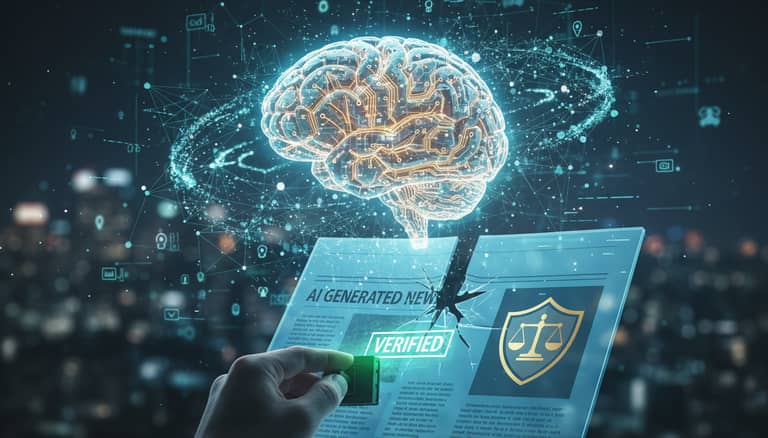
AI-Generated News Credibility: Who to Trust When No One Agrees
Written with AI assistance under our editorial guidelines
AI-generated fake news sites surged over 1,000% as of May 2024, making it increasingly difficult to distinguish credible reporting from fabricated content. Deepfakes and hallucinated headlines spread rapidly across social media, influencing financial markets and elections before fact-checkers can respond, creating an urgent credibility crisis in journalism and public discourse.
Crank up the brightness on your screen and brace yourself: AI-generated news credibility isn’t just the next battleground in journalism—it’s the front line in a war for truth, trust, and the shape of reality itself. In an era when a political deepfake can tank a stock market before breakfast, or a “hallucinated” headline goes viral in minutes, the stakes are existential. This isn’t abstract theory; these are the headlines feeding your feed, the stories shaping elections, and the narratives rewriting our collective memory. As of May 2024, AI-generated fake news sites have exploded by over 1,000%, according to NewsGuard and McAfee, leaving readers and editors scrambling for the truth. The question isn’t whether you can trust AI-generated news—it’s whether you can afford not to know how it works, what’s real, and who benefits from the chaos. So grab your coffee, keep your skepticism sharp, and dive deep into a world where the line between credible and counterfeit is getting blurrier by the hour.
Welcome to the credibility crisis: why AI-generated news is under fire
The viral fake that changed everything
It was just another Tuesday, until an image of President Biden—in full military regalia, supposedly delivering an ultimatum to a foreign government—rocketed across social media. Except it wasn’t real. The photo was fabricated by an AI model, its origins traceable to a cluster of servers nowhere near Washington, D.C. Within hours, the image had racked up millions of views, influenced financial markets, and even spurred diplomatic denials. According to Reuters Institute, 2024, deepfake-driven stories like these have become the new normal in political disinformation campaigns.

"The scale and sophistication of AI-generated fake news are increasing at a pace that traditional fact-checking simply can’t match. It’s a credibility crisis on steroids." — Anna-Sophie Harling, Managing Director, NewsGuard Europe, NewsGuard, 2024
This wasn’t a one-off. From viral TikToks showing AI-generated “eyewitness” videos of non-existent disasters, to entire sites spewing machine-crafted propaganda, 2023–2024 has seen an arms race in digital deception. The casualties? Public trust, institutional credibility, and—if you’re not vigilant—your own grip on reality.
How trust in news collapsed (before AI even showed up)
If you think AI single-handedly destroyed trust in news, think again. The rot set in long before the bots arrived. Sensationalist headlines, echo chambers, and weaponized misinformation eroded faith in journalism bit by bit. According to the Reuters Institute Digital News Report 2023, global trust in news dipped to 40%, with only 29% of Swiss respondents willing to read fully AI-generated news (Vogler et al., 2023).
| Year | Global Trust in News (%) | Major Event Impacting Trust | AI-generated News Sites |
|---|---|---|---|
| 2018 | 44 | Facebook/Cambridge Analytica scandal | 2 |
| 2020 | 42 | COVID-19 disinformation | 15 |
| 2022 | 41 | Ukraine war propaganda | 49 |
| 2024 | 40 | AI-generated deepfakes surge | 600+ |
Table 1: The slow decline of news trust and the rise of AI-generated news sites. Source: Reuters Institute 2023, NewsGuard AI Tracking Center, 2024
The collapse of trust created a power vacuum—one now filled by AI, for better or worse. But don’t let nostalgia fool you: legacy media’s own missteps primed audiences for skepticism, making the current AI-driven credibility crisis not just a tech story, but a cultural reckoning.
AI steps into the chaos: hope or horror?
Enter AI, not as savior but as accelerant. On one hand, platforms like newsnest.ai promise real-time news, scalable coverage, and cost savings that put traditional newsrooms on notice. On the other, AI’s turbocharged content engines also enable bad actors to generate fake news sites at industrial scale—over 600 in just one year, a 1,100% jump according to McAfee Blog, 2024.
The central paradox? AI can both restore and ravage credibility, depending on who’s steering the ship. Some newsrooms wield AI as a tool for accuracy and speed; others see it as an existential threat. Whether AI is hope or horror isn’t just a binary—it’s a spectrum, shifting with every algorithm update and every new fake headline.

How AI-generated news actually works (and what they won’t tell you)
From prompt to publish: the real pipeline
You tap a few words into a headline generator. Seconds later, a full-blown article—complete with quotes, images, and “sources”—appears on your screen. It feels magic. But behind the curtain, a complex pipeline hums: data collection, model selection, prompt engineering, content generation, human review (maybe), and final publication. Each stage brings its own risks and opportunities for bias, error, and manipulation.

| Stage | Human Involvement | Potential Weak Point |
|---|---|---|
| Data selection | Occasional | Source bias, quality |
| Model training | Minimal | Algorithmic bias |
| Prompt engineering | Moderate | Manipulation |
| Content generation | None | Hallucination, error |
| Editorial review | Sometimes | Human oversight |
| Publication | Yes | Editorial standards |
Table 2: Anatomy of the AI news pipeline. Source: Original analysis based on EBU News Report 2024, PNAS Nexus, 2023
The devil’s in the details: “prompt-to-publish” can mean anything from rapid-fire blogs to in-depth reporting with multiple AI checkpoints. But if you think machines are running the newsroom solo, think again.
The role of Large Language Models: myth vs. reality
Everyone’s talking about Large Language Models (LLMs) like they’re digital oracles—but what are they really, and where do the myths end?
A neural network trained on vast amounts of text to predict and generate language, capable of writing news, stories, and even code. According to Built In, 2024, LLMs can reach up to 98% accuracy on fact checks—when used correctly.
When an AI model generates plausible-sounding but false information. This isn’t intentional lying; it’s the byproduct of statistical pattern recognition with no “common sense.”
The smallest unit of language processed by an LLM. Understanding tokens is crucial for grasping why some AI articles are verbose or oddly phrased.
The myth? That LLMs “understand” news like humans. Reality? They remix, predict, and reconstruct based on probabilities—not intuition or investigative rigor. The result: lightning-fast headlines, with accuracy only as good as their inputs and architecture.
Human hands in the machine: newsnest.ai and the new editorial workflow
Don’t buy the hype that AI news is “hands-off.” Platforms like newsnest.ai blend automation with editorial review, aiming to avoid the pitfalls of unchecked algorithmic output. Human editors prompt, tweak, fact-check, and sometimes rewrite AI drafts before publication. The smartest newsrooms don’t just deploy AI—they domesticate it.
"Editorial oversight is non-negotiable. AI can draft, but the final judgment belongs to an editor who understands context, nuance, and the stakes." — Editorial Lead, newsnest.ai, 2024
This hybrid workflow doesn’t just save time. It acts as a failsafe against hallucinated facts, bias, or ethical lapses. The next time you read an AI-generated story that actually gets the facts right, tip your hat to the unseen human in the loop.
The anatomy of bias: is AI more honest—or just differently flawed?
Algorithmic bias: how invisible fingerprints shape stories
Algorithmic bias isn’t science fiction. It’s the fingerprint that lingers on every AI-crafted headline and pull-quote. If a model is trained on data from Western news outlets, its reporting on geopolitics or race issues will reflect those implicit biases—sometimes subtly, sometimes glaringly.

This isn’t just about offensive language or stereotypes. Bias can mean underreporting certain topics, amplifying others, or skewing the perceived importance of a story. According to Cools & Diakopoulos, 2024, algorithmic fingerprints are shaping what gets covered—and what gets left out.
Algorithmic bias isn’t always easy to spot. It creeps in through training data, model architecture, and even the phrasing of user prompts. The end product may look authoritative, but beneath the surface, it can subtly reinforce existing power structures and priorities.
Humans vs. machines: who’s really more biased?
It’s a fair question: are humans or machines more prone to bias? Both have blind spots, but the nature—and scale—differs.
| Bias Type | AI-generated News | Human-written News |
|---|---|---|
| Confirmation | Moderate | High |
| Selection | High | Moderate |
| Overt Prejudice | Low | Variable |
| Scale | Industrial | Individual |
| Accountability | Tricky | Traceable |
Table 3: Comparative bias in AI vs human news reporting. Source: Original analysis based on PNAS Nexus, 2023, Reuters Institute 2023
"Algorithmic bias is rarely intentional but always impactful. It’s easier to spot in humans, harder to decode in code." — Dr. Nicholas Diakopoulos, EBU News Report 2024
The upshot? AI can flatten certain human prejudices, but it can’t escape the fingerprints of its creators and data.
Case studies: when AI got it shockingly right (or wrong)
AI-generated news isn’t all doom or triumph—it’s a messy, evolving spectrum. Here’s a breakdown:
- In 2023, an AI fact-checking model flagged a viral “miracle cure” story as false minutes after publication, saving a health site from a major scandal.
- Conversely, a deepfake video of a government official announcing a fabricated policy change reached 2 million viewers before being debunked by NewsGuard, 2024.
- AI-generated “local news” sites have been caught publishing plagiarized or hallucinated content, leading to public apologies and retractions.
What’s the lesson? AI can outpace humans at debunking misinformation—when properly configured. But when left unchecked, it amplifies error with the efficiency of a printing press on steroids.
Spotting truth in the noise: how to evaluate AI news credibility
Red flags and subtle signals: what to look for
Sifting truth from machine-made fiction isn’t a lost cause—if you know what to watch for. Here’s what seasoned fact-checkers and digital natives seek out:
- Overly generic language or repetitive phrasing, especially in breaking stories.
- Lack of transparent sourcing—no named reporters, no links to original data, no editorial byline.
- Suspiciously fast updates, sometimes within seconds of an event unfolding.
- Headlines that verge on sensationalism without evidence.
- Image artifacts or uncanny “photographs” that look almost, but not quite, real.

These indicators aren’t foolproof, but they’re a start. If you spot more than one, proceed with caution and dig deeper before sharing or believing.
Step-by-step: a reader’s guide to AI news verification
You don’t need a PhD in machine learning to verify AI-generated news—just a disciplined approach.
- Check the byline: Is a real person named as the author? If not, be skeptical.
- Cross-reference the facts: Search for the same story on trusted outlets with known editorial standards.
- Scrutinize images: Use reverse image search to spot out-of-place or generative visuals.
- Analyze the writing style: Watch for formulaic structure or awkward phrasing.
- Look for sourcing: Are studies, experts, or official statements cited—and are those links legit?
Even seasoned readers get fooled, but applying these steps dramatically reduces your risk.
In a world where AI can draft, edit, and publish at warp speed, slow, methodical verification is your best armor against credulity.
Interactive checklist: is this story too good to be true?
Use this quick-fire checklist next time you stumble on a jaw-dropping headline:
- Does the story sound sensational or emotionally charged?
- Are there images or videos that look uncanny or contextless?
- Is there an author, and are they traceable online?
- Do links in the story point to reputable, accessible sources?
- Has another major outlet reported the same story independently?
If you answer “no” or “not sure” to more than two questions, it’s time to pump the brakes—odds are, you’re staring at an AI-generated mirage.
The truth is rarely as tidy—or as viral—as an AI-crafted headline would have you believe.
The psychology of trust: why we fall for AI news (and how to fight back)
Cognitive shortcuts and digital overload
Our brains aren’t wired for infinite feeds. Under digital siege, we rely on cognitive shortcuts—confirmation bias, authority bias, and social proof—to sift through what’s real. AI-generated news, engineered for engagement, exploits these vulnerabilities mercilessly.

According to PNAS Nexus, 2023, labeling news as “AI-generated” can decrease perceived credibility, even if the content itself is accurate. Ironically, our skepticism sometimes works against us, leading to misplaced trust in human-written—but equally flawed—stories.
Our digital overload isn’t just a tech problem; it’s a psychological minefield where AI can play both hero and villain.
Trust fatigue: when skepticism backfires
Relentless exposure to deepfakes, manipulated news, and AI-generated clickbait can trigger “trust fatigue.” That’s when readers—burned too many times—stop believing anything, or worse, double down on tribal loyalties regardless of the facts.
"The paradox of trust is that too much skepticism breeds apathy, making us more vulnerable to manipulation, not less." — Dr. Rasmus Kleis Nielsen, Reuters Institute, 2023
Trust fatigue isn’t just a buzzword; it’s a measurable drop in civic engagement, media literacy, and societal cohesion. In the AI age, the line between healthy skepticism and destructive cynicism is thinner than ever.
The cure isn’t more doubt, but better tools, habits, and critical awareness.
Building your news literacy muscle
Forget passive consumption—news literacy now demands active resistance.
- Educate yourself on how AI-generated news is made and distributed.
- Regularly practice fact-checking, even on stories that confirm your beliefs.
- Familiarize yourself with reverse image and video search tools.
- Support outlets and platforms with transparent editorial standards.
- Share only what you can verify, not just what’s viral.
Media literacy isn’t innate—it’s a muscle that needs regular, rigorous exercise. In the AI era, it’s your best defense against believing the unbelievable.
Global perspectives: AI-generated news credibility around the world
Who trusts AI news? Surprising stats from five continents
Think skepticism about AI news is a Western quirk? The reality is more complex. Attitudes toward AI-generated journalism vary dramatically by country, shaped by cultural, political, and technological factors.
| Country/Region | Trust in AI-generated News (%) | Major Concern |
|---|---|---|
| Switzerland | 29 | Authenticity, job loss |
| United States | 34 | Polarization, deepfakes |
| Brazil | 43 | Political manipulation |
| India | 61 | Language access, speed |
| South Africa | 48 | Media freedom, transparency |
Table 4: Global attitudes toward AI news credibility. Source: Fletcher & Nielsen, 2024, [Vogler et al., 2023]

Europeans generally show more skepticism, while readers in India and South Africa cite AI as a tool for bridging information gaps. Trust remains fragile everywhere, but the reasons for doubt—and hope—are far from universal.
Censorship, freedom, and AI: the new front lines
AI doesn’t exist in a vacuum. In some countries, it’s a force multiplier for censorship and propaganda; in others, a tool for bypassing state-dominated media.
- In China, state media deploys AI to produce sanitized, party-approved reports at scale.
- In Iran, AI-generated “news” sites have been traced to disinformation campaigns targeting foreign audiences.
- In democratic societies, watchdogs use AI to detect censorship and uncover hidden narratives.
The battle lines are as much about freedom and control as about technology.
List of frontline issues in the global AI news war:
- State-sponsored AI news manipulation
- Cross-border disinformation campaigns
- Efforts to build open-source, censorship-resistant AI journalism platforms
Where you live shapes not just your news diet, but the algorithms curating it.
The silent arms race: how newsrooms are adapting (or resisting)
Not every newsroom is racing to automate. Some resist, doubling down on old-school reporting and human judgment. Others are pivoting, training journalists to work with AI, not against it.
"You can’t put the genie back in the bottle. The challenge is building workflows that harness AI’s speed without sacrificing credibility." — Editor-in-Chief, leading international news outlet, 2024
This silent arms race isn’t just about tools—it’s about philosophy. Do you trust human instinct, machine logic, or a mix of both? The answer, as always, depends on whose truth is at stake.
Regulation, accountability, and the future of AI news
Who’s responsible when AI gets it wrong?
Responsibility is slippery in the AI era. When a human reporter errs, accountability is clear. When an AI generates a libelous story, who’s to blame—coder, publisher, or the model itself?
The obligation to answer for errors or harm caused. In AI news, this is complicated by opaque algorithms and blurred roles.
Openness about how news is produced, including whether AI or humans are involved. Vital for rebuilding trust.
Remedies for those harmed by false AI-generated news—still a legal gray zone in many countries.
The current patchwork of policies leaves plenty of room for loopholes and buck-passing. As AI-generated news proliferates, the demand for clear lines of responsibility only intensifies.
The patchwork of global regulations (and what’s coming next)
Laws governing AI in news media are new, uneven, and often contradictory. Here’s a snapshot:
| Region/Country | Regulation Status | Key Provisions |
|---|---|---|
| EU | Draft AI Act (2024) | Transparency, risk classification, fines |
| USA | State laws, pending | Disclosure, consumer protection, anti-fraud |
| China | Strict state controls | Licensing, censorship, content vetting |
| Australia | Industry guidelines | Self-regulation, public complaints |
Table 5: Regulatory landscape for AI-generated news. Source: Original analysis based on EBU News Report 2024
Some regions emphasize transparency and user protection; others prioritize control and censorship. The regulatory landscape is a moving target, with implications for every newsroom and reader.
Regulation isn’t a panacea, but it’s a start. Until standards mature, the onus remains on platforms, publishers, and vigilant readers.
Building a credible future: industry initiatives and watchdogs
Progress isn’t just about laws. Industry groups, academic watchdogs, and tech coalitions are racing to build trust in the AI news ecosystem.
- Implementation of provenance-tracking for images and articles (Content Authenticity Initiative).
- Cross-industry fact-checking alliances to validate AI output in real time.
- Reader education campaigns, like media literacy drives and transparency labels on AI-generated stories.
The most credible future for AI news isn’t handed down by regulators—it’s built by a coalition of honest actors, rigorous standards, and a public that demands accountability.
Beyond the hype: hidden benefits and unconventional uses of AI news
Uncovering the unexpected upsides
It’s not all doomscrolling. AI-generated news, when wielded responsibly, delivers distinct advantages:
- Speed: Instant reporting on breaking events, from earthquakes to elections, that outpaces human teams.
- Personalization: Hyper-relevant updates tailored by topic, region, and even reading level—already leveraged by newsnest.ai.
- Language diversity: AI bridges linguistic divides, making global news accessible in dozens of languages.
- Cost efficiency: Dramatic reduction in overhead for small publishers, enabling broader coverage.

The catch? Each benefit demands responsible oversight and relentless quality control.
AI news in crisis: case studies from disaster zones
When disaster strikes—natural or manmade—AI-generated news can be a lifeline. Consider these cases:
- During the 2023 flooding in Southeast Asia, AI models pushed out evacuation updates in multiple languages within minutes, reaching remote villages before human reporters could arrive.
- In the wake of California wildfires, AI newsbots provided real-time air quality alerts, outperforming traditional outlets for speed and precision.
- After a major cyberattack, AI-generated updates synthesized government, healthcare, and emergency feeds to help citizens navigate chaos.
Unordered list of unconventional uses:
- Automated weather and safety bulletins
- Translation of public health alerts
- Rapid aggregation of eyewitness reports (with verification)
- Support for first responders through synthesized situational awareness
The lesson: When speed and scale are critical, AI-generated news can fill real gaps that legacy media simply can’t.
When AI amplifies marginalized voices
AI isn’t just a tool for the powerful. Under the right conditions, it can amplify stories that traditional gatekeepers overlook.
"We’ve seen AI-generated local news sites cover stories in indigenous languages, reaching readers mainstream outlets ignore." — Media Literacy Advocate, 2024
From regional politics to activism in underreported communities, responsible use of AI helps democratize access to news—if equity and representation are built into the design.
But beware: amplification cuts both ways. Without deliberate safeguards, AI can just as easily serve as a megaphone for the loudest, not the most marginalized.
Your action plan: mastering AI-generated news credibility in 2025 and beyond
Priority checklist for smarter news consumption
Ready to level up your AI news literacy? Here’s your action plan:
- Prioritize sources with named editorial teams and transparent AI disclosure.
- Use browser plugins or tools that flag AI-generated content and check image provenance.
- Fact-check breaking stories, even from familiar platforms.
- Follow watchdogs and independent fact-checkers on social media.
- Discuss AI news credibility in your circles—don’t let confusion breed silence.
Building good habits now is your best shot at staying informed in an age of information overload.
The stakes aren’t just personal—they’re civic. The more critical and collaborative we are as readers, the stronger the ecosystem becomes.
How to talk to friends, family, and colleagues about AI news
Breaking the AI news credibility conversation out of your filter bubble matters. Here’s how:
- Explain that not all AI-generated news is fake, but all should be verified.
- Share simple tools and checklists for spotting red flags.
- Encourage open discussion of mistakes or near-misses—everyone gets fooled.
- Highlight the real risks (and benefits) of AI in news, using current examples.
- Advocate for transparency and accountability from all news sources.
The conversation doesn’t end at your inbox. Spread the skepticism and the skills.
Cultivating a culture of critical consumption is the only sustainable antidote to mass manipulation.
Staying ahead: resources and tools for the future
Don’t wait for the next deepfake to go viral. Arm yourself with these resources:
- Track AI-generated fake news sites at NewsGuard AI Tracking Center.
- Read in-depth reports from Reuters Institute and EBU.
- Use built-in browser plugins or trusted fact-checking tools to scan dubious headlines and images.
- Bookmark newsnest.ai for updates and best practices from the front lines of AI news credibility.

Staying ahead means proactive education, not passive consumption.
Supplementary section: the evolution of news credibility from print to AI
A brief timeline: from yellow journalism to neural nets
The credibility crisis didn’t start with AI. Here’s a timeline:
- 1890s: Yellow journalism—sensationalist, fact-optional headlines dominate U.S. press.
- 1930s–1950s: Radio and TV introduce new verification standards (and new propaganda).
- 1990s: The internet democratizes publishing—and accelerates misinformation.
- 2010s: Social media polarizes audiences and fragments trust.
- 2020s: AI-generated news explodes, forcing a reckoning over what’s real.

Every technology disrupts trust. It’s the response, not the tool, that sets the standard.
Lessons (not) learned from history
If history teaches anything, it’s that trust is fragile, and credibility must be constantly rebuilt.
The move from print to digital—and now to AI—has brought both opportunity and new vulnerabilities. Lessons learned?
- Transparency and accountability can’t be bolted on after a crisis.
- Tech can amplify both truth and lies; intent matters.
- Readers, not just producers, are gatekeepers of credibility.
| Era | Trust Challenge | Response |
|---|---|---|
| Yellow press | Sensationalism | Press councils, codes |
| Radio/TV | Propaganda, bias | Fact-checking, regulations |
| Digital | Viral misinformation | Platform moderation |
| AI | Deepfakes, scale | Transparency, hybrid review |
Table 6: Historical responses to credibility crises. Source: Original analysis based on PNAS Nexus, 2023, Reuters Institute 2023
Reckoning with AI news credibility means revisiting—and finally learning—the lessons of history.
Supplementary section: debunking the biggest myths about AI-generated news
Myth 1: AI can never be trusted with the truth
AI as an untrustworthy narrator? It’s not that simple.
Depends on data, oversight, and intent—not on the technology itself. According to Built In, 2024, AI fact-checkers can outperform humans when deployed responsibly.
Is a moving target, shaped by training inputs and editorial safeguards.
Don’t blame the tool—blame the hands holding it, and the rules (or lack thereof) in place.
Myth 2: AI news is always biased or manipulated
- AI can amplify preexisting biases, but so can human editors.
- The best platforms—like newsnest.ai—use hybrid workflows to minimize bias and errors.
- With open-source and transparent models, bias becomes easier to spot and correct.
- New AI tools actively flag “hallucinations” and discrepancies, supporting editorial accuracy.
Bias isn’t exclusive to machines. It’s a human problem with digital consequences.
The goal isn’t perfection, but measurable, transparent progress.
Myth 3: There’s no way to tell if news is AI-generated
- Look for disclosure labels—most reputable platforms now flag AI content.
- Use browser and image provenance tools to trace visual manipulation.
- Cross-check style, sourcing, and update speed: AI-generated news leaves subtle tells.
- Follow the verification steps outlined earlier—human vigilance trumps tech tricks.
The truth may be hidden, but it’s rarely invisible. Credible AI news leaves a trail for those who look.
Supplementary section: practical applications and real-world implications
How major industries are leveraging AI news
AI-generated news isn’t just for journalists. Here’s how major sectors are deploying it:
| Industry | Use Case | Outcome |
|---|---|---|
| Financial | Real-time market updates | Faster investor response |
| Technology | Product launches, trend coverage | Audience growth, site traffic |
| Healthcare | Public health alerts, research synthesis | Improved patient trust |
| Media/Publishing | Breaking news, event coverage | Reduced delivery time |
Table 7: Industry adoption of AI-generated news. Source: Original analysis based on EBU News Report 2024
The upshot? AI-generated news supports efficiency and reach, but only when paired with diligent oversight.
Unexpected consequences: the dark side of algorithmic reporting
- Loss of local journalism jobs as publishers automate routine news.
- Increased vulnerability to mass-produced propaganda and targeted disinformation.
- “Hallucinated” facts or sources that slip past editorial review.
- Amplification of niche or fringe narratives, skewing public debate.

Every innovation has its shadow. Recognizing—and planning for—the dark side is part of credible adoption.
newsnest.ai: a case study in responsible AI news generation
At the heart of the credibility debate sits newsnest.ai, a platform blending cutting-edge automation with rigorous editorial standards. Rather than replacing journalists, it augments their work—slashing turnaround times without ditching integrity.
"Our approach is to keep humans in the loop at every crucial stage. AI drafts, but humans decide what runs—and what doesn’t. That synergy is the future of credible news." — Editorial Director, newsnest.ai, 2024
This hybrid model—where transparency, accountability, and human oversight are baked into the process—points the way forward for AI-driven journalism.
It’s not about man versus machine. It’s about using both, smarter.
Conclusion
Welcome to the new world disorder, where AI-generated news credibility is the litmus test for media survival and public trust. The surge in fake news sites—a staggering 1,000% increase in just a year—proves how quickly the lines can blur between authentic and artificial. But the tools for survival are already in your hands: critical thinking, media literacy, and a willingness to ask the hard questions about every headline, image, and quote. Platforms like newsnest.ai are showing that automation doesn’t have to mean abdication of responsibility; when paired with rigorous human oversight, AI can enhance, not erode, journalistic integrity. The brutal truth? Credibility in news—AI-generated or not—will always depend on the vigilance of its audience, the transparency of its creators, and the relentless pursuit of fact over fiction. This isn’t the end of news, but a new beginning—if you’re willing to see past the algorithm and demand the truth.
Sources
References cited in this article
- NewsGuard AI Tracking Center(newsguardtech.com)
- McAfee Blog(mcafee.com)
- PNAS Nexus Study(academic.oup.com)
- Built In(builtin.com)
- EBU News Report 2024(ebu.ch)
- Virginia Tech News(news.vt.edu)
- Reuters Institute(reutersinstitute.politics.ox.ac.uk)
- World Economic Forum(weforum.org)
- Gallup(red.library.usd.edu)
- Newsweek Opinion(newsweek.com)
- AP AI Initiatives(ap.org)
- Reuters Institute(reutersinstitute.politics.ox.ac.uk)
- Frontiers in Communication(frontiersin.org)
- CNET AI Use(arxiv.org)
- NPR Example(npr.org)
- ONA Case Studies(journalists.org)
- ATC Editorial Workflows(atc.gr)
- Nieman Lab(niemanlab.org)
- Scientific Reports(nature.com)
- Pew Research(pewresearch.org)
- arXiv Bias Study(arxiv.org)
- TechTarget(techtarget.com)
- Corwin Connect(corwin-connect.com)
- Psychology of Singularity(psychologyofsingularity.com)
- Frontiers in Psychology(frontiersin.org)
- Forbes(forbes.com)
- NLP AI Resources(newslit.org)
- UNESCO Brief(unesco.org)
- Reuters Institute(reutersinstitute.politics.ox.ac.uk)
- Salesforce Global Survey(salesforce.com)
- Freedom House Report(freedomhouse.org)
- MIT Technology Review(technologyreview.com)
- TIME(time.com)
Instantly Generate Breaking News
NewsNest.ai delivers a revolutionary AI-driven news platform, empowering businesses and individuals by automatically generating timely, credible, and engaging news articles. With real-time coverage, deep accuracy, and customizability, you can effortlessly stay informed and ahead of the competition. Eliminate costly journalistic resources and gain instant access to quality content tailored specifically to your preferences and industry focus.
Get startedReady to revolutionize your news production?
Join leading publishers who trust NewsNest.ai for instant, quality news content
Frequently Asked Questions
How much have AI-generated fake news sites increased?
According to NewsGuard and McAfee, as of May 2024, AI-generated fake news sites have exploded by over 1,000%.
What was the example of the viral fake mentioned in the article?
An AI-fabricated image of President Biden in military regalia supposedly delivering an ultimatum to a foreign government went viral across social media, reaching millions of views and influencing financial markets before being identified as fake.
What does Anna-Sophie Harling say about the challenge of AI-generated fake news?
Harling, Managing Director of NewsGuard Europe, states that the scale and sophistication of AI-generated fake news are increasing faster than traditional fact-checking can keep pace with, calling it a credibility crisis on steroids.
What types of AI-generated fake content have emerged in 2023-2024?
The article mentions viral TikToks showing AI-generated eyewitness videos of non-existent disasters, and entire websites producing machine-crafted propaganda as examples of the escalating arms race in digital deception.
Keep Reading
See more from AI-powered news generator

AI-Generated News Authenticity: How to Identify Real Reporting

AI-Generated News Trustworthiness: What the Evidence Shows

How AI-Generated News Verification Tools Actually Perform

AI-Generated News Versus Human Journalists: Reliability Compared

AI-Generated News Accuracy and the New Crisis of Trust
