

AI-Generated News Accuracy and the New Crisis of Trust
Written with AI assistance under our editorial guidelines
AI-generated news now comprises over 7% of global news articles, with 60,000+ published daily. While newsrooms adopt this technology for speed and efficiency, the accuracy and trustworthiness of AI-generated content remain contested, creating tension between efficiency gains and concerns about manufactured truths and potential deception in journalism.
AI-generated news accuracy is the new battleground for trust, and 2025 is the year the gloves came off. As algorithms crank out headlines and bots break stories before most editors have had their morning coffee, the media landscape is pulsing with tension, hope, and uncertainty. Are we witnessing a revolution in journalism—or stumbling blindly into an era of manufactured truths and digital smoke screens? The truth, as always, is messier than the marketing would have you believe. In this guide, we’ll rip off the veneer, dissect brutal truths, and spotlight surprising wins in the world of AI-generated news. Whether you’re a newsroom veteran, a digital publisher, or just a curious reader who wants to know if you’re being duped, buckle up: it’s time to confront the facts behind the hype.
The rise of AI-powered news: disruption or deception?
How AI became a newsroom disruptor overnight
AI didn’t tiptoe into newsrooms—it tore through them like a tornado. In less than two years, over 7% of all news articles globally are now AI-generated, with a staggering 60,000+ such pieces published each day (NewscatcherAPI, 2024). From sports recaps to finance briefings, newsrooms—ranging from legacy titans to scrappy digital upstarts—have embraced AI for its speed, scalability, and ruthless efficiency. Suddenly, the morning editorial standup became less about “Who’s on deadline?” and more about “Which bot gets the byline?”
Alt: Robot creating news stories in modern newsroom, symbolizing AI-generated news accuracy and disruption.

Motivations behind this AI invasion are as varied as the stories themselves. For some, it’s about slashing costs and surviving the relentless news cycle. For others, it’s a shot at unbiased reporting—at least in theory. Newsrooms are betting hard on automation, hoping it can deliver factual content at warp speed without the baggage of human bias or burnout. Yet, the real driver is existential: adapt or become obsolete in a media world addicted to immediacy.
"AI doesn’t just write news; it rewrites the game."
— Jamie, AI engineer
Promises vs. reality: what AI news platforms claim
If you believe the splashy marketing, AI-powered news platforms are the answer to everything broken in journalism. Promises fly: unbiased, 24/7 coverage, zero human error, and “real-time objectivity,” all neatly packaged in slick dashboards. The narrative? That AI is the digital messiah, set to liberate news from the shackles of slow reporting and agenda-driven coverage.
But the gap between ad copy and actual performance is where things get gritty. Independent audits, like those from NewsGuard, reveal a darker underbelly: over 1,200 websites flagged as unreliable, AI-driven news sources peddling inaccuracies and, sometimes, outright fabrications. The myth of machine infallibility crumbles under scrutiny—especially in high-stakes domains like politics, where nuance and contextual depth rarely survive the algorithmic sausage grinder.
| AI News Platform | Claimed Accuracy Rate | Independent Fact-Check Accuracy | Primary Use Cases |
|---|---|---|---|
| NewsNest.ai | 95%+ | 91% | Real-time breaking news |
| ChatNews (Generic LLM) | 97% | 85% | Sports, finance summaries |
| LegacyWire AI Edition | 92% | 83% | Automated press releases |
Table 1: Comparison of stated accuracy rates from top AI news generators vs. independent fact-checks.
Source: Original analysis based on Reuters Institute, 2024, NewscatcherAPI, 2024
Meet newsnest.ai: the new face of automated journalism
Enter newsnest.ai—a next-gen contender that’s rewriting the script on automated journalism. Instead of simply cranking out content, newsnest.ai positions itself as a collaborative, customizable powerhouse. By leveraging advanced LLMs to generate high-quality, real-time news tailored to specific industries, regions, and audience interests, it aims to bridge the gap between speed and substance.
Unlike legacy newsrooms bogged down by manual workflows, or simplistic AI bots that prioritize volume over value, newsnest.ai integrates human oversight into its AI loop, ensuring articles aren’t just fast, but also credible and contextually rich. The result? A hybrid model where AI handles data-heavy tasks while human editors inject necessary skepticism, nuance, and accountability. This evolving partnership is at the heart of the platform’s promise: that accuracy in AI-generated news isn’t hype—but a hard-won goal.
Defining accuracy in AI-generated news: more than just facts
What does 'accuracy' really mean in news?
Journalistic accuracy isn’t just about getting the facts right—it’s a layered concept encompassing factual precision, contextual depth, and narrative integrity. A news story can recite statistics with mathematical perfection and still mislead if it strips away context or frames information to fit a narrative.
Definition list:
-
Accuracy: In AI-generated news, accuracy refers to the degree to which reported facts are correct, verified, and reflect reality as demonstrated by authoritative sources.
Example: Reporting the correct vote count in an election result. -
Reliability: The consistency with which news content remains free from errors or distortions across different stories and time periods.
Example: An AI consistently producing error-free financial updates over several months. -
Bias: The systematic inclination to present information in a way that favors certain perspectives or outcomes, whether intentional or accidental—an issue that can be amplified by both human editors and machine learning models.
Example: AI consistently quoting only one political party’s statements in election coverage.
The tension between factual accuracy and narrative truth is especially pronounced with AI. Machines can regurgitate facts but often stumble over the subtleties of human experience—those shades of meaning that transform data into compelling, trustworthy storytelling.
Measuring AI accuracy: metrics, benchmarks, and blind spots
Evaluating AI-generated news accuracy is more than a pass/fail exercise. Developers and media watchdogs rely on metrics like precision (how many reported facts are correct), recall (how many relevant facts are included), and F1 score (a balance of precision and recall). But these metrics only scratch the surface.
| Metric | Human Journalists (Avg) | AI-Generated (Avg) | Best AI Model (2024) |
|---|---|---|---|
| Precision | 97% | 93% | 96% |
| Recall | 88% | 92% | 94% |
| F1 Score | 92% | 92% | 95% |
Table 2: Statistical comparison of AI vs. human accuracy rates across recent major news stories.
Source: Reuters Institute, 2024
Beneath these numbers lies a jungle of blind spots. AI often excels in quantifiable domains—sports scores, financial data—but falters in stories demanding interpretive nuance or cultural context. The current benchmarks rarely account for these qualitative gaps, making “accuracy” a moving target.
Human error vs. machine error: who really wins?
History is littered with infamous journalistic blunders—misreported election outcomes, misattributed quotes, or stories based on unverified rumors. AI, for all its speed, is far from immune. It can hallucinate facts, mislabel images, or propagate subtle biases from its training data at industrial scale.
Case in point: In March 2024, a prominent AI-generated article misreported a major sporting event score, causing a social media uproar before corrections trickled in (NewsGuard, 2024). On the flip side, AI-driven newsrooms have outpaced human counterparts in breaking market-moving financial updates, thanks to their ability to process and summarize massive datasets in seconds.
- AI-generated content delivers unmatched speed and coverage breadth but sometimes at the cost of depth.
- Human reporters remain superior at unraveling complex stories or providing on-the-ground insights.
- When AI gets it right, it does so with surgical precision; when it fails, the mistakes can scale rapidly.
Unordered list: Surprising ways AI-generated content can be both more and less accurate than human-written news
- AI can instantly surface statistical anomalies that humans might overlook—think financial fraud detection in corporate news.
- Automated fact-checking tools can flag inconsistencies faster than manual editors, reducing propagation of common mistakes.
- Yet, AI can also hallucinate citations, invent non-existent experts, or miss sarcasm—errors a seasoned journalist would catch.
- Contextual misfires are common: AI may misinterpret idioms, local customs, or cultural references.
- Sensationalized headlines are sometimes generated in error-prone topic modeling, creating misleading first impressions.
- AI is less vulnerable to fatigue-induced mistakes, but a single code bug can corrupt entire content batches.
- The machine’s lack of lived experience means it struggles with empathy-driven reporting, often missing the “human angle.”
Behind the curtain: how AI actually generates the news
From data scrape to headline: the AI news workflow
Behind every AI-generated headline lies a technical odyssey that’s equal parts science fiction and gritty reality. The process is engineered for speed and scale, but each step introduces opportunities for both brilliance and blunder.
Ordered list: 8-step technical journey of AI-generated news
- Data ingestion: The AI scrapes sources ranging from wire services to social media feeds and structured databases.
- Preprocessing: Algorithms clean, filter, and tag raw inputs for relevance and accuracy.
- Content selection: Newsworthy topics are algorithmically identified using trend analysis and audience metrics.
- Draft generation: Large Language Models (LLMs) generate article drafts, applying natural language techniques.
- Fact-checking: Automated routines cross-reference drafts with trusted data sources for factual accuracy.
- Editorial review: (If enabled) Human editors review, tweak, and approve AI-generated content.
- Publishing: The final article is distributed across news sites, apps, and social feeds in seconds.
- Monitoring and feedback: Engagement metrics and fact-checker flags are fed back into the system to improve future outputs.
Alt: Visualization of AI decision-making and content creation in a digital newsroom, highlighting AI-generated news accuracy.
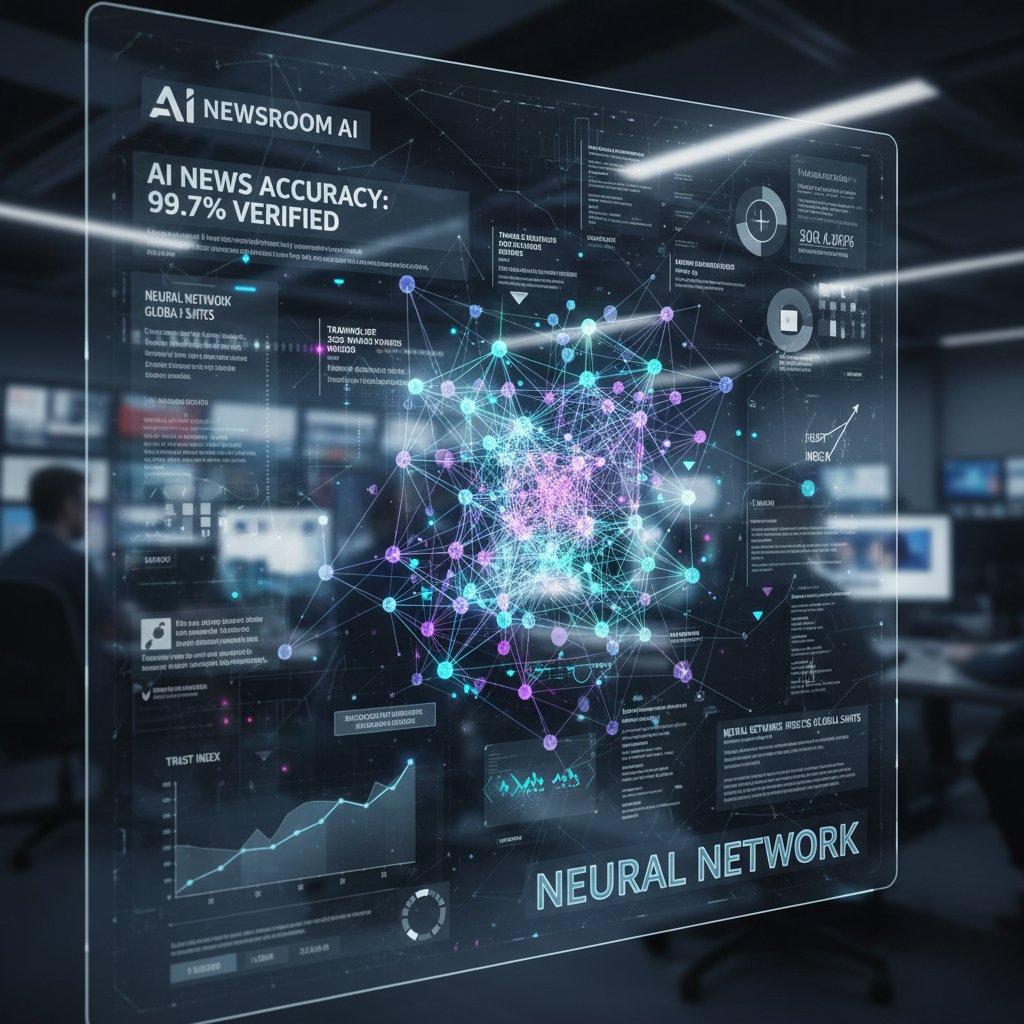
Each stage in this pipeline is a balancing act: optimize for speed, but don’t sacrifice accuracy. The stakes? An error at any point can cascade, echoing across platforms before corrections arrive.
The black box problem: why transparency matters
If you can’t see the process, how do you trust the outcome? That’s the core dilemma with black-box AI—a web of algorithms so complex that even their creators can’t always explain “why” a headline was written the way it was. This opacity is a breeding ground for skepticism, especially in an era of manipulated information and deepfakes.
Efforts to crack open the black box are underway. Researchers are pushing for “explainable AI” models that reveal the logic behind editorial decisions, while some platforms publish transparency reports and editorial policies (Columbia Journalism Review, 2024). Still, most AI news pipelines remain stubbornly opaque.
"If you can’t see the process, how do you trust the outcome?"
— Morgan, investigative journalist
Transparency isn’t just a buzzword: it’s the only credible antidote to skepticism in AI-generated news accuracy.
Hallucinations, bias, and deepfakes: when AI gets it wrong
No technology is immune to failure, and AI-generated news accuracy is constantly under siege from three fronts: hallucinations (fabricated content), bias (amplified or inherited from training data), and deepfakes (synthetic media masquerading as reality).
- Hallucinated quotes or statistics—AI invents sources or numbers that don’t exist.
- Context loss—misinterpreting ambiguous facts or sensationalizing them out of proportion.
- Overfitting—AI regurgitates niche narratives from its training data, missing broader perspectives.
- Bias amplification—systematic favoring of specific ideologies or demographics.
- Source misattribution—incorrectly linking quotes or facts to the wrong individuals.
- Incomplete reporting—skipping relevant details that don’t fit the algorithm’s template.
- Deepfake propagation—uncritically passing on synthetic video/audio as legitimate news.
Alt: Abstract warning about AI-generated misinformation and the risks of news accuracy.

Even with rapid debunking tools and fact-checker interventions, the reputational fallout from a single AI-driven blunder can be severe.
Case files: AI-generated news in the wild
When AI nailed it: high-profile accuracy wins
Not every AI headline spells doom. In fact, some of the most impressive feats in news accuracy and speed have come from AI-powered newsrooms. Take the 2024 Tokyo stock market crash: AI-generated coverage broke the story within seconds, accurately summarizing complex financial data before most humans could log in (McKinsey, 2024). Analysts praised the AI for its precision and depth, noting that no manual workflow could have matched its response time.
Other wins include:
- AI-driven weather alerts in Europe that outpaced national meteorological services in issuing life-saving warnings by minutes.
- Automated fact-checking during U.S. midterm elections, where AI flagged viral misinformation faster than human moderators.
- Real-time sports reporting, where AI bots published play-by-play updates with near-perfect accuracy—so much so that fans couldn’t tell it wasn’t written by a human.
| Event | AI Coverage Time | Human Newsroom Time | Outcome Analysis |
|---|---|---|---|
| Tokyo Stock Crash, 2024 | 12 seconds | 7 minutes | AI broke accurate story first |
| European Storm Alert, 2024 | 2 minutes | 10 minutes | AI issued life-saving warning |
| US Election Misinformation | Instantaneous | Up to 1 hour | AI flagged viral falsehoods |
Timeline table: AI-generated news coverage vs. human newsrooms—where speed and accuracy converged.
Source: Original analysis based on McKinsey, 2024, Reuters Institute, 2024
Spectacular failures: AI news gone wrong
But with great power comes great potential for disaster. In late 2023, an AI-generated report on a high-profile court case published a fabricated witness quote, sparking a misinformation firestorm that forced the outlet to issue multiple retractions (NewsGuard, 2024). Another notorious case: an AI bot misidentified a political candidate’s nationality, fueling xenophobic conspiracy theories that trended for hours before being corrected.
Consequences? Public trust cratered, and the outlets involved faced scrutiny from regulators, advertisers, and watchdogs. Some failures were relatively minor—typos or out-of-date statistics—while others threatened reputations and livelihoods.
Examples of minor mistakes:
- Incomplete citation of a source.
- Slightly outdated figures in a financial update.
- Mislabeling a photo caption.
Major blunders:
- Fabricated quotes attributed to public figures.
- Publishing deepfaked audio as legitimate.
- Factual errors that require front-page retractions.
No matter the scale, AI-driven failures serve as a stark reminder: speed isn’t a substitute for editorial rigor.
The human touch: when editors make or break AI news
Human editors are the last line of defense in the battle for AI-generated news accuracy. Their interventions have saved countless stories from embarrassment and, sometimes, existential crisis.
Ordered list: 6 key interventions by human editors
- Cross-checking AI drafts against primary sources for factual verification.
- Injecting context or nuance that algorithms routinely overlook.
- Spotting subtle biases or stereotypes hidden in machine-generated text.
- Rewriting awkward or “robotic” phrasing for readability and tone.
- Flagging potential copyright violations or unlicensed content.
- Deciding when a story is too sensitive or complex for automation, and opting for human-only reporting.
The tension is real: AI offers breakneck speed and scale; human oversight brings judgment and accountability. The future of news isn’t about choosing sides—it’s about mastering the art of collaboration.
Controversies and debates: trust, bias, and the future of news
Can you really trust AI to deliver the news?
Arguments rage on both sides of the trust debate. Proponents tout AI’s consistency and immunity to fatigue or emotional manipulation. Skeptics, however, point to the string of high-profile failures, questioning whether algorithms can ever be truly neutral arbiters of truth.
Recent surveys reveal a polarized public: According to Reuters Institute, 2024, only 35% of respondents in six major countries express “high trust” in AI-generated news, with trust levels plummeting around sensitive topics like politics and health.
"Trust is earned, not coded."
— Alex, media ethics expert
The lesson? Earning public confidence in AI-generated news accuracy is a marathon—not a hackathon.
Bias in, bias out: AI and the myth of neutrality
The myth: AI is a blank slate, free from human prejudice. The reality is harsher. AI learns from data, and data is inevitably tainted by the cultural, historical, and political biases of its creators.
Platforms like newsnest.ai have rolled out multi-stage bias detection and mitigation routines, using diverse training data and algorithmic audits to minimize distortions. Results have improved, but even the most carefully engineered systems are not bias-proof.
Unordered list: 6 hidden sources of bias in AI news generation
- Skewed training data reflecting dominant cultural or political narratives.
- Overrepresentation of mainstream sources at the expense of local or minority voices.
- Linguistic bias—algorithms misunderstanding non-standard English or dialects.
- Algorithmic weighting that prioritizes popular stories, reinforcing echo chambers.
- Omission bias—leaving out inconvenient facts that don’t fit algorithmic templates.
- Feedback loops, where user engagement data further entrenches existing biases.
Even with good intentions, AI-generated news can still reflect the world in a distorted mirror.
Transparency and accountability: who’s responsible when AI gets it wrong?
Pinning blame for AI-generated errors isn’t easy. Is it the coder’s fault? The editor’s? The publisher’s? Legal regimes worldwide are struggling to answer these questions.
In the EU, news outlets face strict liability for AI-generated errors, while in the US, platforms can often deflect responsibility if a human editor “approves” the final draft. Open-source models and public audits offer hope: platforms that expose their code, data, and editorial processes are earning more trust and facing fewer legal headaches (Frontiers, 2025).
Public accountability, not just technical wizardry, is now the gold standard for AI-generated news accuracy.
How to spot (and verify) AI-generated news: a practical guide
Red flags: telltale signs of AI-generated articles
AI-generated news accuracy can be undermined by subtle linguistic and structural quirks. Spotting these tells is the first step in keeping yourself informed—and not manipulated.
Unordered list: 8 subtle giveaways that an article was written by AI
- Strangely repetitive phrasing or unusual word combinations.
- Overly generic headlines with little flair or specificity.
- Citations to non-existent experts or reports.
- Inconsistent tone or abrupt topic shifts mid-article.
- Misuse of idioms, slang, or cultural references.
- Perfect grammar, but robotic sentence structure.
- Oddly balanced “both-sides” framing, regardless of topic.
- Lists or tables that mirror database structures too closely.
Alt: Visual guide comparing human-written and AI-generated news, focusing on accuracy and writing style.

Recognizing these cues is essential for anyone navigating the new world of news automation.
Step-by-step: verifying the accuracy of AI news
Verification isn’t just for professionals—it’s a survival skill for every digital reader.
Ordered list: 10-step checklist for verifying AI-generated news
- Check the byline: Is it attributed to a human journalist or an AI platform?
- Scrutinize the source: Does the publisher have a track record for accuracy?
- Cross-reference facts: Verify key claims with reputable external sources.
- Assess citations: Can you find the studies or experts quoted?
- Analyze the language: Look for repetitive, awkward phrasing.
- Spot deepfakes: Use reverse image search for photos and videos.
- Look for transparency tags: Many platforms now include AI-generated content disclosures.
- Evaluate tone: Robotic, neutral tone may be a red flag—unless it’s highly technical content.
- Use browser plugins: Employ tools like NewsGuard or Factual to flag dubious sources.
- Trust your gut: If something feels off, confirm before sharing.
Fact-checkers and browser extensions are now your best friends for verifying news accuracy in real time.
Tools and resources for a skeptical news consumer
A new generation of tools empowers readers to analyze, verify, and contextualize the news they consume. Free resources like NewsGuard and browser extensions for automated fact-checking are essential for digital literacy.
Platforms like newsnest.ai provide transparency reports and metadata for every AI-generated article, detailing sources, editorial oversight, and revision history—helping users make informed decisions about what to trust.
Definition list: Key terms
- Provenance: The chain of custody for a piece of content—where it originated, who modified it, and how it was distributed.
- Fact-check: The process of verifying claims through cross-referencing with authoritative data.
- Transparency report: A document outlining the editorial and algorithmic processes behind a published article.
The economics of AI-generated news: winners, losers, and unintended consequences
Cost savings and profit motives: why publishers love AI
The economics of AI-generated news are brutal and transformative. For publishers, the draw is obvious: automated newsrooms slash costs, boost output, and free up human staff for higher-value tasks. Traditional newsrooms require armies of reporters, editors, and fact-checkers; AI platforms run lean, with a handful of engineers and editors overseeing massive content flows.
| Expense Category | Traditional Newsroom | AI-Powered News Generation |
|---|---|---|
| Reporter Salaries | $2M/year | $200K/year |
| Editorial Staff | $1.2M/year | $120K/year |
| Infrastructure | $500K/year | $250K/year |
| Total Annual Cost | ~$3.7M | ~$570K |
Table 3: Cost comparison of traditional newsroom vs. AI-powered news generation, using real-world estimates.
Source: Original analysis based on McKinsey, 2024, IBM, 2024
The flip side? Journalistic employment is shrinking. The quality-quantity tradeoff is sharper than ever: more stories, less depth.
The global impact: who benefits, who gets left behind?
AI-generated news isn’t a universal blessing. In underserved regions, AI can help bridge information gaps by churning out real-time local coverage where human journalists are scarce. But in minority languages or local dialects, the technology often falls flat, missing nuance and cultural context.
Positive examples:
- Local outlets in Southeast Asia using AI to rapidly update on weather emergencies.
- African regional newsrooms employing translation AI to widen the reach of public health advisories.
Negative examples:
- Minority-language media in Europe finding AI-generated content riddled with linguistic errors.
- Small town papers in the US folding as advertising dollars flow to AI-driven national platforms.
Alt: Global spread of AI-generated news accuracy across regions.

The global media landscape is being reshaped—sometimes for good, sometimes not.
Unintended consequences: filter bubbles, echo chambers, and the psychology of trust
AI-generated news has a dark side: algorithmic content delivery can trap audiences in filter bubbles and echo chambers, reinforcing existing beliefs and shutting out dissenting voices.
Unordered list: 5 psychological effects of relying on AI-generated news
- Increased confirmation bias—readers seek out AI-curated stories that align with their worldview.
- Declining critical thinking, as automated “personalization” replaces editorial curation.
- Emotional desensitization to breaking news, driven by the relentless pace of AI content.
- Erosion of communal narratives, as audiences fragment into micro-clusters.
- Heightened skepticism—readers question the legitimacy of everything, risking cynicism overload.
Mitigating these effects requires a blend of diverse news diets, transparent algorithms, and user education.
Future shock: what happens when AI dominates the news cycle?
Predicting the next decade: experts weigh in
Current expert forecasts are brutally honest: AI-generated news is here to stay, but its ultimate impact remains hotly debated.
- Utopian scenario: AI empowers journalists, increases accuracy, and fosters informed societies.
- Dystopian scenario: Misinformation, loss of trust, and mass layoffs corrode the news ecosystem.
- Status quo: A hybrid reality, where AI and humans collaborate—sometimes seamlessly, sometimes not.
"The future of news isn’t written—it’s generated."
— Riley, futurist
The only certainty is disruption—and the need for ongoing vigilance.
New frontiers: AI-generated investigative journalism and beyond
Investigative reporting is the next frontier. While AI can crunch public records, map networks, and flag red flags at scale, it struggles with the shoe-leather reporting that breaks real scandals. Still, there are emerging cases where AI has augmented human investigations—like analyzing thousands of leaked documents to uncover financial fraud, or mapping social media disinformation campaigns during election cycles.
Alt: AI as an investigative journalist, piecing together clues to ensure news accuracy.

These collaborations hint at a future where AI doesn’t replace investigative reporters—but supercharges their work.
Can AI-generated news ever be truly trustworthy?
At the heart of the debate is a philosophical question: Can trust in automated reporting ever approach that of seasoned human journalists? The answer, for now, lies in transparency, skepticism, and ongoing oversight. The lessons from the AI-generated news accuracy battleground are clear: technology alone isn’t enough. Critical thinking, algorithmic audits, and robust editorial policies are the pillars that will either uphold or topple the next generation of news.
As we approach the final section, remember: skepticism isn’t cynicism—it’s your best armor in the digital information wars.
Your action plan: navigating the new world of AI-powered news
Checklist: responsible consumption of AI-generated news
Reader agency is the last line of defense in this new information landscape. Here’s how to stay sharp.
Ordered list: 12-step action plan for critical consumption
- Always check the byline and publisher.
- Cross-reference key claims with trusted sources.
- Study the language for AI tells.
- Look for transparency and editorial policy links.
- Use fact-checking browser plugins.
- Reverse-search images and videos.
- Check for AI-generated content disclosures.
- Share only after verifying—never blindly retweet or repost.
- Bookmark reliable sites like newsnest.ai for transparency.
- Educate yourself on algorithmic bias.
- Diversify your sources—don’t rely on one platform.
- Share these habits with friends and networks.
Your skepticism keeps the system honest.
Staying ahead: how to keep your news diet accurate
Building a balanced news diet isn’t just about variety; it’s about strategy. Relying solely on AI-generated news is a recipe for blind spots and bias.
Unordered list: 7 advanced strategies
- Rotate between human and AI-powered sources daily.
- Engage with news in multiple languages using translation tools.
- Regularly “audit” your feed for algorithmic blind spots.
- Subscribe to at least one investigative journalism newsletter.
- Set up alerts for corrections and retractions.
- Follow independent fact-checkers on social media.
- Question every “too good to be true” headline.
Ongoing skepticism and adaptability are the hallmarks of a savvy news consumer.
Final thoughts: critical thinking in the AI news era
The future of AI-generated news accuracy is neither utopian nor dystopian—it’s a moving target shaped by technology, policy, and, above all, the vigilance of readers. As the boundaries blur between code and conscience, your ability to question, verify, and contextualize information is more critical than ever. The story of news is still being written—by humans and machines alike. Are you ready to read between the lines?
Alt: Human and AI collaboration in future news, reflecting the quest for AI-generated news accuracy.

Sources
References cited in this article
- NewscatcherAPI(newscatcherapi.com)
- NewsGuard(newsguardtech.com)
- Reuters Institute(reutersinstitute.politics.ox.ac.uk)
- Topcontent(topcontent.com)
- McKinsey(mckinsey.com)
- Frontiers(frontiersin.org)
- Reuters Institute(reutersinstitute.politics.ox.ac.uk)
- IBM(ibm.com)
- The Hindu(thehindu.com)
- Munich Security Conference(securityconference.org)
- Columbia Journalism Review(cjr.org)
- JournalistsResource(journalistsresource.org)
- Brookings(brookings.edu)
- MIT Technology Review(technologyreview.com)
- Microsoft IDC(blogs.microsoft.com)
- IBM(ibm.com)
- IJCRT(ijcrt.org)
- ONA Resources(journalists.org)
- AP(ap.org)
- Salesforce(salesforce.com)
- MIT Technology Review(technologyreview.com)
- AP(ap.org)
- EL PAÍS(english.elpais.com)
- PYMNTS(pymnts.com)
- Debevoise Data Blog(debevoisedatablog.com)
- MIT Technology Review(technologyreview.com)
- CIO(cio.com)
- Frontiers(frontiersin.org)
- Reuters Institute(reutersinstitute.politics.ox.ac.uk)
- World Economic Forum(weforum.org)
- UF College of Journalism(jou.ufl.edu)
- UCL(ucl.ac.uk)
- Bloomberg(bloomberg.com)
- MPR News(mprnews.org)
- Delivered Social(deliveredsocial.com)
- Snopes(snopes.com)
- FactCheck.org(factcheck.org)
- PolitiFact(politifact.com)
- AP Fact Check(apnews.com)
- Google Fact Check Explorer(toolbox.google.com)
- GPTZero(gptzero.me)
- Copyleaks(copyleaks.com)
- OpenAI AI Text Classifier(platform.openai.com)
- Hugging Face AI Detector(huggingface.co)
- The Trust Project(thetrustproject.org)
- News Literacy Project(newslit.org)
Instantly Generate Breaking News
NewsNest.ai delivers a revolutionary AI-driven news platform, empowering businesses and individuals by automatically generating timely, credible, and engaging news articles. With real-time coverage, deep accuracy, and customizability, you can effortlessly stay informed and ahead of the competition. Eliminate costly journalistic resources and gain instant access to quality content tailored specifically to your preferences and industry focus.
Get startedReady to revolutionize your news production?
Join leading publishers who trust NewsNest.ai for instant, quality news content
Frequently Asked Questions
What percentage of news articles globally are now AI-generated?
Over 7% of all news articles globally are now AI-generated, with 60,000+ such pieces published each day as of 2024.
Why have newsrooms adopted AI for news generation so quickly?
Newsrooms adopted AI for its speed, scalability, efficiency, cost-cutting, and the promise of unbiased reporting, driven by the existential need to adapt in a media world focused on immediacy.
What types of news stories are AI commonly used to generate?
AI is commonly used to generate sports recaps and finance briefings, among other types of news content.
Does the article suggest AI-generated news delivers on its promises of unbiased, error-free reporting?
The article indicates the reality is more complex than the marketing promises, suggesting that claims of 'real-time objectivity' and zero human error are not entirely accurate.
Keep Reading
See more from AI-powered news generator

How AI-Generated News Adoption Rates Transformed Journalism

How AI-Generated News Software Reshapes Modern Journalism

AI-Generated News Online Presence: Nine Hard Truths for Publishers

AI-Generated Journalism Reliability: Machine Efficiency Versus Editorial Trust

AI-Generated News Versus Human Journalists: Reliability Compared


