


AI-Powered Journalism Vs Democracy: Who Really Controls the News?
Written with AI assistance under our editorial guidelines
AI now automates 96% of publishers' back-end operations, from transcription to copyediting, accelerating news production. However, real humans remain essential for oversight and ethical decisions. The transformation raises critical questions about who controls news algorithms, job displacement, and whether speed and personalization compromise authentic reporting and democratic accountability.
Step inside the digital pressure cooker. In 2025, the world of news is transforming at breakneck speed—and the machine is very much in the driver’s seat. AI-powered journalism has become not just a buzzword but a battleground. Are we witnessing the death of authentic reporting, or is this the rebirth of news itself? As algorithms churn out breaking headlines and data-driven stories fly faster than any human could type, the truth is both more exhilarating and more unsettling than you’ve been told.
Forget the sterile promises of automation. Behind every viral AI-generated headline is a lattice of code, real human oversight, and ethical dilemmas that would make even the most hardened editor sweat. According to a 2025 Reuters Institute report, automation is now the top strategic priority for 96% of publishers, but the story is far messier than the sales pitch. This article is your unvarnished tour through the AI-powered newsroom, its hidden gears, and the wild, often chaotic, implications for trust, jobs, and democracy itself. You’ll get exclusive stats, expert insights, and a look at what the mainstream won’t tell you. Welcome to the new normal.
The rise of AI-powered journalism: what’s real, what’s myth
Why everyone’s talking about AI in the newsroom
In the past twelve months, AI-powered journalism has exploded from niche experiment to industry staple. Newsrooms from London to Lagos are racing to harness the power of large language models (LLMs) and AI-driven content platforms like newsnest.ai to stay ahead of the relentless news cycle. According to WAN-IFRA, over 80% of publishers now use AI to personalize content and recommend stories, while chatbots and real-time quizzes pull readers deeper into digital rabbit holes. The numbers are staggering: 96% of publishers surveyed in 2025 say AI is their top back-end priority, automating everything from transcription to copyediting and data analysis.

Traditional newsrooms, meanwhile, are caught between skepticism, excitement, and confusion. Some old-school editors dismiss AI as a glorified spellchecker, while others fear a tide of synthetic content will drown out authentic voices. In the middle are pragmatic digital leaders who see opportunity—faster reporting, deeper analytics, new ways to engage audiences—and existential threats. As one editor at a major European daily told Reuters, “It’s adapt or become irrelevant, but nobody knows exactly what that means yet.” This collision of hope and anxiety is reshaping newsrooms worldwide.
Common misconceptions debunked
Despite the headlines, myths about AI-powered journalism run rampant. The three most persistent misconceptions?
- AI only rewrites wire stories. In reality, modern AI systems can generate original news, analyze complex data sets, and even conduct basic interviews via chat interfaces.
- Machines run without oversight. Human editors, fact-checkers, and prompt engineers remain vital cogs, especially for high-stakes coverage.
- AI can’t break news. Advanced platforms are now ingesting real-time data streams—think financial tickers or sports feeds—to publish updates before most human reporters can react.
Hidden myths of AI-powered journalism:
- AI outputs are always neutral and unbiased.
- Automation will replace all newsroom jobs.
- AI-generated stories are less engaging than human-written ones.
These misconceptions persist because the technology is evolving faster than the narratives around it. Fear of the unknown stokes suspicion, while overhyped marketing fuels unrealistic expectations. This tension erodes trust, making transparency and media literacy more critical than ever.
What actually powers AI news generators
At the heart of AI-powered news are sophisticated LLMs like GPT-4, custom-trained on billions of news articles and real-time data feeds. These engines use neural networks to “understand” patterns in language and information, producing readable stories at a pace no human can match. But beneath the surface, the process is anything but automatic.
| AI News Generator | Accuracy | Speed | Bias Mitigation |
|---|---|---|---|
| NewsNest.ai | High | Instant | Human-in-the-loop, custom filters |
| OpenAI (generic) | Moderate | Fast | Limited, depends on prompts |
| Google News AI | High | Instant | Extensive, but opaque criteria |
| Bloomberg GPT | Very high | Rapid | Domain-specific, strong controls |
Table 1: Comparison of top AI-powered news generators in terms of accuracy, speed, and bias mitigation (Source: Original analysis based on WAN-IFRA, Reuters Institute, 2025)
And here’s the uncomfortable truth: behind every “automated” story is an unseen army. Human annotators label training data, editors fact-check outputs, and “prompt engineers” design the instructions that guide AI’s voice and ethics. This blend of machine efficiency and human oversight is the engine—flawed, powerful, and always evolving—behind the news you read now.
Inside the machine: how AI-powered news generators really work
Step-by-step breakdown of the AI news pipeline
So how does your morning headline go from raw data to polished story in seconds? The answer is a tightly choreographed dance between algorithms and human oversight:
- Data ingestion: The system pulls news wires, real-time feeds, and social media signals into a central hub.
- Preprocessing: Algorithms filter for relevance, flag anomalies, and weed out duplicate or misleading sources.
- Story generation: Large language models (LLMs) generate draft articles based on structured prompts and editorial “guardrails.”
- Fact-checking: Automated modules cross-reference facts with internal and external databases, flagging discrepancies for review.
- Human review: Editors and fact-checkers scan content for accuracy, tone, and bias, tweaking prompts or rewriting as needed.
- Publication: Approved stories are pushed live, often with personalization layers tailored to reader interests.
- Post-publication monitoring: Feedback loops detect errors, flag hallucinations, and update models for next time.
Each step relies on a combination of machine learning, algorithmic rules, and human intervention—a far cry from the fully “autonomous” systems Silicon Valley loves to hype.
The role of data sources, content filters, and human editors is not just technical—it’s existential. If any link in the chain breaks, errors, bias, or outright fabrications can slip through, damaging reputations and trust.
The hidden human touch
Despite the sci-fi allure, real humans are still the secret sauce in AI-powered reporting. Editors, prompt engineers, and ethics officers shape narratives, set boundaries, and ride herd on algorithms that are clever but often context-blind.
"Even the smartest AI needs a human gut-check." — Samantha, senior AI editor
These unsung professionals grapple with ethical dilemmas daily—balancing speed with accuracy, freedom with responsibility, and innovation with the risk of amplifying bias. Their decisions ripple outward, shaping both what you read and what you never see.
Where the magic—and the mess—happens
Real-time reporting is the holy grail of news automation, but it’s also where things get messy. Technical challenges abound: models can hallucinate facts, misinterpret sarcasm, or mislabel breaking events. Bias mitigation? It’s an arms race. Despite sophisticated filters, subtle prejudices slip through—the ghosts in the machine.

In the chaos of fast-moving news cycles, “content drift” and silent errors are constant threats. A misplaced decimal in a financial report, an out-of-context quote in politics—these aren’t rare slip-ups but everyday risks. According to research from the Reuters Institute, human oversight is still the last line of defense, keeping the wheels from coming off.
AI versus human: who tells the story better?
Speed, scale, and the myth of perfection
AI-powered journalism runs laps around human reporters when it comes to speed and scale. Need 10,000 local weather updates every hour? No problem. Want personalized economic bulletins for every reader? Easy. According to WAN-IFRA’s 2025 study, automation enables publishers to cover 5x more stories at a fraction of the cost.
| Metric | AI Journalist | Human Journalist | Nuance/Accuracy |
|---|---|---|---|
| Speed | Instant | Hours to days | AI: Lacks deep context |
| Cost per article | $0.01–$0.10 | $50–$500 | Humans: Higher, but more nuanced |
| Fact accuracy | 90–96% | 92–99% | Human edge on complex context |
| Emotional depth | Low | High | Human storytelling prevails |
Table 2: AI versus human journalists on key performance metrics. Source: Original analysis based on WAN-IFRA, Reuters Institute, 2025.
But perfection? Hardly. AI struggles with nuance, empathy, and the investigative flair that defines great journalism. Machines excel at routine reporting—sports scores, financial summaries—but fumble when context, cultural sensitivity, or deep inquiry are needed.
Case studies: viral hits and epic fails
Let’s get specific. In April 2024, an AI-generated news story about a regional earthquake went viral for its split-second updates and granular details—public officials praised the coverage for helping coordinate relief. But just weeks later, two AI-driven blunders made waves: a chatbot-penned political piece misattributed quotes, causing public outrage, and an automated sports report invented a player injury, sparking wild gambling rumors before correction.

Industry reaction is mixed. “When it works, it’s magic. When it fails, trust evaporates,” says Lesley-Anne Kelly of DC Thomson. Public sentiment swings between awe at AI’s speed and fury at its missteps, fueling debates about transparency and editorial responsibility.
Hybrid models: best of both worlds or worst compromise?
The rise of “human-in-the-loop” journalism offers a potential middle path. Here, AI drafts stories, while editors polish, fact-check, and contextualize. This hybrid model is gaining traction in financial, sports, and local news—sectors where speed is crucial but stakes are high.
Benefits: Faster turnaround, more coverage, fewer mundane tasks for humans.
Drawbacks: New forms of error (“automation bias”), editor fatigue, and the risk of over-relying on machines.
A workflow where human editors are essential to review, validate, and refine AI-generated content before publication.
The craft of designing prompts and input parameters that guide AI models to produce accurate, ethical, and on-brand content.
Multi-step verification of facts, tone, and context—often mixing automated checks with human review.
The economics of automated news: layoffs, new jobs, and business models
Who wins and who loses in the AI news revolution?
The economics are brutal and exhilarating. As of 2025, hundreds of traditional newsroom roles—copy editors, junior reporters, fact-checkers—have been eliminated or redefined, replaced by data analysts, AI trainers, and machine learning engineers.
| Year | Milestone | Impact on Jobs |
|---|---|---|
| 2015 | Early automation (AP sports) | Minimal layoffs, augmented roles |
| 2020 | AI fact-checking tools | Copyediting jobs shrink |
| 2023 | LLM adoption goes mainstream | Surge in layoffs, rise of prompt engineers |
| 2025 | AI-native newsrooms launch | New data journalism and ethics roles |
Table 3: Timeline of newsroom automation and job changes, 2015-2025. Source: Original analysis based on WAN-IFRA, Reuters Institute, 2025.
New opportunities are emerging—data journalists dig into public records, AI trainers refine model outputs, and “ethics officers” police for bias and fairness. But the churn is real; for every new specialist job, several legacy roles vanish.
How AI is changing the business of news
AI-powered journalism slashes costs and opens new revenue streams. Publishers deploy AI to create hyper-personalized content bundles, automate ad targeting, and license instant news feeds to aggregators.
Unconventional ways AI is monetizing news content:
- Automated subscription models, where AI detects churn risk and tailors offers in real time.
- Micro-paywalls for niche, AI-aggregated topics.
- Syndication of machine-generated local news to small outlets.
- Algorithm-driven content “remixes” for different demographics and platforms.
Yet, cost-cutting brings risks—homogenized content, loss of editorial voice, and a race to the bottom in quality. As news becomes commodity, publishers must fight to differentiate and maintain credibility.
Case study: newsnest.ai and the new wave of AI-native newsrooms
Platforms like newsnest.ai are at the forefront, building entire newsrooms around AI automation. Here, there are no desks stacked with notepads—just glowing data screens, custom dashboards, and a handful of engineers guiding the machine.

These platforms face unique challenges—maintaining accuracy at scale, building trust, and keeping up with ever-shifting regulatory landscapes. The opportunities? Unlimited coverage, cost savings, and the chance to reinvent what news can be. The catch? The human element remains stubbornly indispensable, especially when the stakes are highest.
Trust, truth, and bias: public perception in the age of AI news
Can you trust news written by a machine?
Public skepticism is at an all-time high. According to a 2025 Reuters Institute survey, only 28% of readers say they “mostly trust” AI-generated news, compared to 55% for traditional reporting. The concern isn’t just about factual accuracy—it’s about accountability.
"I want to know who's really behind the words." — Marcus, surveyed news reader
Transparency efforts abound—some outlets badge stories as “AI-generated,” while others link to prompt logs or editorial notes. Still, for many readers, the black-box nature of AI undermines trust. Building credibility in this new era depends on radical transparency and relentless fact-checking.
The bias problem: built-in or beatable?
Every AI model inherits the biases of its creators and training data. Selection bias (which stories get covered), automation bias (over-trusting machine output), and amplification bias (echoing popular narratives) all lurk under the hood.
Best practices now include diverse training datasets, regular audits, and explicit editorial “guardrails.” But no system is perfect. Even the best models can amplify stereotypes or miss underreported angles, especially when data is scarce.
When AI models are trained or tuned on skewed datasets, leading to over- or under-representation of certain topics or demographics. Real-world effect: marginalized communities get less coverage.
The tendency for editors (or readers) to over-rely on AI outputs, even in the face of warning signs. Practical consequence: errors or fabrications slip through to publication.
When AI recommends or repeats the most popular (or sensationalist) stories, deepening echo chambers and polarization.
Fake news, deepfakes, and the arms race for authenticity
AI isn’t just a tool for legitimate news—it’s fueling a dark side: misinformation, deepfakes, and “synthetic media” attacks. In 2024, a viral deepfake of a major political figure triggered real-world protests before fact-checkers contained the damage.

New detection tools scan for telltale linguistic quirks, metadata anomalies, and digital signatures, but the arms race is on. Authenticity is a moving target, forcing both publishers and readers into a perpetual state of vigilance.
Beyond the newsroom: AI journalism’s impact on society and democracy
How AI-powered journalism shapes public discourse
Algorithm-driven news isn’t just fast—it’s influential. Content recommendation engines shape what readers see, wiring public opinion and, sometimes, polarizing discourse. Echo chambers form when AI over-personalizes feeds, amplifying confirmation bias.
Timeline of key turning points in AI-driven media since 2010:
- 2010: First algorithmic curation tools in social media news feeds.
- 2015: Automated sports and finance stories go mainstream.
- 2020: Personalized recommendation engines dominate digital news.
- 2023: LLM-based news generators enter top newsrooms.
- 2025: AI-native newsrooms (like newsnest.ai) launch globally.
The societal implications are huge. Who gets heard and who gets left out? As AI picks winners and losers in the attention economy, marginalized voices risk being drowned out—unless new safeguards emerge.
Local news: savior or executioner?
AI could revive hyper-local coverage, especially in “news deserts” where traditional outlets have folded. Automated systems deliver school board updates, weather alerts, and local sports with unprecedented reach.
But there’s a dark flip side: more jobs lost, more trust eroded, and growing fears of algorithmic manipulation. In practice, outcomes are mixed.
Examples:
- Success: An AI-powered platform in rural India delivers daily weather and crop news to farmers—usage soars, and local engagement spikes.
- Failure: In a US town, automated council meeting coverage missed key details, sparking outrage and corrections.
- Hybrid: A European city uses AI to draft bulletins, but human editors add context and flag errors—audience trust increases.
AI, censorship, and freedom of the press
With algorithms come new risks: automated censorship, government influence, and behind-the-scenes blacklists. In several countries, AI has been used to suppress dissenting coverage or promote state narratives.
Cutting-edge newsrooms counter with transparency dashboards, open-source code, and third-party audits.
Red flags for editorial independence in AI-powered newsrooms:
- Lack of disclosure on AI-generated stories.
- Unexplained content removal or suppression.
- No clear process for challenging algorithmic decisions.
- Single-source data pipelines with opaque filtering.
Practical guide: how to spot, use, and challenge AI-generated news
How to tell if your news is AI-generated
Checklist:
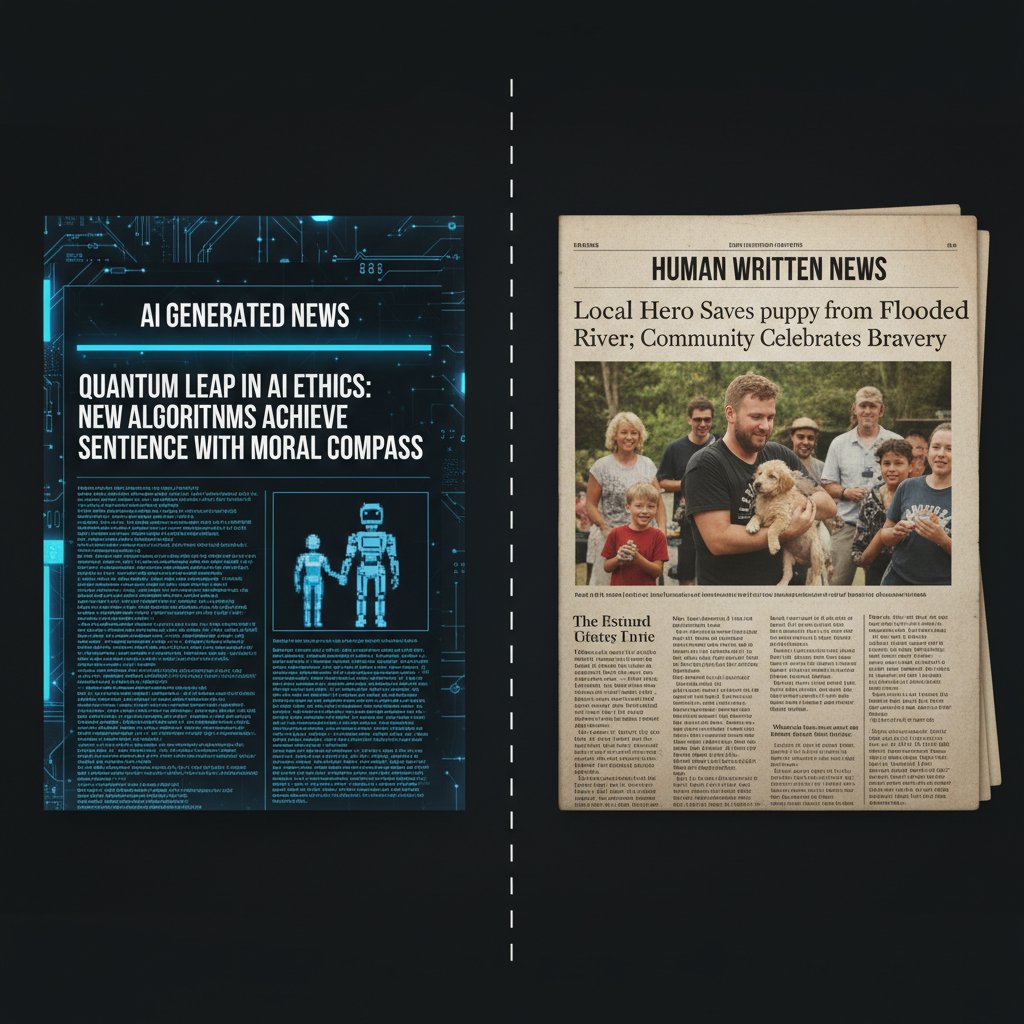
- Look for a byline—AI stories may use “Staff” or generic names.
- Check for disclosure badges—some outlets label AI-generated content.
- Note the style—repetitive phrasing, too-consistent tone, or odd factual errors may indicate automation.
- Scan for real sources—AI stories often lack firsthand accounts or unique quotes.
- Search for similar headlines—AI-generated news is frequently mass-replicated across sites.
Subtle cues include hyper-regular sentence structures and an almost uncanny “neutrality” that lacks the rough edges of human storytelling.
Responsible consumption: what readers need to know
Best practices for readers in the age of AI-powered journalism:
- Question the source: Who wrote this story? Is it labeled as AI-generated?
- Look for supporting evidence: Are claims backed by real, recent data or named experts?
- Notice the context: Does the story explain why an event matters, or just relay facts?
- Be skeptical: If a headline seems too perfect or “just in time,” check other outlets before sharing.
- Cross-reference: Trust isn’t automatic—triangulate with multiple, independent sources.
Questions to ask before trusting a news story:
- Who is the author or publisher?
- Are sources transparent and reputable?
- Is there evidence of human oversight?
- Has the story been fact-checked?
- Does the outlet have a history of corrections?
Critical engagement is your best defense—don’t cede your skepticism to the algorithm.
Adopting AI in your own newsroom: a cautionary roadmap
Thinking of bringing AI into your news operation? Here’s what matters:
- Define your goals: Do you want speed, scale, personalization, or all of the above?
- Map your data sources: Quality in, quality out—junk data produces junk news.
- Choose the right platform: Prioritize transparency, customization, and robust bias controls.
- Establish oversight: Human editors, clear escalation paths, and continuous audits are non-negotiable.
- Train your team: Upskill existing staff in data literacy, prompt design, and AI ethics.
- Monitor and revise: Errors will happen; build rapid feedback loops and correction workflows.
Common mistakes? Underestimating the need for human review, over-relying on off-the-shelf models, and ignoring transparency with your audience.
The future of AI-powered journalism: predictions, possibilities, and wildcards
Expert predictions for 2025 and beyond
Industry experts agree: AI is now the backbone of digital news. “The next wave of news will be written by code—and conscience,” notes Priya, a leading AI ethics consultant. Regulation, public activism, and technical innovation will determine how far, and how safely, the revolution goes.
Forecasts call for more open-source platforms, deeper newsroom customization, and a sharper focus on transparency.
Three scenarios: utopia, dystopia, and something in between
- Best-case scenario: AI democratizes news, expands coverage to underserved communities, and boosts transparency.
- Worst-case scenario: Newsrooms become echo chambers, deepfakes run rampant, and trust collapses.
- Hybrid outcome: Gains in coverage and efficiency are tempered by persistent bias and new forms of manipulation—requiring constant vigilance.
What no one’s talking about: the next big questions
Beneath the headlines, urgent issues are brewing:
- How will AI serve non-English or indigenous newsrooms, which lack vast training datasets?
- What happens in crisis zones where misinformation is weaponized and fact-checking resources are scarce?
- Can AI-powered journalism foster new forms of civic engagement instead of deepening division?
Unconventional uses for AI-powered journalism:
- Real-time translation for multilingual coverage.
- Automated fact-checking in humanitarian crises.
- Survivor-centered storytelling, where AI anonymizes and protects sources.
Ongoing vigilance, adaptation, and cross-disciplinary collaboration are the only paths forward.
Supplementary deep-dives: context, controversies, and practical applications
A brief history of AI in journalism
The journey from clunky rule-based templates to today’s creative LLMs is a story of both progress and pitfalls.
Evolution of AI-powered journalism:
- 2010: Early template-driven sports and finance reports.
- 2015: Machine learning models generate short news summaries.
- 2020: Neural networks enable personalized content curation.
- 2023: LLMs write in natural language, handle complex topics.
- 2025: AI-native newsrooms (e.g., newsnest.ai) become industry leaders.
Each era solved technical bottlenecks—coverage, speed, personalization—but also created new risks: bias, job loss, and the blurring of authorship.
Controversies and common misconceptions revisited
Three debates dominate the present:
- Bias: Are AI models amplifying or correcting societal prejudices?
- Job loss: Do new roles compensate for layoffs, or is the net effect negative?
- Manipulation: Can algorithmic curation be trusted, or is it ripe for abuse?
| Controversy | Stakeholders | Potential Solutions |
|---|---|---|
| Bias in AI models | Publishers, readers | Diverse datasets, regular audits |
| Newsroom layoffs | Journalists, unions | Retraining, new tech roles |
| Algorithmic curation | Public, regulators | Transparency, explainable AI |
Table 4: Controversy matrix—issues, stakeholders, and solutions. Source: Original analysis based on WAN-IFRA, Reuters Institute, 2025.
Over the past 12 months, perspectives have shifted from naive optimism (“AI will save journalism!”) to nuanced realism—progress comes with costs and complex trade-offs.
Real-world guide: integrating AI-powered journalism into your workflow
For media professionals, educators, and students, practical experimentation is the best teacher. Start small—pilot AI tools in low-risk settings. Prioritize transparency, continuous learning, and skepticism.
Tools and resources for experimenting with AI-powered news generation:
- Open-source AI writing platforms (GPT-Neo, Bloom).
- Fact-checking APIs and plugins.
- News analytics dashboards for tracking bias and reach.
- Training resources on prompt engineering and ethical AI use.
Keep questioning, keep learning, and never surrender editorial judgment to the machine.
Conclusion
AI-powered journalism has detonated old certainties, upended newsroom economics, and forced critical questions about truth, trust, and the boundaries of human creativity. As algorithms churn out headlines and reshape public discourse, the challenge isn’t to stop the march of automation but to ensure it serves the public good, not just the bottom line. The stats are clear—automation is the new normal, but human oversight, ethical vigilance, and relentless transparency are more vital than ever. If you crave credible, timely, and engaging news in this wild new ecosystem, stay critical, stay curious, and don’t be afraid to challenge both the machine and the human behind the screen. For those ready to take the leap, platforms like newsnest.ai are leading the way into this dazzling, disorienting future—where the biggest story is how we tell stories now.
Sources
References cited in this article
- AI as a strategic priority for journalism(wan-ifra.org)
- How Generative AI is Transforming Journalism in 2025(makebot.ai)
- Forbes: Beyond Misinformation—The Impact of AI in Journalism(forbes.com)
- ResearchGate: The Rise of AI Journalism(researchgate.net)
- Kakupress: AI in Journalism—Automated News Generation(kakupress.org)
- The Hill: AI-generated anchors to debut on news network in 2024(thehill.com)
- UF College of Journalism: AI Research Shows Automated Journalism More Trusted When Paired With Human Touch(jou.ufl.edu)
- Al Jazeera Media Institute: Analysis—Could AI replace humans in journalism?(institute.aljazeera.net)
- WAN-IFRA: 3 ways newsrooms can enhance AI integration(wan-ifra.org)
- INMA: AI and the Newsroom(inma.org)
- TechXplore: AI vs. human journalist stylistic differences(techxplore.com)
- Pew Research Center: Americans foresee negative effects of AI on news(pewresearch.org)
- CIO: 12 famous AI disasters(cio.com)
- Tandfonline: Generative Visual AI in News(tandfonline.com)
- CNN: News industry layoffs(cnn.com)
- Press Gazette: Journalism job cuts 2025 tracked(pressgazette.co.uk)
- Reuters Institute: Public attitudes towards the use of AI in journalism(reutersinstitute.politics.ox.ac.uk)
- Redline Project: AI’s Transformation of Journalism—Navigating Trust and Bias(redlineproject.news)
- ScienceDaily: Readers trust news less when AI is involved(sciencedaily.com)
- Trusting News: Journalists should disclose AI use(trustingnews.org)
- Optica-OPN: Generating and Detecting Deepfakes(optica-opn.org)
- Hacker News: Deepfake Defense in the Age of AI(thehackernews.com)
- SAGE: Preserving democracy during the first AI revolution(journals.sagepub.com)
- Reuters Institute: AI and the Future of News(reutersinstitute.politics.ox.ac.uk)
- Ring Publishing: AI in Journalism—Adoption and Impact(ringpublishing.com)
- Frontiers in Communication: Digital transformation in journalism(frontiersin.org)
- Purple Frog Systems: 11 Ways to Spot AI-Generated Text(purplefrogsystems.com)
- Forbes: Newsrooms Are Already Using AI, But Ethical Considerations Are Uneven(forbes.com)
- EBU News Report 2025(ebu.ch)
Instantly Generate Breaking News
NewsNest.ai delivers a revolutionary AI-driven news platform, empowering businesses and individuals by automatically generating timely, credible, and engaging news articles. With real-time coverage, deep accuracy, and customizability, you can effortlessly stay informed and ahead of the competition. Eliminate costly journalistic resources and gain instant access to quality content tailored specifically to your preferences and industry focus.
Get startedReady to revolutionize your news production?
Join leading publishers who trust NewsNest.ai for instant, quality news content
Frequently Asked Questions
What percentage of publishers are now using AI in their newsrooms?
According to WAN-IFRA, over 80% of publishers now use AI to personalize content and recommend stories, while 96% of publishers surveyed in 2025 say AI is their top back-end priority.
What specific tasks are newsrooms automating with AI?
Newsrooms are using AI to automate transcription, copyediting, data analysis, personalize content, recommend stories, and deploy chatbots and real-time quizzes to engage readers.
Is AI-powered journalism replacing human journalists entirely?
No; the article emphasizes that behind every AI-generated headline is 'a lattice of code, real human oversight, and ethical dilemmas,' indicating that human oversight remains integral to the process.
What are newsroom editors' main concerns about AI journalism?
According to the article, editors fear that synthetic content will drown out authentic voices, though some pragmatic leaders see opportunities in faster reporting and deeper analytics alongside existential threats.
Keep Reading
See more from AI-powered news generator

AI-Generated Journalism Software: How Newsrooms Are Changing

How AI Is Rewriting Journalism and Newsroom Control

How AI Is Transforming Journalism and Reshaping Newsrooms

AI-Generated News Governance: Regulation and Power in Automated Journalism

How AI-Generated Journalism Is Reshaping Newsrooms
