

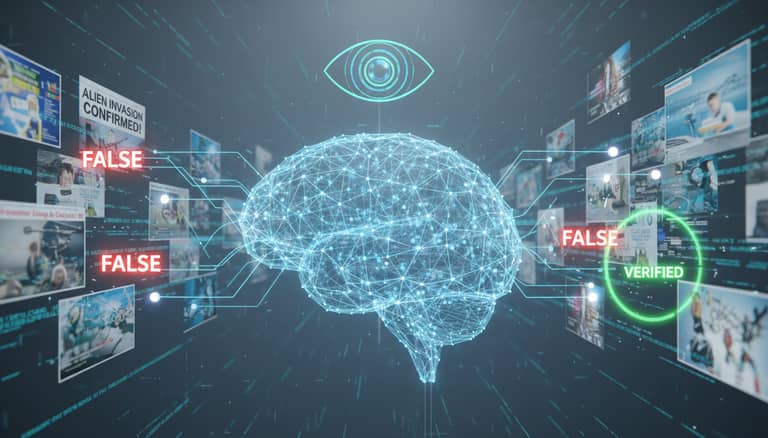
AI-Generated Fake News Detection Is Quietly Eroding Our Trust
Written with AI assistance under our editorial guidelines
As AI-generated fake news proliferates at unprecedented scale, detection systems struggle to keep pace. Over 1,200 AI-enabled fake news sites emerged by late 2023, flooding social media faster than human fact-checkers can verify. Detection tools often miss context-specific cues, particularly outside major languages, leaving audiences unable to distinguish real from fabricated content and eroding fundamental trust in news and institutions.
Disinformation isn’t new. But the game has changed—radically, and in ways that should keep you up at night. In 2025, AI-generated fake news detection is a high-stakes arms race, not a solved problem. Deepfakes bleed into reality; synthetic headlines flood your feeds faster than they can be checked; and the very tools you trust to stem the tide sometimes fail, especially where the eyes of the West don't reach. This isn’t just a tech story—it’s about the raw, messy intersection of power, perception, and the slow-motion meltdown of trust. If you think you can easily spot fake news in 2025, buckle up. The lines are blurrier than ever, and almost nobody is telling the whole story. Here’s what really matters—backed by hard data and cold truths—to anyone who cares about the future of news, democracy, and their own sanity.
The rise of AI-generated fake news: A new era of deception
How AI rewrote the rules of misinformation
AI didn’t just up the ante—it reset the table. Since 2020, the volume of AI-generated fake news has exploded. By late 2023, over 1,200 AI-enabled fake news sites were tracked worldwide, a tenfold increase in just one year, according to the NewsGuard AI Tracking Center. It’s not just the raw numbers that are staggering. It’s the breathtaking reach: articles, deepfake videos, and synthetic audio flood social media at a scale human fact-checkers can’t hope to match. The democratization of generative AI models—think LLMs like GPT-4, open-source text generators, and deepfake tools—means anyone with a smartphone and an agenda can spin up plausible news articles, fake interviews, or viral hoaxes in minutes. This isn’t the slow, clumsy propaganda of yesteryear; it’s a firehose, and the old buckets just won’t cut it.

Traditional fact-checking—laborious, methodical, and human-driven—simply can’t keep up. The speed and sophistication of AI-generated fakes mean that by the time a hoax is flagged, it’s already done its damage. Worse, automated detection tools, while impressive in some contexts, struggle with nuance, context, and rapid adaptation. According to the 2024 Dean’s Report from the University of Florida, detection models often miss context-specific cues, especially outside major languages or cultural settings. The consequence? A world where trust is not just eroded but actively weaponized.
A brief history: From propaganda to algorithmic chaos
Disinformation has always been a moving target. In the 1800s, fake pamphlets and forged documents swayed public opinion. The 20th century brought radio propaganda and doctored photos. The internet era introduced viral hoaxes and social media echo chambers. But the shift to algorithmic chaos is new—and uniquely destabilizing. Consider how, in the past, even the most sophisticated forgeries required resources and risk. Today, a lone operator can deploy AI tools to create synthetic newsrooms, complete with fake bylines and plausible sources, all at the push of a button.
| Year | Milestone | Impact |
|---|---|---|
| 1800s | Fake pamphlets, forgeries | Swayed public opinion, slow spread |
| 1930s | State radio propaganda | Mass persuasion, centralized control |
| 1980s | Doctored photographs | Visual manipulation, limited reach |
| 2000s | Social media hoaxes | Viral spread, low-cost, global impact |
| 2015 | Early deepfake videos | First AI-generated fake media emerges |
| 2020 | LLMs for synthetic text | Plausible, fast, scalable misinformation |
| 2023 | 10x growth in AI fake news sites | Industrial-scale, decentralized fakes |
| 2024 | Multimodal deepfakes go mainstream | Text, image, audio, video fused |
| 2025 | AI detectors struggle with bias | Detection lags, global impact |
Table 1: Key milestones in fake news evolution from pamphlets to AI-generated content. Source: Original analysis based on NewsGuard, 2024, University of Florida Dean's Report, 2024
Each technological leap not only increased the reach of fake news but also made it more psychologically jarring. As the fidelity of synthetic content improved, so did its plausibility—and its power to sow confusion, fear, and division. As one media theorist put it:
"Every new tool for truth becomes a weapon for fiction."
— Maya (quote)
2025 stands apart because the scale, speed, and sophistication of AI-generated fakes have finally overwhelmed the immune system of traditional media literacy. Misinformation is no longer a fringe issue—it’s the new normal, with consequences that ripple through every institution that relies on the public’s trust.
Why detection matters more now than ever
Unchecked AI-generated fake news isn’t just a nuisance: it’s a real-world threat with consequences that can be measured in lost elections, market crashes, and lives put at risk. In the past 24 months alone, AI-generated deepfakes have sparked false reports of political coups, manipulated stock prices, and spread bogus health advisories that led to public panic. In 2023, a synthetic video purporting to show a government official confessing to election fraud was shared over 500,000 times in a single weekend before being debunked—after the damage was done. Similarly, voice deepfakes have been used to impersonate CEOs and orchestrate financial scams, as reported by Security.org.

Hidden dangers of ignoring AI-generated fake news:
- Democratic backsliding: Elections undermined by synthetic scandals and microtargeted rumors.
- Market manipulation: Fake earnings reports and CEO voice clones move billions in minutes.
- Public health threats: Synthetic advisories trigger panic buying or vaccine hesitancy.
- Amplified polarization: Fakes reinforce echo chambers, making dialogue impossible.
- Reputational destruction: Brands and individuals tanked by convincing but false reports.
- Weaponized censorship: Overzealous detection removes legitimate dissent or whistleblowing.
- Global inequality: Weak detection in the Global South makes these societies prime targets.
The stakes aren’t just high—they’re existential. And the arms race between creators and detectors is just getting started.
Inside the machine: How AI-powered fake news is made
Meet the new con artists: Generative language models and deepfakes
Forget shadowy cabals—the real con artists in 2025 are algorithms. Large language models (LLMs) like GPT-4 and its open-source cousins churn out readable, plausible news stories on demand. They can mimic journalistic style, fabricate quotes, and cite fake sources with chilling accuracy. Deepfake tools, meanwhile, let bad actors create synthetic images, audio, and video: think fake news anchors, fabricated press conferences, or voice clones that can fool even seasoned professionals.

Key terms defined:
- Synthetic media: Content (text, image, audio, video) wholly or partly generated by AI, designed to imitate or manipulate reality.
- Deepfake: AI-generated audio or video in which a person’s likeness or voice is convincingly faked, often for deceptive purposes.
- LLM (Large Language Model): Advanced AI trained to generate coherent, contextually plausible text, capable of mimicking news articles, interviews, and more.
Can you trust your own eyes and ears? Increasingly, the answer is no. The technology to create seamless fakes is now cheap, accessible, and alarmingly effective.
The economics of automated misinformation
Disinformation used to be labor-intensive and expensive. Not anymore. Low-cost, off-the-shelf AI tools have gutted the barriers to entry. Today, a bad actor can launch a fake news campaign for the price of a meal, with the potential for viral reach and lucrative returns from ad fraud or manipulation.
| Cost Category | Traditional Disinfo Campaign | AI-Generated Fake News |
|---|---|---|
| Setup Cost | $20,000+ (staff, assets) | <$500 (cloud AI, tools) |
| Time to Launch | Weeks or months | Hours |
| Scale of Output | Dozens of articles/week | Thousands/day |
| Detection Evasion | Moderate, slow adaptation | High, rapid mutation |
| Revenue Potential | Moderate | High (global scale) |
Table 2: Cost-benefit analysis of AI-generated vs. traditional disinformation. Source: Original analysis based on NewsGuard, 2024, [Security.org, 2023]
The profit isn’t just for the shadowy operators. Social platforms rake in ad revenue from viral fakes; click farms and ad networks profit from artificial engagement; and even legitimate cybersecurity firms profit from the detection arms race. As Alex, an industry analyst, put it:
"Fake news is just another revenue stream for some."
— Alex (quote)
But beneath the surface, the real costs mount: reputational ruin, lost public trust, and the risk of collateral censorship as detection tools cast wider nets.
The deepfake arms race: Creators vs. detectors
The battle lines are always shifting. For every advance in detection, creators find new ways to evade or outsmart the algorithms. In 2023, new watermarking methods promised to make synthetic images traceable—only to be bypassed by adversarial attacks within months. Multimodal fakes (blending text, image, and audio) proved especially difficult to spot. Despite advances, even state-of-the-art detectors scored under 24% on challenging datasets, according to MiRAGeNews (EMNLP, 2024).
Timeline of AI-generated fake news detection breakthroughs and setbacks:
- Early 2010s: Machine learning models flag obvious fakes—limited success.
- 2015: First deepfake videos emerge; detection tools lag behind.
- 2018: Social platforms launch automated fact-checkers—mixed results.
- 2020: LLM-generated news articles evade most detectors.
- 2021: Watermarking and forensic analysis gain traction.
- 2022: Voice deepfakes surge; detection lags.
- 2023: Multimodal fakes (text+image+audio) stump detectors.
- 2024: Detection tools show bias in non-Western contexts.
- 2024: AI detectors achieve under 24% F1 score on hard benchmarks.
- 2025: Human-AI hybrid models gain popularity, but scale is an issue.
Despite heroic efforts, detection tech is always playing catch-up. The next section unpacks what works, what doesn’t, and why you can’t rely on detection alone.
Decoding detection: What actually works—and what doesn’t
How AI detects AI: Under the hood of cutting-edge detection tools
Modern AI-driven fake news detection blends several approaches: natural language processing (NLP) to spot textual anomalies, digital watermarking to trace synthetic images, and anomaly detection to identify patterns typical of fake generation. For example, NewsGuard’s AI Tracking Center uses proprietary classifiers to flag suspicious sites, while MiRAGeNews benchmarks detection algorithms against known fakes.
Case studies:
- News media: Major outlets use hybrid AI-human workflows to vet breaking stories before publication.
- Social media: Platforms like X deploy real-time classifiers to downrank suspected fakes, but results are inconsistent.
- Government: Election authorities use AI dashboards to monitor information flows and flag viral anomalies.

| Tool / Platform | Detection Method | Strengths | Weaknesses | 2025 Score |
|---|---|---|---|---|
| NewsGuard AI | NLP, site analysis | High-scale, transparency | Lags in non-English | 7/10 |
| MiRAGeNews Benchmark | Multimodal, AI/ML | Text+image+audio detection | Low F1 on complex fakes | 6/10 |
| Custom Newsroom AI | Hybrid human+AI | Context, nuance, accuracy | Scalability, cost | 9/10 |
| Social Platform AI | Real-time NLP, ML | Speed, breadth | False positives, bias | 5/10 |
Table 3: Comparison of leading AI-powered fake news detection tools (2025). Source: Original analysis based on NewsGuard, 2024, EMNLP MiRAGeNews, 2024
Human-AI hybrid models are increasingly the gold standard: AI flags suspicious content at scale; humans bring contextual judgment and cultural fluency. The result isn’t perfect—but it’s the best shot at stopping viral fakes before they metastasize.
The limits of detection: False positives, false hope
Detection tools are powerful, but they're not magic bullets. Common failure modes abound: some fakes slip through undetected, while genuine stories are wrongly flagged. In April 2024, a viral story about a political protest in Kenya was incorrectly labeled as fake by an automated system, leading to public outrage and accusations of censorship—only for human reviewers to confirm its accuracy days later.
Red flags your detection tool might be giving you a false sense of security:
- Flags legitimate dissent or whistleblowing as “fake.”
- Struggles with minority languages or local context.
- Fails to update rules fast enough for new AI models.
- Relies on dated or narrow training data.
- Lacks transparency in decision-making.
- Overcorrects, leading to blanket censorship.
The myth of perfect detection is just that—a myth. Nuance, skepticism, and critical thinking remain essential, no matter how advanced the tool.
Human vs. AI: Who’s the better fake news buster?
AI excels at pattern recognition across millions of data points; humans catch context and subtext that machines miss. In 2023, a major newsroom combined automated AI checks with manual reviews to break a fake news scandal: AI flagged an unlikely spike in stories about a “new miracle drug,” but it was a human editor who spotted the telltale linguistic quirks that exposed the fake. As one journalist put it:
"Machines miss the context. People miss the patterns."
— Jordan (quote)
Tips for blending tech and critical thinking in your own detection strategy:
- Always corroborate flagged stories with multiple sources.
- Use AI tools as a first-pass filter, not a final judge.
- Stay skeptical of both “too good to be true” and “too bad to be true” headlines.
- Learn to spot linguistic and visual signs of synthetic content.
- Encourage newsroom diversity to catch cultural blind spots.
The bottom line: Trust is a team sport—machines and humans must play together to win.
Real-world fallout: How AI-generated fakes upend society
Elections, chaos, and the new information battlefield
The 2024 election cycle offered a grim preview. In one major country, AI-generated fake news swamped social feeds with synthetic videos of candidates making inflammatory remarks, fake polls showing wild swings, and fabricated leaks timed to the hour. The tactics were sophisticated: flooding channels with noise, micro-targeting swing voters, and deploying deepfake “leaks” that looked so real, even seasoned analysts were fooled.

Unconventional uses for AI-generated fake news detection:
- Financial markets: Spotting pump-and-dump stock scams fuelled by fake headlines.
- Healthcare: Flagging synthetic “research” driving anti-vax sentiment.
- Academia: Detecting ghostwritten AI essays and fraudulent citations.
- Corporate PR: Identifying fake press releases or impersonated executives.
- Law enforcement: Tracking synthetic ransom and blackmail attempts.
- Nonprofits: Countering fake donation drives and scam campaigns.
- Activism: Authenticating protest footage in contested zones.
Each incident has forced platforms and policymakers to rethink everything from content moderation policies to public education campaigns—often too late to avoid the damage.
Who profits, who loses: The new misinformation economy
AI-generated fake news isn’t just ideological—it's big business. Advertisers, click farms, and political actors all have skin in the game. According to MiRAGeNews, the estimated market size for misinformation campaigns reached billions by 2025, with hotspots in North America, Europe, and increasingly, in the Global South.
| Metric | 2020 | 2023 | 2025 (est.) |
|---|---|---|---|
| Estimated global market ($B) | 1.2 | 4.8 | 7.4 |
| Top countries (activity) | US, RU, BR | US, RU, IN | US, RU, IN, NG |
| Deepfake incidents (annual) | 50,000 | 500,000 | 900,000 |
Table 4: Global misinformation economy trends (2020-2025). Source: Original analysis based on MiRAGeNews, 2024, [Security.org, 2023]
For every platform or operator profiting, there are countless individuals, brands, and institutions caught in the crossfire—reputationally and economically gutted by fakes. In this era, attention is currency, and fake news is one of the fastest ways to mint it.
The psychological toll: Living in a post-truth world
Endless exposure to AI-generated fakes isn’t just a cognitive problem—it’s an emotional and psychological one. Studies show that misinformation overload breeds cynicism, disengagement, and even digital burnout. The sense that “nothing is real” leads many to tune out entirely, a phenomenon experts at the Nieman Journalism Lab dubbed “critical fatigue.”

Experts urge a new kind of digital resilience: active skepticism, not nihilism. Mental clarity in 2025 means learning to question, verify, and—occasionally—step away from the endless scroll.
Tips for digital resilience:
- Curate your news sources, prioritizing those with transparent editorial standards.
- Take regular digital detoxes to avoid critical fatigue.
- Build habits of cross-verifying major stories before sharing.
Myth-busting: What most people get wrong about AI fake news detection
Debunking the ‘silver bullet’ illusion
Let’s kill the fantasy right now: there is no perfect, all-knowing AI that can spot every fake. History is littered with failed “tech fixes” for social problems—think spam filters, early social media moderation, or even email encryption. Each solved a piece of the puzzle, but none delivered utopia.
Common misconceptions about AI-generated fake news detection:
- AI can detect all fakes instantly.
- More detection means fewer fakes overall.
- Only “obvious” fakes are dangerous.
- Detection models are unbiased and universal.
- Human oversight is obsolete.
- Detection tools never flag real stories.
- All platforms enforce detection equally.
- Once detected, fakes stop spreading.
A more realistic approach is layered: use multiple tools, blend human and machine judgment, and accept that some level of uncertainty will always persist.
Why more detection can mean less trust
Paradoxically, as detection tools proliferate, public trust can erode—a digital “cry wolf” scenario. In 2024, mass takedowns of “suspect” content led to accusations of censorship and political bias, undermining confidence in platforms and authorities.
"When everything’s a lie, nothing matters."
— Taylor (quote)
The answer isn’t to abandon detection, but to be transparent about its limits—and to give readers the tools and context to stay meaningfully engaged, not just jaded.
The hidden risks of overreliance on technology
Automated solutions come with their own dangers: bias, adversarial attacks, and even intentional manipulation. In one notable case, adversaries poisoned a detection tool’s training data—causing it to flag legitimate news from minority outlets as fake en masse.
Key technical risks:
- Adversarial AI: Attackers exploit detection model weaknesses to slip fakes past the net or mislabel real news.
- Data poisoning: Deliberate contamination of training data, leading to systemic misclassification.
The bottom line? Ongoing human oversight and constant adaptation are not optional—they’re essential.
How to fight back: Tools, tactics, and mindsets for 2025
Building your personal detection toolkit
A layered, proactive approach is your best defense. Don’t settle for silver bullets—build a toolkit.
Step-by-step guide to mastering AI-generated fake news detection:
- Choose credible sources: Prioritize outlets with transparent editorial policies.
- Cross-verify major stories: Use at least two independent sources for confirmation.
- Leverage AI tools cautiously: Use browser plugins and detection dashboards—but double-check flagged results.
- Learn red flags: Spot linguistic quirks, visual glitches, or too-perfect images.
- Stay updated: Detection tools (and fake news techniques) evolve fast.
- Practice digital hygiene: Don’t share stories you haven’t vetted.
- Report suspicious content: Use platform reporting tools judiciously.
- Engage in critical communities: Follow experts and participate in fact-checking forums.

Combining tech and human judgment is the only way to stay ahead of the curve.
Checklists for individuals, organizations, and platforms
Stakeholders have different needs—here’s how to stay sharp.
Priority checklist for newsrooms implementing AI-powered detection:
- Set clear editorial standards for AI-generated content.
- Vet detection tools for accuracy and bias.
- Blend automated and manual review workflows.
- Train staff on new forms of AI-generated deception.
- Monitor feedback loops for error correction.
- Regularly update tool training data.
- Document and publish detection methodology.
- Engage with independent auditors for transparency.
- Use resources like newsnest.ai for ongoing best practices.
Common mistakes to avoid:
- Blindly trusting automated flags.
- Failing to adapt to new fake news techniques.
- Neglecting minority language or regional contexts.
- Over-censoring and undermining trust.
Independent audit and oversight aren’t luxuries—they’re requirements for trust.
What to do when detection fails: Responding to viral fakes
Even the best defenses sometimes break. When a fake goes viral, crisis response is key.
Emergency protocol for responding to AI-generated fake news:
- Confirm the incident: Use multiple tools and human review.
- Isolate the spread: Flag and downrank on all platforms.
- Issue timely corrections: Publish clear, accessible debunkings.
- Engage trusted voices: Leverage influencers and credible experts.
- Document the event: For transparency and future learning.
- Review detection failures: Identify where the system broke down.
- Communicate proactively: Rebuild trust with openness, not defensiveness.

Transparent communication is the only way to rebuild trust when things go sideways.
The future of trust: Where AI-generated fake news detection goes next
Next-gen tech: What’s coming (and what might blindside us)
Cutting-edge research aims to fortify detection: blockchain-based content verification, multi-modal analysis that integrates text, image, and audio cues, and cross-platform “trust signals” for source authentication. Startups are racing to deploy real-time, decentralized verification systems. In 2025, projects like Project Origin, DeepTrust, and MiRAGeNews are pushing the boundaries—combining cryptographic authenticity with large-scale AI pattern-matching.

But new threats loom: AI-generated “micro-fakes” that evade detection through subtlety, or synthetic content so convincing it achieves “plausible deniability.” The goalposts keep moving—detection must, too.
The human factor: Teaching critical thinking in an AI world
No matter how smart the tech, digital literacy is the last line of defense.
Essential skills for navigating AI-powered information:
- Source triage: Quickly assess credibility.
- Pattern recognition: Spot inconsistencies in text and visuals.
- Contextual awareness: Understand manipulation tactics.
- Tech fluency: Use detection tools, but know their limits.
- Community engagement: Share verifications, not just suspicions.
- Resilience to overload: Maintain skepticism without cynicism.
Schools, workplaces, and platforms must invest in these skills. Resources like newsnest.ai offer ongoing education and community support—essential as threats evolve.
Hope, hype, and hard truths: The road ahead
The brutal truth: detection is necessary but not sufficient. The arms race continues, and complacency is fatal. But giving in to despair is a luxury none of us can afford. Stay vigilant, proactive, and skeptical—but resist the urge to tune out entirely.
"Hope is not a strategy, but neither is fear."
— Morgan (quote)
As you navigate the news in 2025, ask yourself: What will you trust? The answer may decide more than you think.
Supplementary deep dives: Beyond fake news detection
The evolution of algorithmic deception: Lessons from other industries
AI-generated misinformation isn’t confined to news. In finance, synthetic press releases have tanked stocks and triggered regulatory probes. In healthcare, deepfake audio “advice” has gone viral, undermining public trust in medical guidance. Academia faces a surge of AI-generated essays and fake citations, as tools outpace plagiarism detectors.

Detection challenges vary by sector: finance demands real-time alerting; healthcare prioritizes trusted sources; academia needs robust authorship verification. Cross-industry collaboration—such as sharing threat intelligence and detection methods—is shaping the next generation of defenses.
The economics of digital propaganda: Who pays—and who gets paid?
Misinformation is a booming business. Traditional propaganda budgets ran into the millions; today, AI-powered campaigns can match their impact for a fraction of the cost.
| Campaign Type | Traditional Budget (avg.) | AI-Powered Budget (avg.) |
|---|---|---|
| Political (nation) | $10M+ | $100K |
| Corporate sabotage | $2M | <$50K |
| Health myths | $500K | <$10K |
Table 5: Traditional vs. AI-powered propaganda costs. Source: Original analysis based on NewsGuard, 2024, [Security.org, 2023)
New business models are emerging: pay-for-play fake news, synthetic ad campaigns, and subscription-based disinformation services. The regulatory and ethical debates for 2025 are fierce—and unresolved.
Facing the future: Building resilience in a world of synthetic media
Detection is half the battle; resilience is the rest.
Key terms:
- Digital resilience: The ability to adapt to, recover from, and thrive despite digital threats and misinformation.
- Synthetic skepticism: A mindset of informed, proactive questioning of digital content—without slipping into paranoia.
Three tips for building skepticism without paranoia:
- Assume plausible deniability, not universal deception.
- Build trusted networks for shared verification.
- Balance skepticism with openness to correction.
The future will be noisy, messy, and contested. But with the right tools, tactics, and mindsets, trust isn’t dead yet—it’s just evolving.
Sources
References cited in this article
- NewsGuard AI Tracking Center(newsguardtech.com)
- 2024 Dean's Report, University of Florida(2024.jou.ufl.edu)
- Nieman Journalism Lab(niemanlab.org)
- MiRAGeNews Dataset(aclanthology.org)
- DISA: Impact of Fake News(disa.org)
- Security.org: Deepfake Statistics(security.org)
- Reuters Institute(reutersinstitute.politics.ox.ac.uk)
- Divided We Fall: Election Misinformation(dividedwefall.org)
- MIT Technology Review(technologyreview.com)
- Harvard Misinformation Review(misinforeview.hks.harvard.edu)
- ICFJ Guide(icfj.org)
- Stanford Report(news.stanford.edu)
- McAfee: AI Fake News(mcafee.com)
- WEF Global Risks Report 2024(weforum.org)
- Stanford: Fake News and Misinformation(web.stanford.edu)
- IEEE Spectrum(spectrum.ieee.org)
- Springer: Comparative Evaluation(link.springer.com)
- IEEE Xplore(ieeexplore.ieee.org)
- arXiv: Comparative Study(arxiv.org)
- DeepMind study(dailyai.com)
- Medium: Societal Challenges(medium.com)
- WIRED(wired.com)
- Frontiers in Political Science(frontiersin.org)
- Navigating the Psychological Landscape of the Post-Truth Era (2024)(prasadamore.com)
- APA PsycNet(psycnet.apa.org)
- Penn State Expert Analysis(psu.edu)
- PMC: Fake News Detection Overview(pmc.ncbi.nlm.nih.gov)
- SAGE Journals(journals.sagepub.com)
Instantly Generate Breaking News
NewsNest.ai delivers a revolutionary AI-driven news platform, empowering businesses and individuals by automatically generating timely, credible, and engaging news articles. With real-time coverage, deep accuracy, and customizability, you can effortlessly stay informed and ahead of the competition. Eliminate costly journalistic resources and gain instant access to quality content tailored specifically to your preferences and industry focus.
Get startedReady to revolutionize your news production?
Join leading publishers who trust NewsNest.ai for instant, quality news content
Frequently Asked Questions
How much has AI-generated fake news increased since 2020?
According to the NewsGuard AI Tracking Center, over 1,200 AI-enabled fake news sites were tracked worldwide by late 2023, representing a tenfold increase in just one year.
Why can't traditional fact-checking keep up with AI-generated fake news?
AI-generated fakes spread at a speed and scale that human fact-checkers cannot match, and by the time a hoax is flagged, it has already caused damage.
What are the limitations of current automated detection tools?
According to the 2024 Dean's Report from the University of Florida, detection models often miss context-specific cues, especially outside major languages or cultural settings.
What AI tools have made it easy to create convincing fake news?
Democratized generative AI models—including LLMs like GPT-4, open-source text generators, and deepfake tools—enable anyone with a smartphone and an agenda to create plausible fake articles, interviews, or hoaxes in minutes.
Keep Reading
See more from AI-powered news generator

Why AI-Generated Misinformation Detection Is Struggling to Keep Pace

AI-Generated News Authenticity: How to Identify Real Reporting

AI News Accuracy Is Broken — New Rules for Knowing What to Trust

How AI-Generated News Verification Tools Actually Perform

How AI-Generated Political News Shapes Election Outcomes
