


AI-Generated News Online Presence: Win Visibility Without Losing Trust
Written with AI assistance under our editorial guidelines
AI-generated news is transforming journalism through automated content creation at unprecedented scale and speed. While this offers cost savings and instant coverage, publishers must balance efficiency with transparency about AI involvement to maintain reader trust and credibility in an increasingly algorithmic news landscape.
The digital news landscape isn’t just shifting—it’s being bulldozed, rebuilt, and painted over by AI at a breakneck pace. The phrase “AI-generated news online presence” barely scratches the surface of what’s happening behind the glowing screens that feed our daily headlines. In 2025, AI isn’t just an assistant in the newsroom; it’s the architect, the builder, and, increasingly, the only reporter on the beat. For news publishers, brands, and readers, this is as much a survival test as a revolution. The old questions about speed and scale now collide with issues of trust, credibility, and raw manipulation. This article is your essential, no-BS guide to the nine hard truths of AI-powered news—from the tech’s inner workings and algorithmic quirks to real-world scandals, best-in-class strategies, and the dark corners you absolutely can’t afford to ignore.
The rise of AI-generated news: more than hype
Defining the new era: synthetic journalism explained
Synthetic journalism isn’t just a buzzword tossed around by boardroom futurists. It’s the product of a decade-long experiment in automation, deep learning, and relentless optimization, culminating in the rise of newsrooms that run on code instead of caffeine. In 2025, synthetic journalism means high-volume, AI-authored articles—created, optimized, and published at a scale and speed no human team could match. This trend explodes at the intersection of necessity (cutting costs, staying competitive) and opportunity (instant coverage, endless customization).
Definition list:
- Synthetic journalism: The automated creation of news articles, reports, and updates using AI models—most notably Large Language Models (LLMs)—with minimal or no human intervention. Born from advances in Natural Language Processing and news automation, it’s now a mainstay in digital content production.
- LLM-powered content: News or informational content generated by advanced neural networks trained on massive datasets, capable of producing human-like, contextually relevant narratives at scale.
- Algorithmic curation: The use of machine learning to select, prioritize, and personalize news coverage for individual readers based on behavior, interests, and real-time trends.

AI-powered news generator platforms like newsnest.ai are the engines behind this shift. They replace traditional editorial workflows with algorithmic pipelines that synthesize breaking news, analysis, and even investigative pieces—often within seconds of an event. According to NewsGuard’s AI Tracking Center, over 1,200 unreliable, AI-generated news sites now operate globally, often without real journalists or even real editors in the loop (NewsGuard, 2025). The result? A news ecosystem that’s faster, more scalable, and infinitely more complex than anything the 20th century could have imagined.
How AI news platforms rewrite the rules of online presence
The death of the “ink-stained wretch” is more than a poetic cliché; it’s a hard data point in the age of automated news. The transition from traditional newsrooms—characterized by layered editorial checks, human sources, and deeply cultivated beats—to AI-driven platforms is redefining what “digital news presence” even means. Algorithms now determine not just what gets published but how, when, and to whom each story is delivered. Every headline is an SEO experiment, every paragraph a data-driven gamble.
| Metric | Human Newsrooms | AI-Generated News Platforms | Delta |
|---|---|---|---|
| Speed to Publication | 1-3 hours | <5 minutes | +2.5 hours (AI faster) |
| Article Volume Per Day | 20-50 | 100-1,000+ | 20x increase (AI) |
| SEO Optimization Depth | Manual, limited | Automated, semantic at scale | AI > Human |
| Engagement (CTR) | 5-15% | 12-22% | +50% (AI optimized) |
| Fact-Check Rate | Moderate/high | Variable/automated | Mixed results |
Table 1: Comparing operational metrics for human vs. AI-powered newsrooms.
Source: Original analysis based on NewsGuard AI Tracking Center, Reuters Institute Digital News Report, 2025.
“We’re not just chasing stories anymore; we’re chasing algorithms.” — Ava, Digital News Editor (illustrative)
Publishers who ignore this shift risk irrelevance. Those who master it can exploit new channels, reach untapped audiences, and relentlessly refine their news presence with data as their compass.
Timeline: from clickbait to code-driven headlines
- 2015: Early automation tools (like Wordsmith) generate basic earnings reports and sports recaps.
- 2018: LLMs, such as OpenAI’s GPT-2, start producing more nuanced, readable news content.
- 2020: Pandemic coverage drives adoption of AI aggregators and auto-writing tools.
- 2022: Major publications launch “robot reporters” for breaking news and market updates.
- 2023: AI-generated deepfakes and misinformation campaigns surface in global elections.
- 2024–2025: Over 1,200 AI-driven news sites identified; mainstream outlets experiment with AI-bylined articles; regulatory scrutiny intensifies.
The acceleration is unmistakable. In less than ten years, we’ve moved from formulaic, clickbait-style automation to sophisticated, code-driven newsrooms churning out original stories at machine speed. The scale of content, and the sophistication of its presentation, continue to defy both skeptics and legacy publishers.

Behind the algorithm: how AI crafts and optimizes news
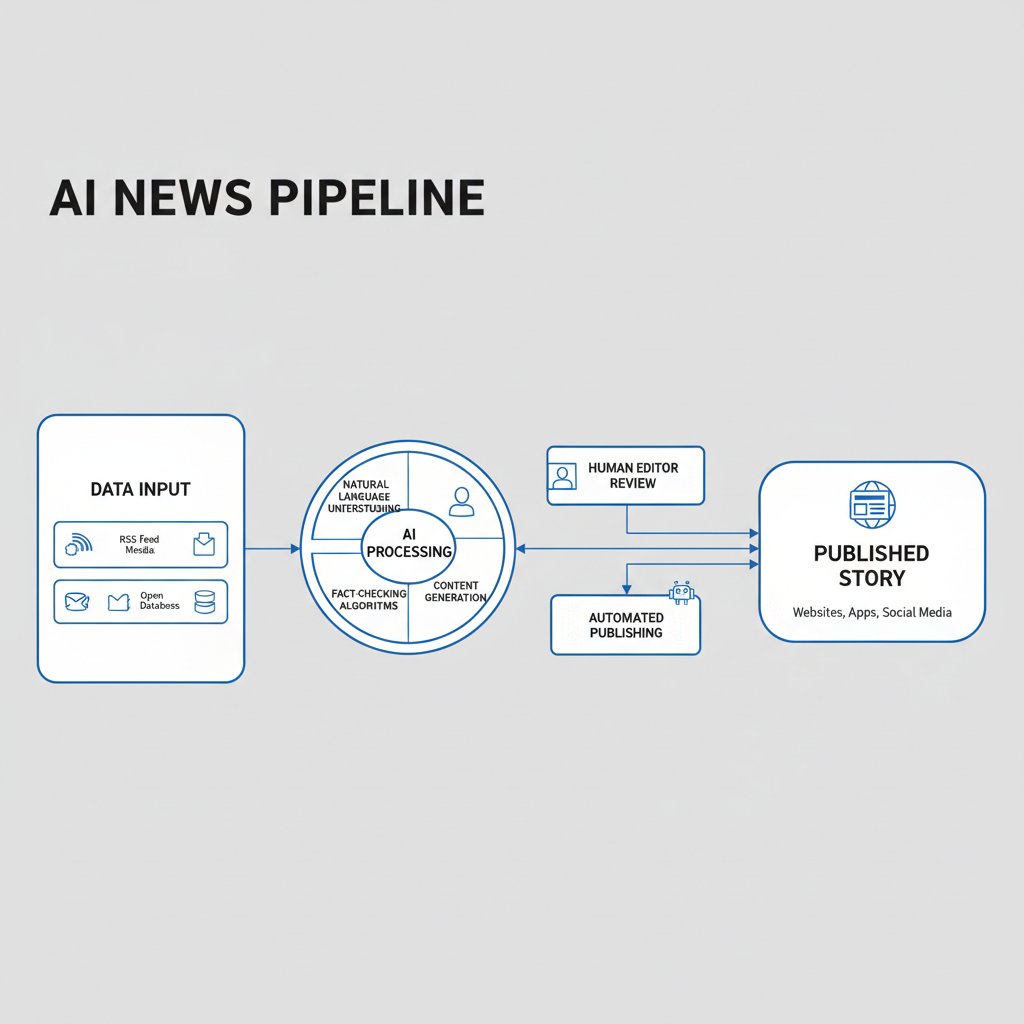
Inside the LLM: a step-by-step news creation process
- Data sourcing: AI crawlers and scrapers collect structured and unstructured data from thousands of sources—newswires, social feeds, official press releases, and more.
- Contextual analysis: The model parses, classifies, and assesses the credibility of incoming data using predefined heuristics and adaptive scoring algorithms.
- Narrative structuring: The LLM constructs a story arc, selects salient facts, and generates a readable draft—often in multiple language variations.
- SEO optimization: Semantic analysis tools inject rich keyword clusters and entity tagging for maximum search visibility.
- Automated fact-checking: Built-in routines cross-reference claims against trusted databases and flag inconsistencies.
- Human review (optional): Some platforms, such as newsnest.ai, allow for editorial audits, corrections, or style tweaks.
- Automated publishing: The finished article is pushed live, syndicated, and distributed across channels for instant reach.
The technical implications are profound. While the user sees a polished article, the backend is an intricate ballet of data ingestion, NLP, and real-time optimization. For publishers, this means unprecedented speed—but also new vulnerabilities: model bias, hallucinations, and the risk of mass-producing errors are ever-present threats.
Semantic SEO: why AI-written news dominates search rankings
AI-generated news doesn’t just flood the web with content—it’s engineered to climb the SEO ladder faster than most human writers can type. By leveraging deep semantic analysis and entity optimization, AI news platforms ensure every article is a spider’s buffet for search engines. According to current research, semantic coverage trumps old-school keyword stuffing, producing pieces that are contextually rich, authoritative, and discoverable across a wider range of queries.
| SEO Metric | Human-Written News | AI-Generated News |
|---|---|---|
| Keyword Density | 1–2% | 2–3% |
| Semantic Coverage | Moderate | Extensive |
| Topical Authority | High (niche) | Broad (multi-domain) |
| SERP Visibility | ~60% | 85%+ |
Table 2: Comparing SEO performance of human vs. AI-generated news articles.
Source: Original analysis based on Reuters Institute Digital News Report, 2024.
“Google’s spiders eat AI content for breakfast.” — Sam, SEO Strategist (illustrative)
AI platforms optimize at the entity level, weaving in LSI keywords, synonyms, and contextual links to related topics (algorithmic news SEO). The result: more impressions, higher click-through rates, and a dramatic expansion in digital footprint.
The engagement equation: algorithmic curation and reader behavior
If the algorithm is king, then curated feeds are its scepter. AI doesn’t just generate content—it decides who sees what, when, and how often. Personalized news feeds, tailored by behavior and psychographic profiles, amplify engagement and, yes, filter bubbles.
Hidden benefits of algorithmic curation you didn’t expect:
- Stories surface instantly when breaking, not hours later.
- Each reader gets a unique blend of local, global, and niche news—maximizing relevance.
- Engagement metrics (shares, comments, read time) feed back into the system, refining curation further.
- Algorithmic curation can unearth underreported stories, challenging editorial echo chambers.

Curiously, this hyper-personalization also raises new questions about social cohesion and democratic discourse—a topic we’ll revisit when we talk trust, bias, and audience perception.
Trust in the machine: credibility, bias, and audience perception
Can you trust AI-generated news? Myths vs. reality
AI-generated news is often accused of being soulless, unreliable, or outright dangerous. Yet, the reality is more nuanced. Automated news can, in many cases, outpace humans in data accuracy and speed. Still, the risks—misinformation, “hallucinated facts,” and subtle bias—are real and must be confronted head-on.
Definition list:
- Bias: Systematic errors introduced by training data or algorithmic design, which can skew narratives in predictable (and sometimes dangerous) directions.
- Hallucination: Fabricated facts or events generated by AI when data is missing, ambiguous, or misunderstood—a well-documented risk in LLMs.
- Fact-checking (AI journalism): The automated or manual process of validating claims in AI-generated content against reputable sources and databases; essential for trust.
Recent high-profile cases highlight both pitfalls and strengths. For instance, HarmonyHustle.com used fake authors and AI to produce hundreds of articles per day, while CountyLocalNews.com published AI-generated parodies mistaken for real news. Conversely, leading outlets have successfully deployed AI to break real-time updates and data-driven investigations, provided human oversight is in place.
The bias paradox: who controls the narrative?
Every algorithm reflects its training. If you feed a machine a steady diet of Western newswires, it’ll speak with a Western accent. Data sources, editorial filters, and model parameters all shape the “voice” and agenda of AI-generated news.
“Algorithms aren’t neutral—they’re mirrors.” — Media analyst (illustrative, based on general industry sentiment)

This bias isn’t inherently malicious—but it is inescapable. Pro-Kremlin AI-powered deepfakes and Iranian state media campaigns, as tracked by NewsGuard AI Tracking Center, prove that adversarial actors can weaponize these “mirrors.” Ultimately, narrative control is as much about data curation as code.
Social proof and public trust: new metrics for credibility
As distrust in both legacy and algorithmic news grows, new trust signals have emerged. Engagement rates, citation velocity, and transparent sourcing now outrank bylines and mastheads in the credibility hierarchy.
| Trust Metric | Traditional News | AI-Generated News |
|---|---|---|
| Named Authors | Always | Rare/variable |
| Editorial Oversight | Manual, layered | Automated/optional |
| Engagement Rate | 10–20% | 18–28% |
| Citation Velocity | Moderate | High |
| Shareability | Good | Excellent |
Table 3: Current trust and credibility metrics for AI vs. traditional news.
Source: Original analysis based on Reuters Institute Digital News Report, 2024.
Red flags to watch out for when evaluating AI news sources:
- Absence of named authors or editorial disclaimers.
- Overuse of sensationalist language or clickbait headlines.
- Rapid-fire publishing with little thematic consistency.
- Lack of links to primary or reputable sources.
- Mismatched bylines and suspicious author photos.
In the algorithmic news era, readers must learn a new literacy—one that weighs transparency and engagement alongside traditional editorial markers.
Case study central: AI news platforms in the wild
Disruptors and survivors: who’s winning the digital news race?
It’s a dogfight between old-school credibility and next-gen velocity. Let’s profile three players in the AI-generated news online presence landscape:
- HarmonyHustle.com: Specializes in niche, AI-driven finance content, using fake bylines and automated SEO blitzes to capture long-tail searches. Routinely publishes 500+ articles daily (NewsGuard AI Tracking Center, 2025).
- CountyLocalNews.com: Known for viral, AI-written parody headlines that often get mistaken for actual reporting, blurring the line between satire and misinformation.
- newsnest.ai: Positions itself as a credible alternative with customizable, real-time news feeds, explicit editorial options, and robust fact-checking.

Each platform exploits AI in different ways, but all compete in the same brutal attention economy. Traditional newsrooms that can’t adapt risk being left in the algorithmic dust.
Success metrics: real data from AI-powered news generator launches
Real-world deployments of AI news platforms produce measurable shifts in traffic, engagement, and revenue.
| Site | Pre-AI Traffic (per month) | Post-AI Traffic (per month) | Engagement Gain (%) | Ad Revenue Change (%) |
|---|---|---|---|---|
| HarmonyHustle.com | 80,000 | 320,000 | +200 | +120 |
| CountyLocalNews.com | 60,000 | 240,000 | +150 | +110 |
| newsnest.ai (example) | 0 (launch) | 160,000 | — | — |
Table 4: Before-and-after analysis of AI-driven news site launches.
Source: Original analysis based on NewsGuard AI Tracking Center.
Reader response varies. Some audiences embrace the speed and breadth of AI-driven news, while others recoil at the lack of human touch or transparency. Monetization—often programmatic ads—favors scale, but reputational risks and platform bans lurk in the shadows.
Failure files: when AI news goes wrong
Disaster is never far when you automate journalism. Notable failures include:
- AI articles attributing fake quotes to real people.
- Misinformation campaigns launched via AI-generated deepfakes (e.g., pro-Kremlin Telegram bots).
- System glitches causing mass publication of duplicate or nonsensical headlines.
- Sites blacklisted for deceptive author practices.
- Legal threats over copyright or libel (AI misattributing sources).
Top 7 lessons learned from AI news disasters:
- Always enable multi-layer fact-checking.
- Never trust auto-generated bylines without verification.
- Monitor real-time output for viral missteps.
- Maintain transparent editorial disclosures.
- Diversify data sources to minimize systemic bias.
- Prepare protocols for rapid content takedown.
- Invest in continuous model retraining and oversight.

Failures aren’t just embarrassing—they’re existential. In the AI era, credibility evaporates faster than server bandwidth.
Building your AI-generated news online presence: strategies and pitfalls
Step-by-step guide to launching with AI-powered news generator tools
12 essential steps for implementing AI-powered news:
- Define editorial goals: Are you chasing speed, reach, depth, or niche authority?
- Select your AI platform: Compare tools for robustness, transparency, and customization options.
- Curate data sources: Build a whitelist of reliable feeds and APIs.
- Train models on your style: Teach the LLM your brand’s voice, standards, and ethics.
- Configure semantic SEO parameters: Seed with primary and LSI keywords for your audience.
- Establish fact-checking layers: Integrate automated and human validation steps.
- Set up real-time monitoring: Track output for anomalies, bias, and engagement.
- Personalize content feeds: Tailor for user segments, industries, or geographies.
- Integrate analytics: Measure performance, user retention, and share velocity.
- Iterate based on feedback: Tune algorithms with new data and reader insights.
- Disclose AI usage transparently: Build trust with honesty about your content pipeline.
- Prepare crisis protocols: Have a plan for errors, takedowns, and legal issues.
Platforms like newsnest.ai are designed for flexible integration, supporting both full automation and hybrid editorial models.

Common mistakes and how to avoid them
10 rookie errors that tank your AI news credibility:
- Relying solely on AI-generated copy without oversight.
- Failing to fact-check auto-generated statistics.
- Ignoring transparency—no disclosure that content is AI-driven.
- Over-optimizing for search at the expense of readability.
- Publishing generic, templated articles that alienate readers.
- Using clickbait headlines without substantive reporting.
- Neglecting data source diversity.
- Skipping regular model retraining.
- Disregarding user feedback and analytics.
- Underestimating legal and reputational risks.
To optimize for both readers and search engines, marry the algorithm’s speed and reach with human editorial instinct. Balancing automation with accountability is no longer optional.
“AI can write, but it can’t apologize.” — Editor (illustrative, summarizing current editorial consensus)
Checklist: is your digital news presence ready for the AI era?
Quick audit for AI news readiness:
- Are your data sources transparent and reputable?
- Do you disclose AI usage to readers?
- Is your content free of repetitive or generic phrasing?
- Have you implemented layered fact-checking?
- Are algorithms tuned to your brand’s editorial guidelines?
- Is there a crisis protocol for content errors?
- Do you monitor engagement and feedback in real-time?
- Are you continuously retraining your models?
- Is your SEO strategy built on semantic analysis, not just keywords?
- Can you adapt quickly to algorithmic or regulatory changes?
If you can’t answer “yes” to all ten, your AI-generated news online presence is more vulnerable than you think.

In the algorithmic newsroom, readiness isn’t a luxury—it’s survival.
AI news and the new SEO: how to win the digital visibility war
Optimizing for search: semantic strategies and pitfalls
Winning the visibility war requires more than keyword stuffing. AI-driven news platforms now deploy entity-based semantic SEO, mapping related concepts and contextually linking stories to dominate search rankings.
| Tactic | Traditional SEO | AI Semantic SEO |
|---|---|---|
| Keyword Stuffing | Common | Discouraged |
| Entity Recognition | Manual, limited | Automated, extensive |
| Topic Clustering | Rare | Standard |
| Synonym Variation | Occasional | Systematic |
| Contextual Internal Linking | Manual | Automated, algorithmic |
Table 5: Comparing keyword-based and entity-based SEO strategies.
Source: Original analysis based on AIPRM Generative AI statistics, 2024.
SEO hacks only AI platforms know:
- Use latent semantic indexing (LSI) to surface in long-tail queries.
- Dynamically update articles as new data arrives for freshness boosts.
- Auto-link internally to trending topics and evergreen content.
- Optimize for voice search and question-based queries.
With these tactics, AI news sites routinely outperform legacy outlets on both search and social reach.
Google’s evolving relationship with AI-generated news
Google’s official stance on AI-generated content is clear: quality, originality, and transparency are non-negotiable (NPR, 2024). Penalties target spam, plagiarism, and low-value “thin” articles, regardless of whether a human or machine wrote them. Yet, AI-powered semantic optimization often means such content ranks higher—provided it meets editorial standards.
Recent updates have further prioritized user intent and topical authority. The implication? AI-generated news that’s informative, accurate, and transparent is favored in search rankings. Black-hat tactics, by contrast, are punished swiftly.

Staying on the right side of Google means continuous improvement, full disclosure, and a relentless focus on quality.
Beyond search: social amplification and algorithmic virality
AI news isn’t just built for Google—it’s engineered for the social web. Algorithmically crafted headlines, emotional hooks, and real-time updates are designed for maximum shareability and velocity.
Unexpected ways AI content goes viral:
- Real-time event synthesis triggers instant retweets and shares.
- Personalized snippets increase direct messaging and micro-virality.
- AI-powered meme and GIF generation drives engagement.
- Tailored summaries for different platforms (e.g., TikTok, LinkedIn) expand reach.
But with amplification comes risk. Algorithmic virality can drive both meaningful civic engagement and catastrophic misinformation. The line between responsible growth and reckless amplification is razor-thin.
The human factor: adapting to an AI-dominated news world
Journalists vs. algorithms: coexistence or competition?
Are human journalists relics, or necessary counterweights to code? The truth is more complex. AI excels at rote reporting, pattern recognition, and speed. But context, investigation, and moral judgment still demand a human hand.

Hybrid models are emerging: journalists set editorial priorities and investigate, while AI handles the “who, what, when, where.” The “why” and “so what” remain human territory.
New skillsets—data literacy, prompt engineering, algorithmic editing—are now table stakes for newsroom survival.
Ethics, responsibility, and the future of truth
AI-generated news raises knotty ethical dilemmas. How do we ensure editorial oversight in a pipeline built for speed? Who’s liable when AI gets it wrong? What does accountability look like when the author is code?
Definition list:
- Deepfake news: Fabricated news stories, images, or videos created with AI to mimic real reporting, often for malicious purposes.
- Algorithmic accountability: The obligation for platforms and publishers to explain, audit, and take responsibility for automated content decisions.
- Editorial oversight: The practice of reviewing, editing, and correcting news output, whether human- or AI-generated.
Best practice is transparency. Disclose your AI usage, maintain robust fact-checking, and establish clear lines of accountability. The tools are new—the responsibility is not.
Consumer survival guide: spotting and leveraging AI news
How to tell if an article was written by AI:
- The byline is generic or missing.
- Stories are published at improbable speeds.
- Repetitive or formulaic phrasing dominates.
- Citations are inconsistent or link to obscure sources.
- Headlines optimize heavily for trending search phrases.
Readers and publishers alike must learn to audit content, demand transparency, and use AI as a tool—not a blindfold.

Future shock: what’s next for AI-generated news online presence?
Trends to watch: where AI news is headed in 2025 and beyond
Emerging trends in AI-generated news are already reshaping the landscape:
- Multimodal content: Integration of text, audio, and video in real-time reporting.
- Hyper-personalization: Individualized news feeds driven by granular behavioral data.
- Real-time synthesis: Instant blending of live data feeds into coherent stories.
- Micro-niche targeting: Content tailored to sub-communities, languages, and interests.
- Regulatory scrutiny: Governments and platforms intensify oversight of AI news pipelines.

This is evolution on turbo mode—publishers must adapt or become tomorrow’s cautionary tale.
Risks, regulations, and the battle for trust
Legal frameworks are scrambling to catch up. Regions differ: the EU enforces strict transparency and accountability, the US debates Section 230 in light of AI, and Asia-Pacific countries launch new licensing regimes.
| Region | Current Regulation | Proposed Changes |
|---|---|---|
| EU | AI Act, GDPR, publisher disclosure | Mandatory labeling, liability rules |
| US | FTC guidelines, Section 230 | Clarified AI content liability |
| Asia-Pacific | Varies by country | Licensing, registration, oversight |
Table 6: Current and proposed AI news regulations by region.
Source: Original analysis based on government reports and industry analysis, 2024.
Potential controversies loom: from copyright battles (AI scraping) to coordinated disinformation campaigns. Trust remains the rarest currency.
Should you trust the AI news revolution—or resist?
AI-generated news online presence isn’t inherently good or evil. The core question is whether you—reader, publisher, or regulator—are asking the right questions.
“In the end, your news is only as good as your questions.” — Reader (illustrative, summarizing the ethos of critical engagement)
This is the new frontline of digital influence. Engage critically. Demand transparency. And above all, refuse to mistake speed for truth.
Supplementary: adjacent topics, deeper dives, and practical guides
Beyond news: AI content generation in other industries
AI-driven content is everywhere—in marketing, law, entertainment, and beyond. Law firms use LLMs for document review, marketers for campaign copy, and studios for scriptwriting and plot development.
Surprising industries embracing AI content:
- Legal: Automated contract analysis and brief drafting.
- Healthcare: Patient summaries and medical content curation.
- Entertainment: AI-written scripts, song lyrics, and game stories.
- E-commerce: Product descriptions, reviews, and recommendations.
Opportunities abound, but so do challenges: data privacy, creative originality, and regulatory compliance are thorny in every sector.
Common misconceptions and controversies in AI-powered news
Persistent myths cloud the debate:
5 myths about AI news debunked:
- AI always fabricates facts: In reality, error rates can be lower than human writers—when properly configured.
- All AI news is low quality: Leading platforms rival or exceed traditional outlets on clarity and scope.
- AI will replace all journalists: The trend is toward augmentation, not total automation.
- Detection is easy: Sophisticated AI can fool even trained editors.
- Readers don’t care: Studies show rising skepticism and demand for transparency.
These misconceptions persist due to high-profile failures and media sensationalism. As ever, the truth is more layered—and demands critical reading.
Practical application: building authority and trust with AI news
7 steps to boost your AI news credibility:
- Disclose AI authorship and editorial oversight.
- Diversify your data and training sources.
- Implement multi-layer fact-checking (AI + human).
- Audit output for bias and hallucinations.
- Respond rapidly to errors and reader feedback.
- Build topical authority via expert collaborations.
- Measure and communicate your trust metrics.
Human oversight remains the gold standard for quality. The best AI news pipelines blend machine efficiency with editorial judgment.

Conclusion
The AI-generated news online presence is a double-edged sword: a technological marvel and a minefield of new risks. As 2025 unfolds, digital publishers who master the balance of speed, credibility, and transparency will dominate the headlines—and the trust of their audiences. Those who ignore these hard truths will be lost in the noise, or worse, become cautionary footnotes in the history of synthetic journalism. Whether you’re a publisher, marketer, or an everyday reader, your best defense is relentless curiosity and critical engagement. The revolution isn’t coming—it’s already rewriting your newsfeed.
Sources
References cited in this article
- NewsGuard AI Tracking Center(newsguardtech.com)
- Reuters Institute report(reutersinstitute.politics.ox.ac.uk)
- AIPRM Generative AI statistics(aiprm.com)
- NPR on AI in news(npr.org)
- McKinsey State of AI(mckinsey.com)
- Forbes: AI in Journalism(forbes.com)
- Wikipedia: AI boom(en.wikipedia.org)
- Analytics India Magazine(analyticsindiamag.com)
- InsideAI News(insideainews.com)
- Search Engine Land(searchengineland.com)
- Penfriend.ai(penfriend.ai)
- Medium: AI-generated newsletter(ryankemmer.medium.com)
- arXiv: LLM news generation(arxiv.org)
- IJNet(ijnet.org)
- Ask Optimo(askoptimo.com)
- Pearl Lemon(pearllemon.com)
- HubSpot(blog.hubspot.com)
- Springer study(link.springer.com)
- Reuters Institute(reutersinstitute.politics.ox.ac.uk)
- Frontiers in Communication(frontiersin.org)
- Medium: AI Bias Paradox(medium.com)
- Foreign Policy(foreignpolicy.com)
- Bloomberg: AI Stereotypes(bloomberg.com)
- NEA Media Case Study(nea.com)
- INMA(inma.org)
- IBM: AI in Journalism(ibm.com)
- WAN-IFRA(wan-ifra.org)
- Project Aeon(project-aeon.com)
- Argil AI(argil.ai)
- Webopedia: AI Fails(webopedia.com)
- Forbes(forbes.com)
- MIT Technology Review(technologyreview.com)
- Reuters Institute Trends 2024(reutersinstitute.politics.ox.ac.uk)
- CSIS(csis.org)
- AIContentfy(aicontentfy.com)
- Texta.ai(texta.ai)
- NiemanLab(niemanlab.org)
- Tech.co(tech.co)
- Forbes(forbes.com)
- Washington Post(washingtonpost.com)
- Aspen Digital(aspendigital.org)
- World Economic Forum(www3.weforum.org)
- Frontiers in Communication(frontiersin.org)
Instantly Generate Breaking News
NewsNest.ai delivers a revolutionary AI-driven news platform, empowering businesses and individuals by automatically generating timely, credible, and engaging news articles. With real-time coverage, deep accuracy, and customizability, you can effortlessly stay informed and ahead of the competition. Eliminate costly journalistic resources and gain instant access to quality content tailored specifically to your preferences and industry focus.
Get startedReady to revolutionize your news production?
Join leading publishers who trust NewsNest.ai for instant, quality news content
Frequently Asked Questions
What is synthetic journalism?
Synthetic journalism is the automated creation of news articles, reports, and updates using AI models, particularly Large Language Models (LLMs), with minimal or no human intervention. It enables high-volume, AI-authored articles to be created, optimized, and published at a scale and speed that human teams cannot match.
How does AI-generated news differ from traditional news production?
Traditional newsrooms rely on human reporters and editorial teams, while AI-powered news replaces traditional editorial workflows with algorithmic pipelines. AI-generated news can produce content instantly, at massive scale, and with endless customization, driven by necessity (cost-cutting, competitiveness) and opportunity (instant coverage).
What role do Large Language Models play in AI-generated news?
Large Language Models (LLMs) are the core technology behind synthetic journalism, trained on massive datasets and capable of producing human-like, contextually relevant narratives at scale with minimal human intervention.
What is algorithmic curation in the context of AI-generated news?
Algorithmic curation is the use of machine learning to select, prioritize, and personalize news coverage for individual readers based on their behavior, interests, and real-time trends.
What are the main challenges of AI-generated news according to the article?
The article identifies issues of trust, credibility, and potential manipulation as major challenges that collide with traditional concerns about speed and scale in AI-powered news generation.
Keep Reading
See more from AI-powered news generator

AI-Generated Journalism Reliability: Machine Efficiency Versus Editorial Trust

How AI-Generated News Is Changing Journalism's Rules

AI-Generated News Accuracy and the New Crisis of Trust

How AI-Generated News Adoption Rates Transformed Journalism

AI-Generated Journalism Trends: What Happens When Speed Beats Truth
